Bloomberg — the prices lived in traders' heads, one man wrote them down
Everyone on Wall Street had the same phones and the same market. One man wrote the prices down — and the record became worth more than the trades.

Every trader on Wall Street had the same phones and the same market. One of them wrote the prices down, and the record he built became worth more than the trades. That record has a name now — a business memory — and AI just made it something any owner can keep.
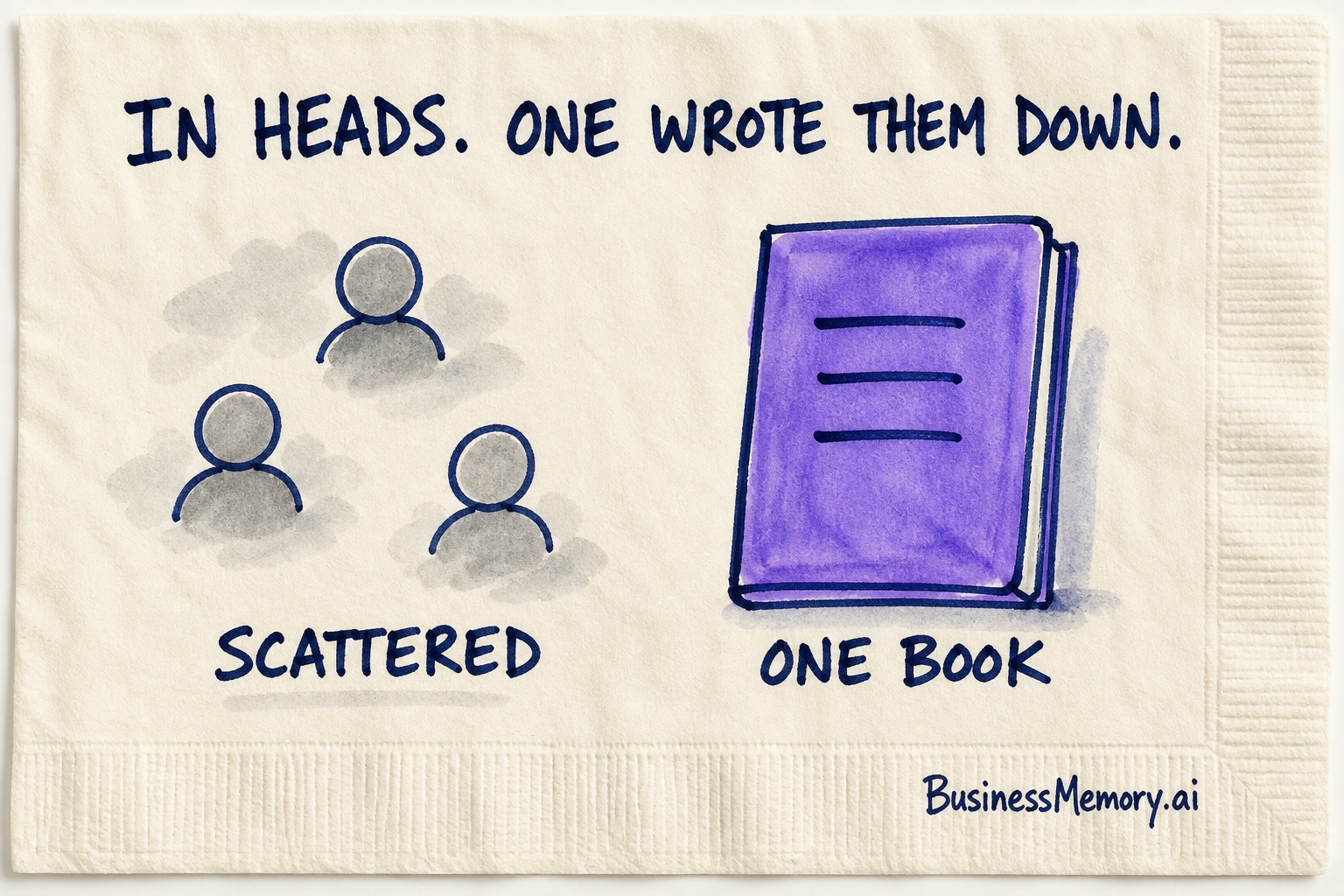
What turns what your business knows into an asset?
Writing it down. Knowledge you carry in your head cannot be handed to a new hire, searched, checked, or read by a machine — so it is not an asset yet. It becomes one the day it lives in a record you own. Wall Street proved this in 1982. Bond prices and terms lived in traders' heads, paper notebooks and phone calls — everyone had the same phones and the same market. Michael Bloomberg took that scattered knowledge and put it into one record he could search in seconds: the Market Master terminal, delivered to Merrill Lynch that December. He then rented that record back to the whole industry — today around $30,000 a year, per screen, to more than 300,000 of them. The record was worth more than the trades. A business memory is that same move, now cheap: your business's own record, in plain files on your computer that any AI can read.
| The question | What lives in your head | A written record you own |
|---|---|---|
| Can a new hire use it? | No — it walks out when the person does | Yes — they open the file and read it |
| Can an AI use it? | No — there is nothing to read | Yes — plain text files any AI can read |
| Can you check it a year later? | Only if you still remember | Yes — with the exact reference behind it |
| What happens when you switch tools? | It stays stuck in your head | The record moves with you — it is yours |
| Bloomberg's version | Prices in traders' heads and phone calls | The terminal, rented back to Wall Street |
What is a business memory, and what does Bloomberg prove?
Bloomberg proves the record can be worth more than the work it records.
He did not get rich trading bonds. He got rich keeping the record of the trades and renting it back to everyone who needed it.
A business memory is that same idea, cut down to the size of your business. Not a trading empire — a record of what your company knows: what was agreed, what was paid, what was promised, what was decided. Bloomberg needed engineers and millions of dollars to build his in 1982. You do not. The record that used to cost a fortune is now plain text files on your own computer, and any AI can read them.
Now look at what actually happened on Wall Street, because the how is the whole point.
What did Wall Street look like before the terminal?
Before 1982, a bond trader's most valuable tool was his own memory and a telephone.
Prices, terms, yields — they lived in people's heads, in paper notebooks, and in phone calls between desks. If you wanted to know what a bond was really worth, you called somebody, asked, and did the math by hand.
Here is the part that matters. Everyone had the same phones. Everyone traded the same market. The tools were equal. What nobody had was the record — one place that held it all and could answer a question in seconds.
What did Bloomberg actually build?
In 1981, Salomon Brothers was sold, and one of its partners, Michael Bloomberg, was let go with a $10 million buyout.
He spent it on a strange idea for the time: a computer that would hold the scattered knowledge of the bond market in one place and do the math for you.
He called the company Innovative Market Systems. The machine was the Market Master terminal, and it reached the market in December 1982. His first customer was Merrill Lynch, which bought 20 terminals and a 30% stake in the company for $30 million.
The terminal did not trade for you. It remembered, and it answered. A trader could ask what a jump in rates would do to everything he was holding, and see it at once, instead of calling around and doing the math by hand.
How did a record become worth more than the trades?
Because everyone needed it, and only Bloomberg had kept it.
By 2022 there were about 325,000 Bloomberg terminals on desks around the world, each one renting for around $30,000 a year. The company that started with one man's buyout check now sits between traders and the very market it writes down.
The most valuable thing Wall Street ever made was not a trade. It was a record of what everyone half-knew and nobody bothered to write down.
Why does this matter to your business now?
Because AI just did to business software what those telephones did to Wall Street: it made the tools equal.
I see the same thing happening with AI in small businesses today. Every owner can rent the same AI for a few dollars a month — the same models, the same upgrades, the same day. If we all have the same machine, the machine cannot be the edge.
The edge is the record only you have. And in most small businesses, that record does not exist yet. The price lives in your head. The deal lives in a text message. The promise lives in a phone call nobody wrote down. No AI can read what was never written.
So here is the honest part, and you should hear it from me. A record is only an asset if you keep it. The tool is cheap now. The habit is the work.
So I'm committed to writing mine down — every price, every term, every promise, the day it happens, not the day I finally need it.
A business memory is a private record of everything your business knows — what was agreed, paid, promised and decided — kept on your own computer as plain text files any AI can read, so you can ask anything and get the answer with the exact reference behind it.
Records were never meant for storage. Give your business a memory.
Frequently asked questions
What turns what a business knows into an asset? Writing it down. Knowledge kept in your head cannot be handed to a new hire, searched, checked, or read by a machine, so it is not an asset yet. It becomes one the day it lives in a record you own and can query. That is what Michael Bloomberg did with bond prices in 1982, and it is what a business memory does for a small business today.
What did Michael Bloomberg build, and when? After Salomon Brothers let him go in 1981 with a $10 million buyout, Bloomberg founded Innovative Market Systems and built the Market Master terminal, which reached the market in December 1982. His first customer, Merrill Lynch, bought 20 terminals and a 30% stake in the company for $30 million. The terminal turned scattered bond data — prices that had lived in traders' heads and phone calls — into one record anyone could search.
Why can't AI use the knowledge in my head? Because there is nothing for it to read. If the price is in your head, the deal is in a text message, and the promise is in a phone call nobody wrote down, the AI has nothing to work from and will answer in a confident voice about a business it has never met. A business memory gives it the record to read.
Do you need expensive software to keep a business memory? No. What cost Bloomberg engineers and millions in 1982 costs an owner almost nothing today: plain text files on your own computer, readable by any AI. The real cost is the habit of writing the business down.
What is a business memory? A business memory is a private record of everything your business knows — what was agreed, paid, promised and decided — kept on your own computer as plain text files any AI can read, so you can ask anything and get the answer with the exact reference behind it.