Borders Handed Its Customer Record to Amazon and Called It Loss Reduction
The savings showed up on the statement. The record of its own customers walked out of the building with no line of its own — and Borders called it a goal.

*A record of your customers has never appeared on a balance sheet — which is exactly why it gets traded away. That is what a business memory is for, and in 2001, Borders offered theirs to Amazon on a silver platter.*
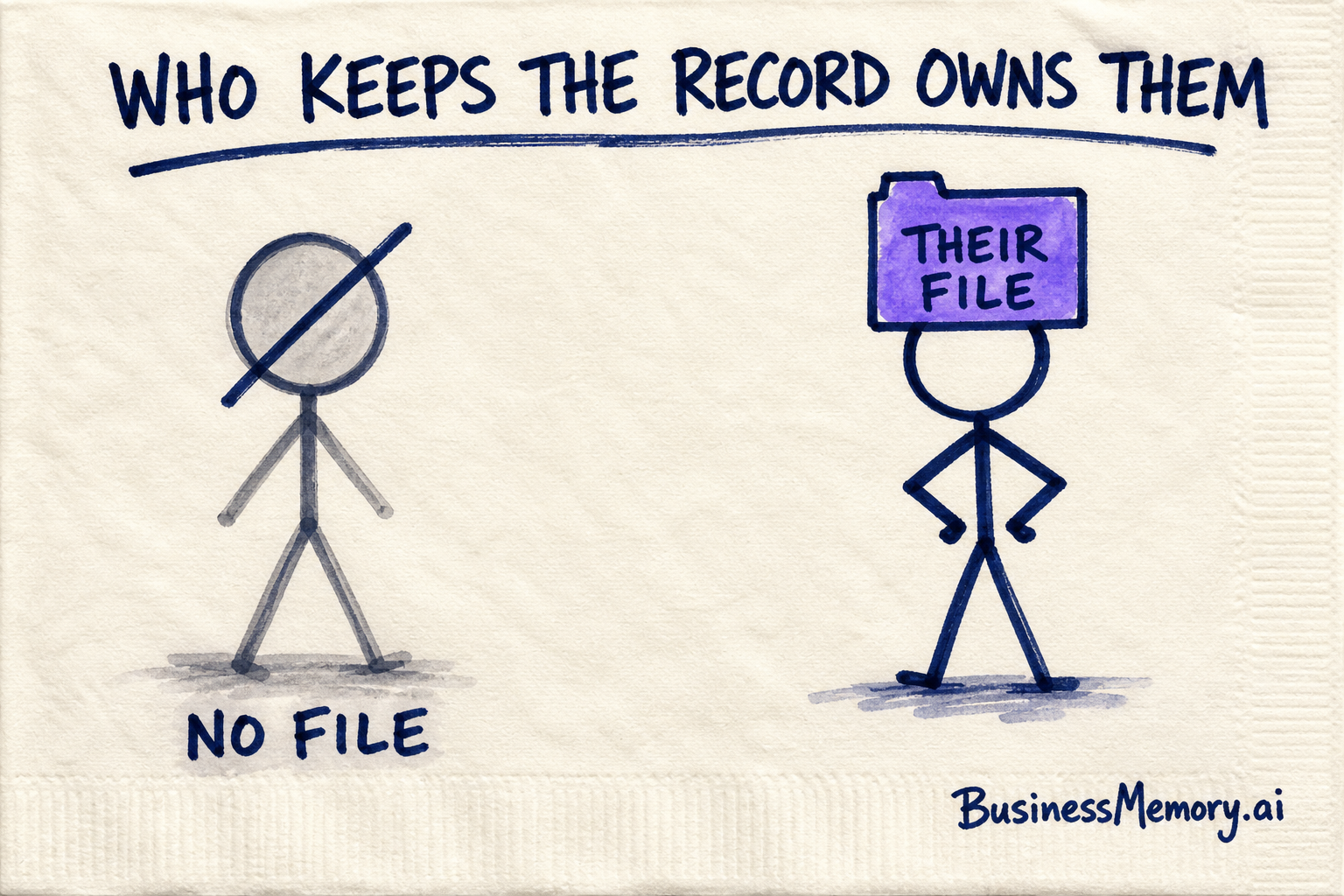
A record of your customers has never appeared on a balance sheet — which is exactly why it gets traded away. That is what a business memory is for, and in 2001, Borders offered theirs to Amazon on a silver platter.
Why did Borders let Amazon run its own website?
To stop bleeding cash online, Borders outsourced its entire e-commerce operation to its biggest rival. On the income statement, it looked brilliant: immediate savings and almost no digital overhead. Off the statement, every click, every search and every returning buyer became a record inside Amazon's business rather than its own. Both companies sold the exact same books from the exact same publishers, but only one of them walked away with the asset money could not buy — the record of who bought what, and why. By the time Borders realised it had rented out its own future, Amazon owned the market and Borders was headed for liquidation. That record is what a business memory keeps in your building, whatever else you rent out.
| Shows on the statement | Never shows on the statement | |
|---|---|---|
| Running your own website | The cost, every month | What you learn from every visit |
| Outsourcing it | The saving, immediately | Who your customers are, and what they wanted |
| The books on the shelf | Inventory, to the cent | Nothing — anyone can stock them |
| The record of your customers | No line exists for it | The only part a rival cannot buy |
Did Borders know what it was giving up?
It thought it was buying a saving, and it said so in its own annual report. The 2000 report set out the thinking in plain words: "Our online investment will be channeled to support our in-store platform" and "We have targeted loss reduction as a major goal."
Loss reduction was the goal, and they hit it. The plan worked perfectly — that was the tragedy.
What is the asset with no line on the statement?
The record of what your business knows.
Here is the trap, and it is not stupidity. An accountant can price your stock, your van and your lease. Nobody can price the fact that you know which customer always pays late, which supplier failed you in March, and what you quoted the man who is about to call back.
So when somebody offers to run a part of your business more cheaply, the saving is a number and the loss is not. One of them goes in the meeting. The other does not come up.
That is how a company gives away the only thing a competitor could never have bought, and books it as an improvement.
What did Borders keep?
The copyable half.
It kept the stores, the shelves, the stock and the staff — every part a rival with enough money could reproduce. It handed over the part that could not be reproduced at any price, because it had taken years of real customers to accumulate.
And I want to be fair, because the easy version of this story is smug. Borders did not die of one decision, and plenty of clever people signed it off. The website was genuinely losing money. Amazon genuinely ran it better. The deal was defensible on every number anyone had.
That is the whole problem. It was defensible on every number anyone had.
Where does this happen to a small business today?
Every week, and it does not look like a bad decision either.
The platform that takes your bookings keeps the record of who booked. The marketplace that brings you orders keeps the record of who ordered. The chat box you paste your quotes into keeps the record of your quotes.
Each one is cheaper and better than doing it yourself. Each one is the Borders trade in a smaller envelope.
Now the honest part, so you hear it from me. I am not telling you to stop using them — I use them, and refusing good tools to protect a principle is its own kind of stupid. The question is narrower than that: when the work happens somewhere else, does a copy of what happened come back to you? If nothing comes back, you are renting a business you do not have a record of.
That is the whole reason to give your business one. A business memory is a private record of everything your business knows — what was agreed, paid, promised and decided — kept on your own computer as plain text files any AI can read, so you can ask anything and get the answer with the exact reference behind it.
Borders got the savings it asked for.
It just did not get to keep the customers.
Records were never meant for storage. Give your business a memory.
#BeBusinessSmart
FAQ
Did Borders really let Amazon run its website? Yes. From 2001 until 2008, Borders outsourced its online sales to Amazon, across the years when online bookselling was being decided. Borders got its own site back in May 2008 and filed for bankruptcy in 2011.
Why would a company hand its online business to a competitor? Because it was losing money on it, and the company said so. Its 2000 annual report states that its online investment would be "channeled to support our in-store platform" and that it had "targeted loss reduction as a major goal." The saving was a number on a statement. What it gave up — the record of its own customers — has no line on any statement, so it did not appear in the comparison.
Did outsourcing the website kill Borders? Not on its own, and anyone who tells you otherwise is selling a tidy story. Borders made several costly decisions over the same period. What this one shows is narrower and more useful: the asset that left had no price tag, so nothing in the numbers argued for keeping it.
Is using a booking platform or marketplace the same mistake? Not automatically. The useful question is whether a copy of what happens there comes back to you — who booked, what was agreed, what was quoted. If it does, you are using a tool. If nothing comes back, the record of your business is accumulating inside somebody else's.
What is a business memory? A business memory is a private record of everything your business knows — what was agreed, paid, promised and decided — kept on your own computer as plain text files any AI can read, so you can ask anything and get the answer with the exact reference behind it.