Every Courier Had Planes. FedEx Sold the Answer to "Where's My Box?"
Every courier had planes. FedEx wrote down where every box was and handed that record to the customer. Give your business a memory at BusinessMemory.ai.

Every delivery company had the same planes and trucks. FedEx built a record of where every package was, minute by minute — and handed it to the customer. "Where's my box?" became answerable instantly, and that record became the thing people actually bought. Today nobody ships without it. So ask yourself: what record could your customers be paying you for? A business memory is where that record lives.
How can a record become the thing customers pay for?
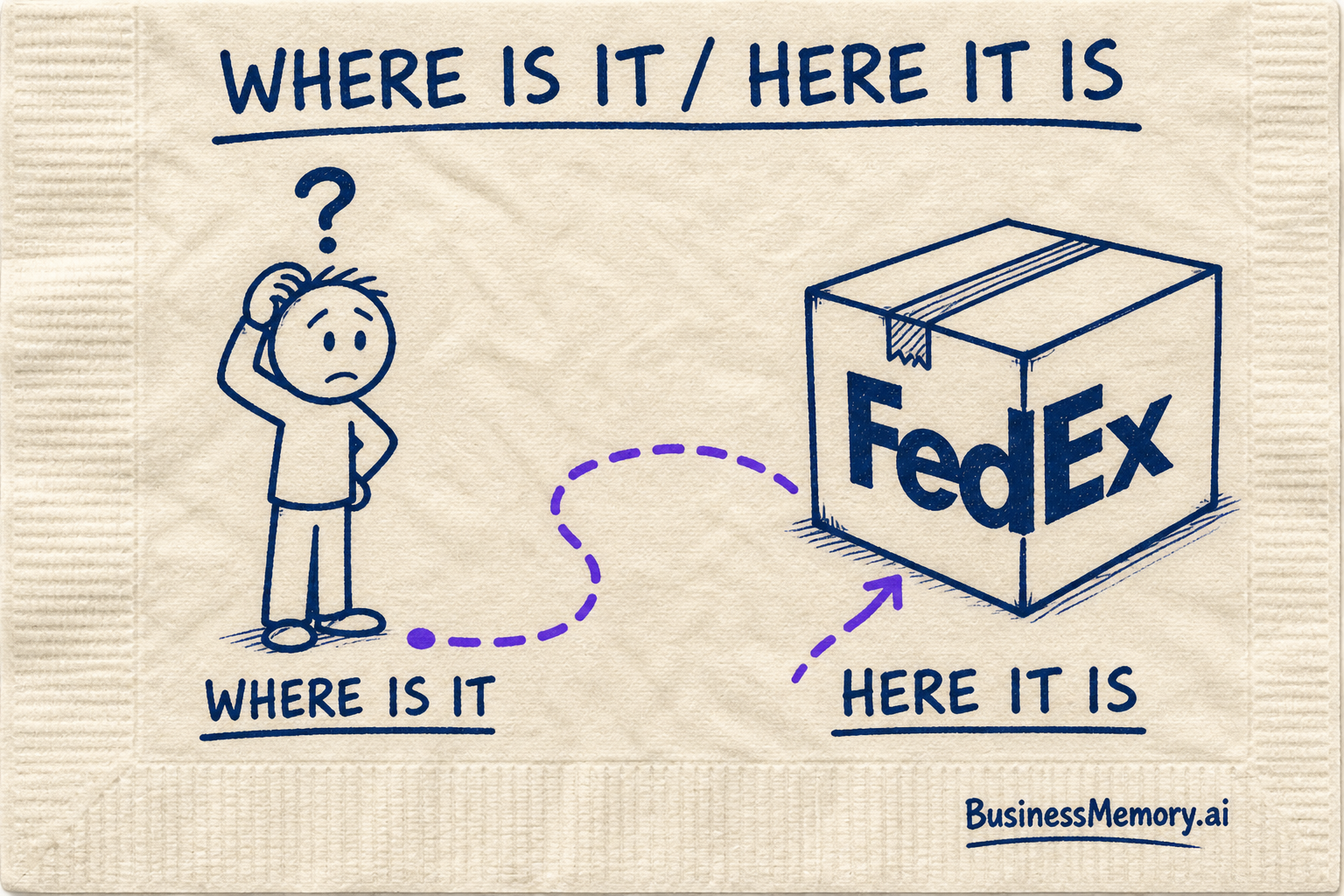
By keeping track of where things stand and letting people see it — because knowing is worth money, not just doing. FedEx proved it. Every courier in the 1970s had the same planes, the same trucks, the same roads. What FedEx built that the others did not was a record: a system called COSMOS, from 1979, that wrote down where every package was as it moved. Then it did the thing that changed everything — it handed that record to the customer. In 1994, fedex.com let you look up your own package. "Where's my box?" went from a phone call and a shrug to an instant answer, and that answer became the product. Today nobody ships without tracking. A business memory is where your business keeps that kind of record — so you can answer "where does this stand?" the instant anyone asks.
| Same delivery, two companies | No record to show | The record, handed over |
|---|---|---|
| "Where's my box?" | "Call us and we'll find out" | Look it up yourself, right now |
| What the customer feels | In the dark, anxious | Calm — they can see it |
| What you're actually selling | A delivery | A delivery you can watch |
| Why they come back | Price, until someone's cheaper | They trust that they'll always know |
What is a business memory, and what does FedEx prove?
FedEx proves the record does not have to sit behind the business. It can BE the business.
The boxes moved the same way they always had. What people paid for, and stayed for, was knowing where the box was — the record, made visible. That is a strange and powerful idea: the thing you write down can become worth more than the thing you do.
A business memory is where that record lives for your company — what was ordered, what was promised, where each job stands. Kept in one place, it lets you answer any "where does this stand?" on the spot, for yourself and for your customers. And because it is plain files, the AI you already use can read the whole record and give the answer instantly, instead of you digging for it.
What did FedEx actually build?
Not faster planes. A memory.
FedEx started flying packages in 1973, the same way rivals did. But in 1979 it switched on COSMOS, a system that recorded where every package and truck was as it happened. In 1981 it added barcode scanning, so each package was logged at every stop. For the first time, the company always knew exactly where your box was.
Then came the move that mattered most. In 1994, FedEx put that record online — the first transportation company to let customers look up their own package on the web. The record stopped being an inside tool and became something the customer held.
Why did the record become the product?
Because the delivery was never really the worry — the not-knowing was.
Anyone can carry a box from here to there. What made people anxious was the silence in between: has it shipped, where is it, will it make it. FedEx sold the cure for that silence. The record answered the question before you had to ask it, and once customers had that, going back to "call us and we'll check" felt broken.
That is the whole lesson: the record of where things stand can be worth more than the service itself.
Why does this matter to your business now?
Because AI made the tools equal, and "where does this stand?" is a question your customers still ask you every day.
I see it in every small business. The customer wants to know where their order, their repair, their project stands — and most owners answer the FedEx-1970s way: "let me check and call you back." Meanwhile the details live in one person's head, or a chat, or a pile of texts.
Every owner can rent the same AI now. But an AI with nothing to read cannot tell a customer where their job stands. An AI reading your business memory can — it finds the exact status and the record behind it the moment you, or they, ask.
So here is the owner's question FedEx hands you: what record could your customers be paying you for? Often it is not a new service. It is being the one who always knows, and can show it.
Now the honest part, so you hear it from me. The record only answers if it is kept as the work happens. FedEx scanned every package at every stop; you have to write down where each job stands as it moves. The tool is cheap now; keeping the record live is the work.
So I'm committed to keeping mine live — every order, every promise, every step written down as it happens, so the answer is always ready.
A business memory is a private record of everything your business knows — what was agreed, paid, promised and decided — kept on your own computer as plain text files any AI can read, so you can ask anything and get the answer with the exact reference behind it.
Records were never meant for storage. Give your business a memory.
Frequently asked questions
What was FedEx's COSMOS system?
COSMOS was the computer system FedEx switched on in 1979 to record where every package and delivery truck was as it moved. In 1981 the company added barcode scanning at its stops, so each package was logged along the way. It gave FedEx a live record of where everything was — the foundation of package tracking.
When could customers first track a FedEx package themselves?
FedEx put tracking online in 1994, when fedex.com became the first transportation company website to let customers look up their own package's status. Until then, the record was an internal tool; after that, the customer held it.
How did tracking become FedEx's product?
Every courier had the same planes and trucks, so the delivery itself was not the difference. What customers really wanted was to know where their package was. FedEx's record answered that instantly, and that answer — the visibility — became the thing people paid for and came back for.
What does FedEx tracking have to do with my business?
Your customers ask you the same question FedEx answered: where does my order, repair, or project stand? A business memory keeps that record in one place, so you can answer on the spot instead of "let me check and call you back." The record of where things stand can be part of what you sell.
What is a business memory?
A business memory is a private record of everything your business knows — what was agreed, paid, promised and decided — kept on your own computer as plain text files any AI can read, so you can ask anything and get the answer with the exact reference behind it.