Every Hotel Has the Same Beds. One of Them Writes Down How You Sleep.
The Ritz-Carlton writes down how each guest sleeps, and the note travels to the next city. Give your business a memory at BusinessMemory.ai.

Anyone can copy a building, a menu or a price — and now every business on your street rents the same AI you do. The one thing nobody can buy a copy of is your record of the customer. One hotel chain has been proving that with a notepad since before the internet.
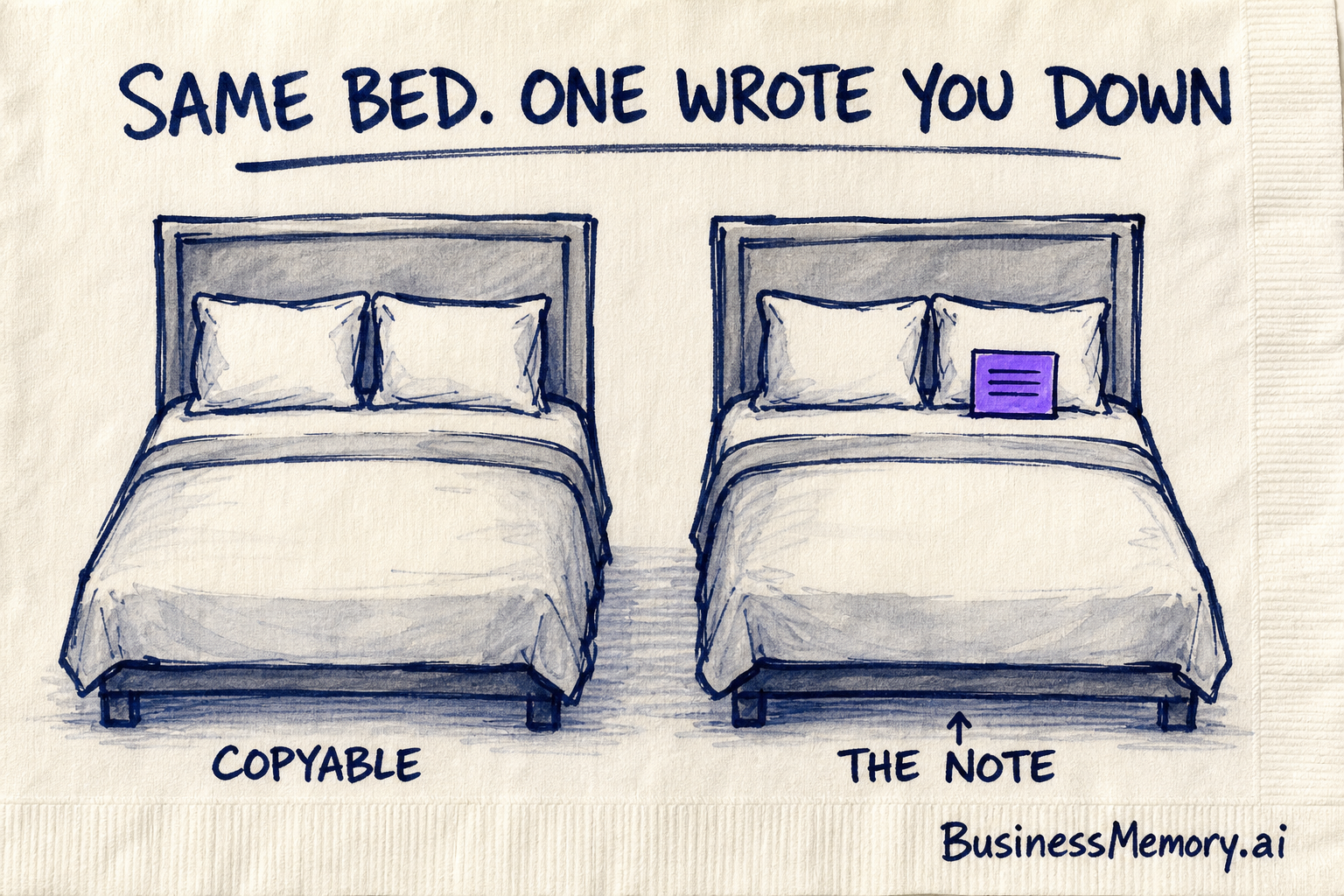
Why does one hotel feel personal when every hotel has the same rooms?
Because somebody writes you down, and the note travels. At The Ritz-Carlton, noticing what a guest likes is a job with paperwork attached to it. A CRM trade report from April 2000 described it plainly: "A 'guest preference pad' is part of each employee's uniform," with preferences routed to a guest recognition office, and a guest recognition manager at each of the chain's 32 hotels at the time. Even the software has not kept one name: that report calls it CLASS; an IMD case study from 2011 calls it Mystique. A hotel school that trains people for this industry describes what the guest feels: "If you once requested extra pillows in New York, you'll find them waiting in your London suite." The rooms can be copied. The record of you cannot. A business memory is where a small business keeps the same kind of record.
| One regular customer, two businesses | Kept in somebody's head | Written down where the business can read it |
|---|---|---|
| Who knows what he likes | Whoever served him last time | Anyone working today |
| The day that person is off | The customer explains himself again | Nothing changes. The note is already there |
| The day that person quits | It walks out the door with them | It stays |
| What it takes to serve him well | A good memory and luck | Ten seconds of reading |
| What the AI you rent can do with it | Nothing. It has nothing of yours to read | Read it and hand you the answer |
What did the Ritz-Carlton actually write down?
Small things. The kind of thing a guest says once and forgets he said.
A pillow. A floor. A drink. Something he cannot eat.
None of that is clever. What is unusual is where it went. It did not stay in the head of the person who heard it. It went on the pad, and off the pad into the record, and the record was not the property of that room, that shift or that hotel.
And it was not only guests. The IMD case says the chain writes down "everything from guest preferences to scuff marks" and then makes it widely available.
Nadia Kyzer, then the company's corporate manager of guest recognition, put the whole thing in one sentence in 2000: "Our people supply the initial information that is added to the system as well as carry out the services detailed within the system. If our employees didn't put the information to real, concrete use the system would be worthless."
Two halves. Somebody writes it. Somebody else uses it.
And the company was not judged on charm for it. The Ritz-Carlton Hotel Company won the Malcolm Baldrige National Quality Award in 1992 and again in 1999 — the only two-time winner in the service category, on a scorecard run by the U.S. government.
Why does it matter that the record leaves the room?
Because that is the moment a nice gesture turns into an asset.
Think about who is standing there when it pays off. The person who wrote down your pillow in one city is not in the room. He may never see you again. He will never know it worked.
The one handing you the pillow has never met you. She is not remembering anything. She is reading.
That is the part almost everybody misses about this story. The service does not travel because the staff are special. It travels because the note does.
What one person remembers is not what the business knows.
And notice what none of it depended on. The software did not even keep one name — CLASS in 1998, Mystique by 2011 — while the habit underneath stayed exactly the same: see it, write it down, keep it where the next person can read it. The tool was replaceable. The record was not.
Why does this matter to your business now?
Because the tools are the same for everybody now, and they read nothing you did not keep.
Every owner on your street can rent the same AI you rent, today, for what lunch costs. That part of the race is over. Nobody is winning on the tool anymore.
So look at what you actually have that nobody can rent. Your customers. What they ordered, what went wrong once, the delivery day that does not work for them, the thing they always ask for and you always remember.
Where does that live right now?
For most small businesses, the honest answer is: in the owner's head. And that is not a record, it is one person. It cannot be in two places. It does not answer questions at eight in the morning when that person is asleep. And when your best employee gives notice, half your customer knowledge walks to the parking lot with them.
Now the honest part, so you hear it from me. Writing a customer down is small, boring work, and it pays late. You write the note today and somebody collects it in three months — maybe not even you. That is exactly why almost nobody does it. It is also exactly why it is still worth something when everyone owns the same machines.
And a record of your customers is not something to leave lying around in somebody else's cloud. It is private. Keep it where you can see it and control it.
So I am writing my customers down as they tell me — what they asked for, what they hate, what I promised. I would rather my business know it than trust myself to remember it.
A business memory is a private record of everything your business knows — what was agreed, paid, promised and decided — kept on your own computer as plain text files any AI can read, so you can ask anything and get the answer with the exact reference behind it.
Records were never meant for storage. Give your business a memory.
Frequently asked questions
How does The Ritz-Carlton remember guest preferences?
By writing them down and keeping them in one shared record rather than in an employee's memory. A CRM trade report in April 2000 described a "guest preference pad" as part of each employee's uniform, with preferences routed to a guest recognition office, and a guest recognition manager at each of the chain's 32 hotels acting as the repeat-guest expert. The company implemented the program as CLASS — Customer Loyalty Anticipation and Satisfaction System — in 1998; a 2011 IMD case study describes the same job being done under the name Mystique.
Why is a written customer record better than a good memory?
Because a memory belongs to one person and a record belongs to the business. The person who noticed the preference does not have to be working, or even still employed, for the next person to use it. That is what lets a stranger serve a customer the way somebody who knows him would.
Is this only possible for a big company?
No. The habit is a notepad and a place to put the note — the Ritz-Carlton version started as paper in a uniform pocket. A one-location business can keep the same record for far less than a hotel chain spends, and today ordinary AI can read that record and answer from it.
What can AI do with a customer record that it cannot do without one?
Answer about your business instead of about businesses in general. AI that has nothing of yours to read gives generic advice. AI that can read what your customers actually ordered, asked for and complained about can tell you what this customer needs, with the reference behind it.
What is a business memory?
A business memory is a private record of everything your business knows — what was agreed, paid, promised and decided — kept on your own computer as plain text files any AI can read, so you can ask anything and get the answer with the exact reference behind it.