For 600 Years, England's Receipts Couldn't Be Faked
England ran its money on wooden sticks nobody could fake for 600 years. The lesson for your business: keep the proof ready, and an audit stops being scary.

For six centuries, England's treasury kept its accounts on wooden sticks, split in two so the halves matched only each other — a receipt no one could fake. When a demand came, you produced your half, and the matter was settled. An audit is only frightening when you cannot produce the record. A business memory is that drawer of matching halves: the proof is already there when the letter arrives.
Why is an audit only scary when you cannot produce the record?
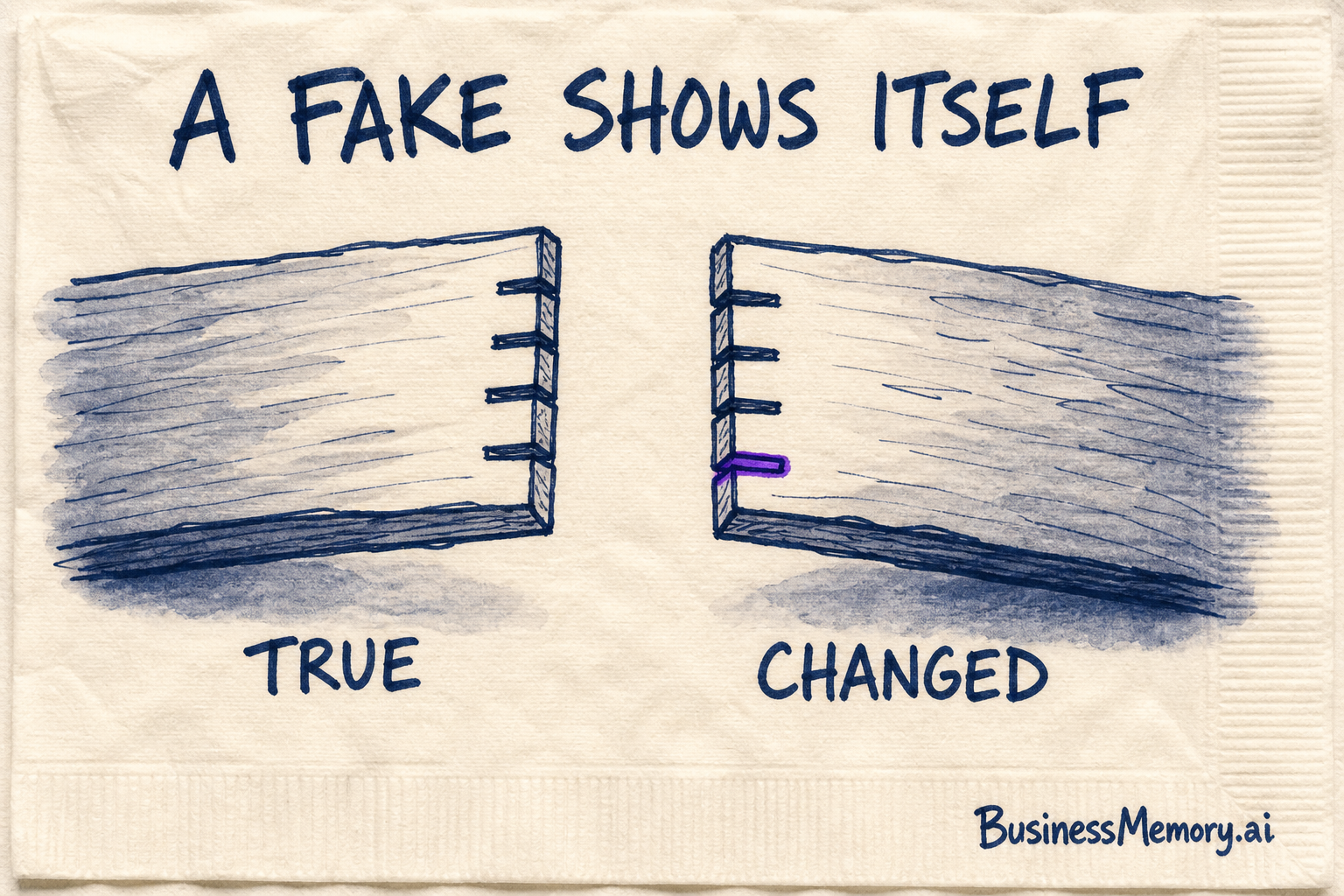
Because the fear was never the demand itself — it is not being able to show the proof. When the record is right there, an audit is just a question you already have the answer to. England ran on this idea for six hundred years. Its treasury recorded debts and payments by cutting notches into a wooden stick, then splitting it down the middle — one half to each party. The grain and the notches lined up on those two halves and no others, so neither side could change their piece without it being caught. When money was demanded, you produced your half, the two were matched, and it was settled. A business memory is that drawer of matching halves for your company: the proof is already kept, so when the letter arrives, you produce it instead of panicking.
| When a demand arrives | Answering from a shoebox | Answering from your record |
|---|---|---|
| The taxman wants proof of a payment | Days of digging, or you just pay | Produce it in minutes, with the date |
| A supplier says you never paid | Your word against theirs | Here is the receipt |
| "Prove you delivered on time" | Hope it's in an inbox somewhere | The record shows exactly when |
| How the demand feels | A threat | A question you can answer |
What is a business memory, and what do tally sticks prove?
Tally sticks prove that a record you cannot fake ends the fear, not just the argument.
The stick worked because it was made when the deal happened and could not be changed afterward. Nobody had to trust anybody — you just matched the halves. Six hundred years is a long time to trust one idea, and England trusted this one because it simply could not be cheated.
A business memory is that idea for your company, minus the wood. It is a record of what you agreed, paid and were promised, kept as it happens — so it is the honest version, not something reassembled the night before an audit. And because it is plain files, the AI you already use can find the right receipt and hand it to you the moment you are asked for it.
What were tally sticks?
They were England's receipts for six hundred years — and they were made of wood.
The treasury, the Exchequer, would record a debt or a payment by carving notches into a stick: the bigger the notch, the bigger the sum. Then they split the stick lengthwise into two halves. One half, the longer "stock," went to one party; the other half, the "foil," went to the other. (That "stock" is where the word in "stockholder" comes from.)
They were used from the 1100s all the way to 1826. Kings, merchants and tax collectors ran the country's money on notched wood for longer than most nations have existed.
Why couldn't anyone fake one?
Because you could not add a notch to your own half without getting caught.
The two halves had been split from the same stick, so the grain of the wood and the notches matched each other and nothing else. If you tried to carve in a bigger debt on your piece, the halves would no longer line up when they were put back together. The fake showed itself the instant the two were matched.
That is the whole trick, and it is a good one: a record that proves it was not changed. Not because anyone was trusted — because it could not be faked.
Why does this matter to your business now?
Because AI made the tools equal, but the demands still come — and they still scare people who cannot produce the record.
I see it every week. The taxman asks for proof of a number. A supplier swears an invoice went unpaid. A customer disputes what was agreed. And the fear on the owner's face is never about the question. It is about the scramble — the shoebox, the inbox, the hope that the paper still exists.
Every owner can rent the same AI now. But an AI with nothing to read cannot produce your half of the stick. An AI reading your business memory can — it finds the exact record and the proof behind it while you are still reading the letter.
That is the tally-stick lesson, brought to your desk: keep the record as it happens, and a demand stops being a threat. It becomes a question you already answered.
Now the honest part, so you hear it from me. The record only saves you if it was kept before the demand came. You cannot carve the stick after the taxman knocks. The tool is cheap now; keeping the receipts as the work happens is the work.
So I'm committed to keeping mine — every payment, every agreement written down when it happens, with the proof beside it, ready to produce.
A business memory is a private record of everything your business knows — what was agreed, paid, promised and decided — kept on your own computer as plain text files any AI can read, so you can ask anything and get the answer with the exact reference behind it.
Records were never meant for storage. Give your business a memory.
#BeBusinessSmart
FAQ
What were Exchequer tally sticks? England's official receipts for debts and payments, used for about six centuries. The treasury carved notches into a wooden stick to record a sum, then split it lengthwise so each party held a matching half — one called the "stock," the other the "foil." Used from the 1100s until 1826.
Why couldn't a tally stick be faked? Because the two halves were split from the same stick, so the grain and notches matched each other and nothing else. Add a notch to your half and the pieces no longer line up — the fake was caught the moment they were matched.
What do tally sticks have to do with my business? An audit or a demand for proof is only frightening when you cannot produce the record. Tally sticks kept the proof ready to produce on the spot. A business memory does the same: the record of what you paid, agreed and were promised is already kept, so when a demand arrives you show it instead of scrambling.
How does a business memory make an audit easy? It keeps the record and the proof together, made as things happen — so when the taxman, a supplier, or a customer asks you to prove something, the answer and the exact receipt are minutes away, not a week in a shoebox. It only works if the record was kept as the work happened.
What is a business memory? A business memory is a private record of everything your business knows — what was agreed, paid, promised and decided — kept on your own computer as plain text files any AI can read, so you can ask anything and get the answer with the exact reference behind it.