Gen Z's First Job Is Getting Harder. Its First Business Is Getting Cheaper.
The same AI making Gen Z's first job harder to get is making its first business cheaper to build. That is changing how a generation thinks about financial security.

AI may be squeezing some entry-level work while cutting the time and cost needed to launch a business. Gen Z is responding by building more than one way to earn.
Why is Gen Z turning to side hustles and entrepreneurship?
Gen Z is not rejecting work. It is hedging the risk of relying on one employer. Two forces are pushing at once. The entry-level job market has weakened—recent U.S. college graduates faced a 5.6% unemployment rate and a 42% underemployment rate in the second quarter of 2026, according to the Federal Reserve Bank of New York—and AI is making some junior tasks easier to automate. At the same time, the same technology is cutting the cost of starting: in Gusto's 2026 survey of people who founded businesses in 2025, 71% of Gen Z founders used AI to launch, and half of all founders said AI made starting faster or cheaper. So a second income stream now costs less to test than a first job costs to win. Gen Z is not running from work; it is building more than one way to earn.
That creates a strange moment:
| On the employee side | On the founder side |
|---|---|
| AI can reduce the value of some junior tasks | AI can reduce the cost of starting |
| Employers can demand experience sooner | Beginners can test an idea sooner |
| One paycheck feels less dependable | A second income stream feels more practical |
The same machine is changing the price of both choices.
What is happening to the first job?
Recent college graduates in the United States had a 5.6% unemployment rate and a 42% underemployment rate in the second quarter of 2026, according to the Federal Reserve Bank of New York. Underemployment means they were working in jobs that typically do not require a college degree.
AI appears to be part of the pressure.
Stanford researchers found that employment among workers ages 22 to 25 in highly AI-exposed occupations was contracting at an annual rate of 3.8%, while employment in the least-exposed occupations grew 2%. The decline was strongest where AI use leaned toward automation instead of helping a person do the job better.
But AI is not the only explanation.
New York Fed researchers estimate that remote work explains 64% of the post-pandemic increase in unemployment among young college graduates. Their argument is simple: distributed teams make training and mentoring beginners harder, so employers prefer people who already know the job. That change began before generative AI became common. Read the New York Fed analysis.
The honest conclusion is not that AI destroyed the first job.
It is that the first job was already weakening when AI arrived—and AI gave employers another reason to question which beginner tasks still require a beginner.
What is happening to the first business?
On the other side of the same market, AI is lowering the cost of trying.
Gusto surveyed 1,051 people who started businesses in 2025. In that sample, Gen Z represented 9% of founders, compared with 5% for Baby Boomers. Among the Gen Z founders, 71% used AI while launching.
Half of all surveyed founders said AI made starting faster or cheaper. Yet only 3% said the business probably would not have existed without AI.
That distinction matters.
AI is not creating the courage, the customer, or the business idea.
It is compressing the work between idea and test.
The same Gusto new-business report found that building financial stability or a future asset was the leading motivation, cited by 51% of founders.
This is not a generation running away from work.
It is a generation trying to own more of the result.
Is Gen Z abandoning the traditional career?
The evidence says no.
LinkedIn's 2026 graduate research found that 21% of recent graduates had started a business or side hustle to begin their careers. That is meaningful, but it is not a mass exit from employment. See LinkedIn's 2026 Grad's Guide.
Financial pressure also limits how many people can take a real entrepreneurial risk. The Federal Reserve found that only 63% of adults ages 18 to 29 said they were doing okay or living comfortably in 2025. Among adults under 30, 49% lived with a parent and 47% received outside help paying an expense. Read the Federal Reserve's household well-being report.
Deloitte found another important contradiction: 55% of Gen Z respondents were delaying major decisions—including starting a business—because of financial concerns. The 2026 global survey covered more than 22,500 Gen Z and millennial respondents across 44 countries.
So the trend is not "quit your job and become an entrepreneur."
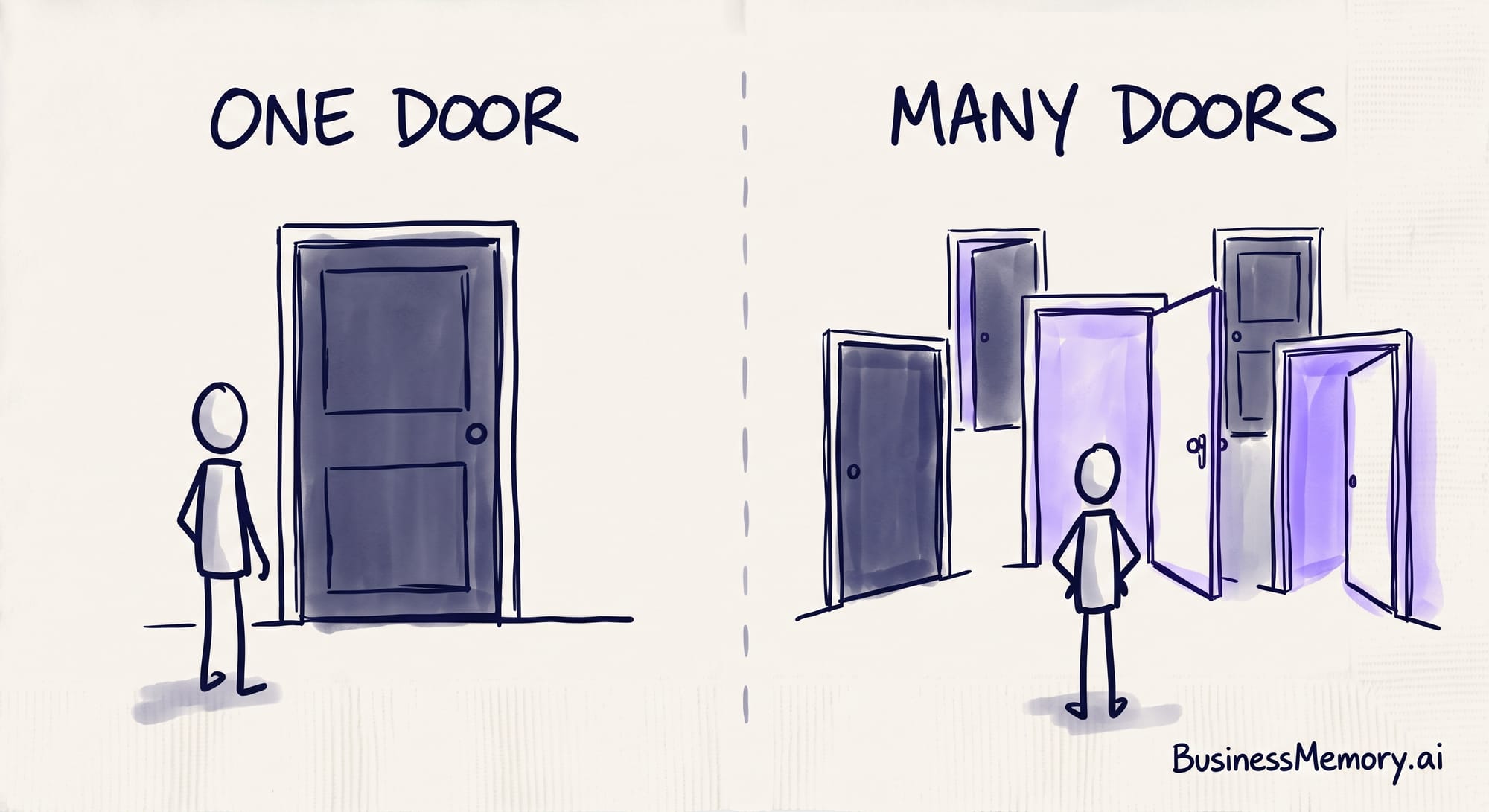
It is "do not let one job become your only plan."
Does a side hustle create financial freedom?
Not automatically.
The vape-vending story that started this conversation is a useful example. Bloomberg reported that 26-year-old Micah Stanley's operation produced as much as $75,000 in monthly profit. That is an exceptional, scaled operation—not a typical vending route and not a promise about what a beginner can earn.
For comparison, vending routes sold through BizBuySell from 2021 through 2025 had median annual owner earnings of $39,601. Stanley's reported monthly maximum should not be used as a normal side-hustle benchmark. See the BizBuySell vending benchmarks.
Business applications can also create a false picture of success.
The U.S. Census Bureau recorded 531,423 seasonally adjusted business applications in June 2026. It projected that 29,741 of that month's applications would become employer businesses with payroll tax liabilities within four quarters. That is about 5.6%.
This is not a failure rate. Many legitimate businesses never hire an employee. But it shows why an application, a side hustle, and a durable company are three different things. See the Census Business Formation Statistics.
Financial freedom is not created by collecting more unstable jobs.
It comes from building something that can survive after the excitement, the headline, and the first customer disappear.
What does this shift really mean?
Gen Z grew up hearing that education would lead to a job, the job would lead to security, and security would create freedom.
Now the first part of that promise is becoming harder to trust.
At the same time, AI has made it cheaper to test another path.
That does not make entrepreneurship safe.
It makes dependence look riskier.
The biggest change may not be that more young people want to become founders.
It may be that fewer believe one employer should control their entire financial future.
AI did not make work disappear.
It changed the price of dependence.
BeBusinessSmart
Takeaway: Gen Z is not rejecting work; it is hedging the growing risk of depending on one employer.