Why Rolling Luggage Took 17 Years to Catch On
A wheeled suitcase reached stores in 1970. The design people copied arrived in 1987, after travelers watched flight crews use it.

Why did rolling luggage take so long to catch on?
Rolling luggage took years to become normal because invention alone did not remove the social and practical barriers to adoption. Bernard Sadow put a suitcase on wheels in 1970 and patented his design in 1972. It reached stores, but the low, strap-pulled case could tip and was dismissed by some travelers as feminine or weak. In 1987, Northwest Airlines pilot Robert Plath built the upright, two-wheeled Rollaboard with a retractable handle. He first made it for pilots and flight attendants. Travelers then saw trusted professionals moving easily through airports with it. The better design mattered, but visible proof mattered too. People could finally see who used it, how it worked, and why it was useful.
What changed between Bernard Sadow and Robert Plath?
| Bernard Sadow's rolling luggage | Robert Plath's Rollaboard | |
|---|---|---|
| Year | 1970 idea; 1972 patent | 1987 |
| Position | Flat case on four casters | Upright case on two wheels |
| Handle | Long pulling strap | Retractable handle |
| Early market | Sold through Macy's | Pilots and flight attendants |
| What travelers saw | A strange new product | Professionals using it every day |
Sadow proved that a suitcase could roll. His 1972 rolling-luggage patent shows a conventional case mounted on casters and pulled by a flexible strap.
Plath made the idea easier to control. According to Travelpro's history of rolling luggage, he turned the case upright, placed two wheels at its base, and added a retractable handle. His design first spread among fellow flight crews.
That changed more than the product.
It changed what the public could SEE.
How did flight crews help rolling luggage become normal?
The wheel is more than five thousand years old.
The suitcase is centuries old.
Yet travelers still carried heavy bags through airports. Sweating. Switching hands. Setting them down to rest.
Bernard Sadow combined the two in 1970.
Surprisingly, it did not immediately change travel.
Stores called it a bag for women.
Men said pulling one looked weak.
So people kept carrying their luggage.
For seventeen more years!
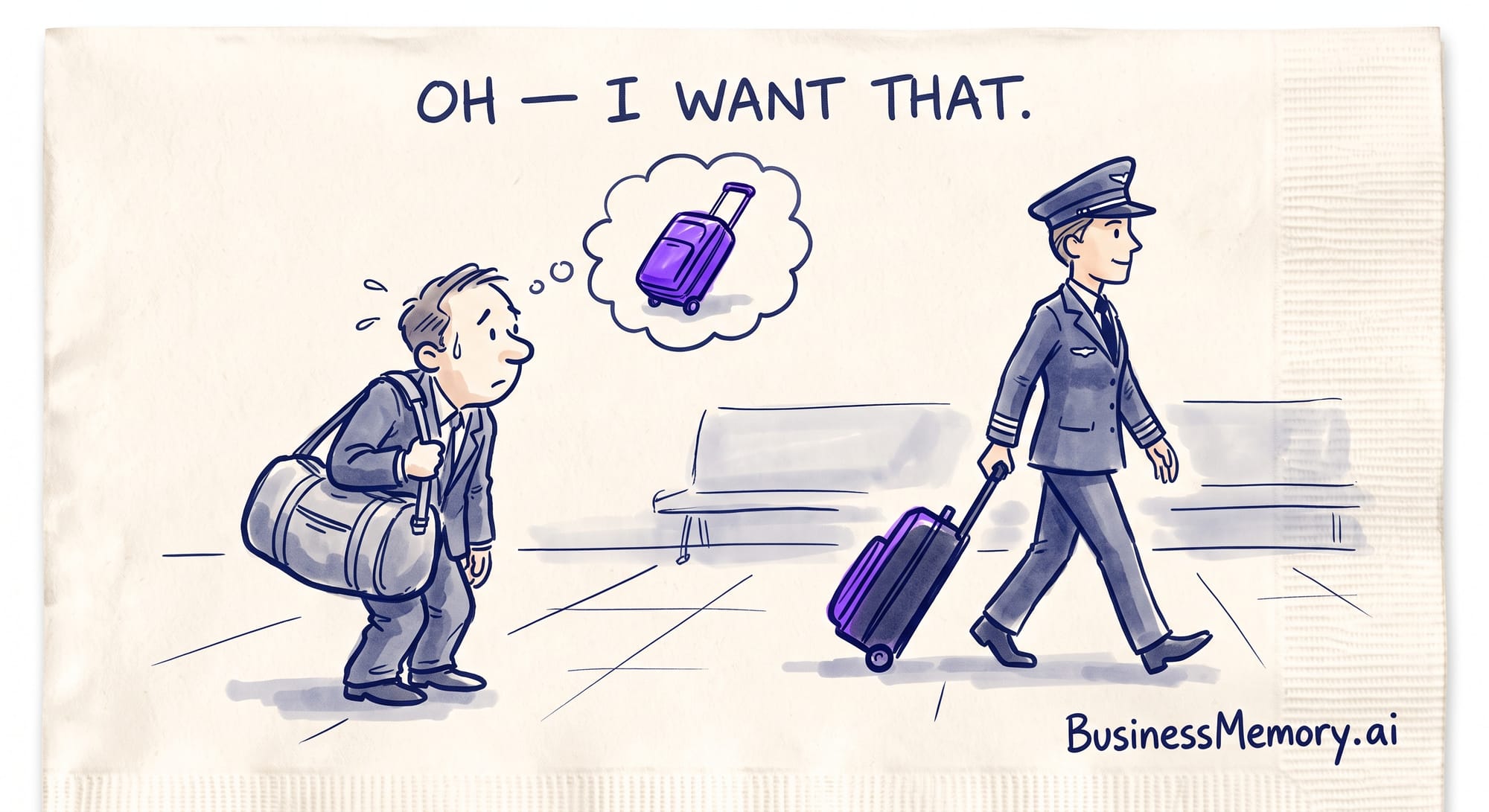
Then Robert Plath, a Northwest Airlines pilot, built the Rollaboard in his garage. Upright. Two wheels. A handle that pulled out.
He did not begin with a giant advertising campaign.
He made the bags for other pilots and flight attendants.
Every day, passengers watched flight crews glide through terminals while they dragged their own heavy bags. The people using the new design were not actors in an advertisement. They were professionals who lived in airports.
The product became visible in the hands of people travelers had reason to trust.
That is when adoption broke open.
What does rolling luggage teach us about AI adoption?
The luggage story does not prove that every technology spreads the same way. It shows one mechanism that also appears in current research on workplace AI: people often discover useful applications by watching peers use them in real work.
A 2025 study of experienced Microsoft 365 Copilot users found that trial-and-error and swapping tips with colleagues were far more common paths to discovering useful features than formal training. The study was small—ten participants—so it should not be treated as a universal statistic. But its interviews show the same practical problem: access to a tool does not automatically show people where it fits.
The researchers discuss social learning strategies and outline steps organizations can take to help people find high-value uses. Read the full workplace AI adoption study.
For a small business, that means the next step may not be another presentation about what AI could do.
It may be one respected employee showing one real job:
- the invoice matched against the purchase order;
- the meeting turned into a list of decisions;
- the old contract found in seconds;
- the customer question answered from the company's own records.
Not a demo built for a stage.
Real work, done where others can see it.
What is the lesson for a small-business owner?
Nobody is waiting on an INVENTION.
Most of us need to see somebody we respect use it first.
That does not mean copying every new tool. It means making a useful result visible enough to be judged.
If an AI system is helping inside your company, show the work. Name the task. Show the old way and the new way. Let people see what improved and what did not.
The first rolling suitcase gave travelers wheels.
The Rollaboard gave them someone worth copying.
Do not wait to see it—be the one they copy!
#BeBusinessSmart