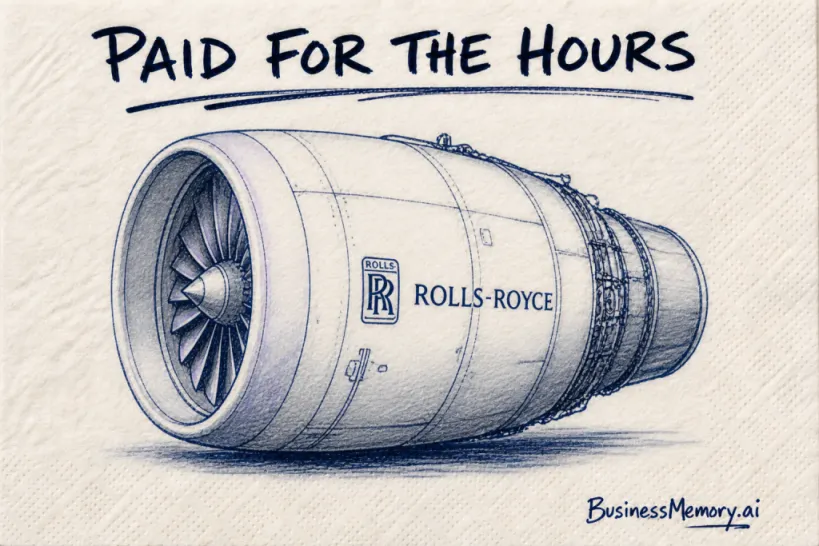
Rolls-Royce Stopped Getting Paid for the Engine. It Got Paid for the Hours.
Power by the Hour: since 1962 Rolls-Royce gets paid per flying hour, and it keeps a file on every engine. Give your business a memory at BusinessMemory.ai.

In 1962 a British engine maker promised airlines a fixed price per flying hour and took the whole repair bill onto itself. Today every rival sells that same deal. The one thing none of them could copy is the file the maker keeps on every single engine — and your business could have a file like that, if somebody writes it down.
How can a company promise to fix every engine for a fixed price per hour?
Only if it keeps a record of what its engines actually do out there. "Power-by-the-Hour" was invented in 1962 to support the Viper engine on the de Havilland/Hawker Siddeley 125 business jet — "a complete engine and accessory replacement service was offered on a fixed-cost-per-flying-hour basis." The airline pays for the hours it flies. The maker pays for the repairs. It started because the Viper was first built to be thrown away and so had "many recurring maintenance issues", and operators paid "a fixed hourly rate to Bristol Siddeley" — the company Rolls-Royce later absorbed. Rolls-Royce still sells it that way: TotalCare "is charged on a fixed $ per flying hour basis, so we are only rewarded for engines that perform", on top of the "large amounts of data on engine performance" the company gathers. A business memory is where your own company keeps a record like that.
| Selling the thing, or selling the hours | You hand it over and walk away | You get paid for the hours it runs |
|---|---|---|
| What you are promising | It worked the day I gave it to you | It keeps working, or I pay |
| Who pays when it breaks | The customer | You |
| What the promise needs from you | Nothing. A receipt | A record of how this exact thing behaves |
| What a rival can copy | The price | Not the record. He never kept one |
| What your AI can do with it | Nothing. It has nothing of yours to read | Read the whole record and tell you what is coming |
What is a business memory, and what does Rolls-Royce prove?
Rolls-Royce proves a record can change what a company sells.
Not what it makes. What it SELLS. The metal did not change. The customer did not change. The sentence on the contract changed — from "here is your engine" to "here are your hours."
And you can only write that second sentence if you know what your engines really do. Not in a workshop. Out there. On real routes, in real heat, flown by real people, for years.
The engine was never the promise. The record behind it was.
A business memory is where that record lives for your company — what was agreed, what was paid, what was promised, what went wrong and when. Kept in one place, in plain files, so it can be asked questions later. And because it is plain files, the AI you already pay for can read the whole thing, instead of handing you something general that would fit any business on your street.
What was the deal Rolls-Royce actually offered?
A fixed price per flying hour, and the repair bill moved across the table.
Sit with what that sentence costs a man who does not know his own product. If the engines come off the wing sooner than he guessed, he pays for every one of them, for years, at a price he already signed.
That is not a clever idea. That is a bet.
And here is the part the business schools skip. It was not born in a strategy meeting. The Viper had been designed as an engine for a target drone — used once, thrown away. Put on a business jet, it kept giving trouble. The maker offered to carry the maintenance because the maintenance was the problem.
So the famous business model started as an apology.
Did anyone else copy Power by the Hour?
They did. All of them.
Every big engine maker now sells the same deal — Rolls-Royce, General Electric, CFM, Pratt & Whitney — and for some engine types "100% of airline customers have signed up." The idea everybody teaches turned out to be the easy part. It is not an edge any more. It is the price of being in the room.
So look at what did NOT get copied.
Nobody could photocopy Rolls-Royce's file on your engine. In business jets alone the company watches over 8,000 engines — not a model, not a type. Each one. What it did last Tuesday. How it behaves in heat. What wore out, at what hour, on which route.
A rival can match your offer by lunchtime. He cannot match twenty years of watching your own work.
Why does this matter to your business now?
Because the tools just got even for everybody, and the same split is opening again.
Every owner can rent the same AI I rent, today, for what lunch costs. Nobody is winning on the tool. That part of the race was over before it started.
But think about what you could promise if you actually knew your own numbers. Not a feeling — the record. Which jobs run over, and by how much. Which customer always adds work on day three. What that install really takes, instead of what you hoped it would take.
A man who knows that can quote a flat price and sleep. A man who does not has to pad every quote, or gamble.
Ask your AI what your last twenty jobs really cost you, and watch. If nothing was kept, you get something pleasant and general — the kind of answer it would give any owner on any street. It has nothing of yours to read.
Now the honest part, so you hear it from me. Rolls-Royce did not get that file by deciding it wanted one. Somebody wrote down every hour, for years, back when it was worth nothing. Nobody can go back and create that later. The work gets done on the quiet days and it pays on the loud ones.
So I'm committed to writing my own down as they happen — what was agreed, what was paid, what was promised, what went wrong. So the day somebody asks me for a firm price, I am reading, not guessing.
A business memory is a private record of everything your business knows — what was agreed, paid, promised and decided — kept on your own computer as plain text files any AI can read, so you can ask anything and get the answer with the exact reference behind it.
Records were never meant for storage. Give your business a memory.
Frequently asked questions
What is "Power by the Hour"?
It is an arrangement where an airline pays a fixed price for every hour its engine flies, and the engine maker carries the cost of maintaining or replacing it. Rolls-Royce says the trademark was invented in 1962 to support the Viper engine on the de Havilland/Hawker Siddeley 125 business jet, offering a complete engine and accessory replacement service on a fixed-cost-per-flying-hour basis. The maker earns when the engine flies and loses when it does not.
Why did Power by the Hour start?
Because of a problem, not a strategy. The Viper had first been developed as an expendable engine for a target drone, and because of that it was subject to many recurring maintenance issues. Operators began paying a fixed hourly rate to Bristol Siddeley — a company Rolls-Royce later absorbed — for the continual maintenance of the engines. The deal that business schools now teach as an innovation began as an answer to an engine that kept giving trouble.
Did other engine makers copy the model?
Yes. Rate-per-flight-hour agreements are now offered by all the major manufacturers — Rolls-Royce, General Electric, CFM and Pratt & Whitney — and for certain recently launched engine types, 100% of airline customers have signed up for an OEM agreement of this kind. The pricing model is no longer a competitive advantage; it is the standard.
If everyone copied the deal, what is left as the advantage?
The record. A maker can only promise a fixed price per hour if it knows how its own engines behave in service, and that knowledge is built one flying hour at a time over decades. Rolls-Royce says it gathers large amounts of data on engine performance and uses it to plan maintenance before it is needed; in business aviation alone it monitors the health of over 8,000 engines. A rival can copy a price overnight. He cannot copy twenty years of records he never kept.
What is a business memory?
A business memory is a private record of everything your business knows — what was agreed, paid, promised and decided — kept on your own computer as plain text files any AI can read, so you can ask anything and get the answer with the exact reference behind it.