The Manual Ran McDonald's — Not the Founder
In 1958 McDonald's wrote the whole business down. The manual, not the founder, trained every new hire. Give your business a memory at BusinessMemory.ai.

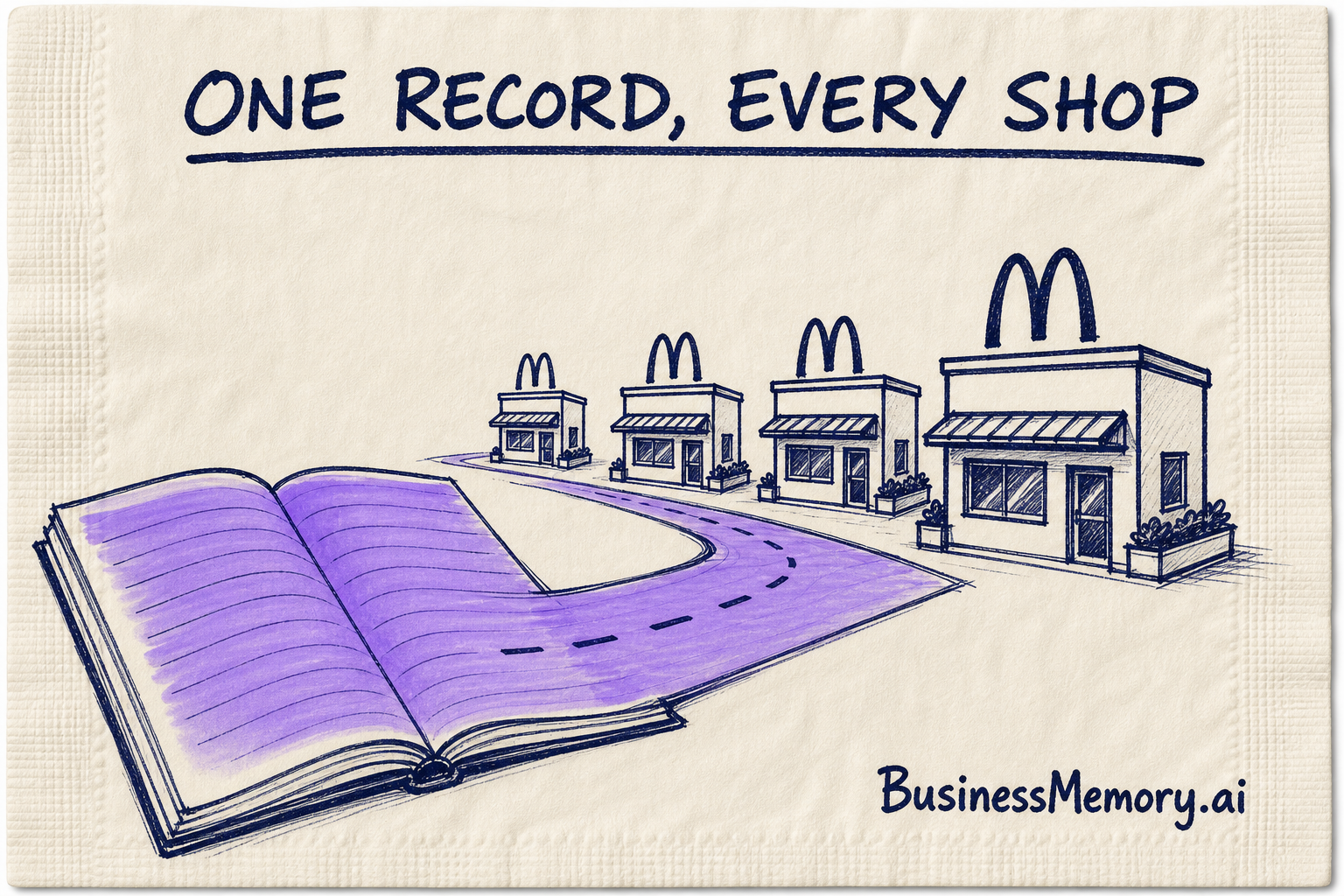
In 1958, McDonald's wrote the whole business down, and that record — not any single manager — trained every new hire to run a store. A new AI walks into your business the same way a new hire does: it can only run what is written down. That written record is a business memory, and AI just made it something any owner can keep.
How do you get a new hire — or a new AI — productive on day one?
You write the business down before they arrive. A new person cannot know your prices, your steps and your standards by instinct — and neither can an AI. Both are strangers on day one, and both can only run what has been written down for them to read. McDonald's proved it in 1958. The chain had just 34 restaurants when Fred Turner wrote its first operations and training manual — the whole business on paper: fries cut to a precise 0.28 inches, exactly ten patties to a pound of beef, one standard for everything. That record, not the founder, trained every new hire — and it let 34 stores become tens of thousands, each run by people who started the week as strangers. A business memory is that manual for your own business, except it writes itself as you work, and any AI can read it.
| A business kept in people's heads | A business written down | |
|---|---|---|
| A new hire on day one | Shadows someone for weeks, guesses the rest | Opens the record and runs it to standard |
| A new AI on day one | Guesses from the internet's average | Reads your record and answers about YOU |
| When your best person leaves | The know-how walks out with them | It stays — it was written down |
| Opening the next location | Starts from the founder's memory | Starts from the same record, day one |
| McDonald's version | 34 stores, run by the people who built them | One manual, tens of thousands of stores |
What is a business memory, and what does McDonald's prove?
McDonald's proves that a business written down is a business that can be run by someone who did not build it.
The manual did the teaching. A teenager who had never flipped a burger could open it and produce the same fries as a store two thousand miles away. The founder did not have to be in the room. The record was.
A business memory is that same idea, shrunk to fit your business. Not a franchise empire — a record of how your company actually works: your customers, your prices, your steps, the decisions you have already made. McDonald's needed a typewriter and years of steady work to build its version. You do not. The record that used to be a binder is now plain text files on your own computer, and the newest worker you will ever hire — an AI — can read the whole thing in a second.
What did McDonald's actually write down in 1958?
The parts that usually live only in the owner's head.
Fred Turner was running operations when the chain was still tiny. Instead of teaching each new operator himself, he wrote the business down: how long the fries cooked, how thick they were cut, how many patties came from a pound of beef, how the place got cleaned. "Quality, Service and Cleanliness" was the motto, and the manual was how it survived being copied a thousand times.
Here is the part most people skip past. The manual was not paperwork. It was the business itself, in a form a stranger could pick up and run. Everything McDonald's became was already sitting in that record.
Why did writing it down let it scale?
Because the knowledge stopped depending on any one person being there.
When the business lives in the founder's head, it can only grow as far as the founder can reach. Written down, it can be handed to anyone, anywhere, at once. That is the whole trick of scaling, and it is not a bigger founder — it is a better record.
It also survives people leaving. The know-how that usually walks out the front door when your best employee quits stays in the building, because it was never only in their head.
Why does this matter to your business now?
Because AI just handed every owner a brand-new worker, and it starts exactly like a new hire: knowing nothing about you.
I see the same thing happening with AI in small businesses today. Every owner can rent the same AI for a few dollars a month — the same one, the same day. So the AI is not the edge. What you have written down for it to read is.
Hand it nothing and it does what a lost new hire does: it guesses from the average and gives you a generic answer. Hand it your record — your customers, your prices, the way you actually work — and the same AI runs your business instead of business in general, from day one.
So here is the honest part, and you should hear it from me. A record only trains anyone if you keep it. McDonald's kept its manual current for sixty years. The tool is cheap now; the habit of writing the business down is the real work.
So I'm committed to writing mine down — the way we work, the day we work it, not the day a new person or a new machine finally needs it.
A business memory is a private record of everything your business knows — what was agreed, paid, promised and decided — kept on your own computer as plain text files any AI can read, so you can ask anything and get the answer with the exact reference behind it.
Records were never meant for storage. Give your business a memory.
#BeBusinessSmart
FAQ
What was McDonald's first operations manual? The first Operations and Training Manual, written by Fred Turner in 1958 when McDonald's had about 34 restaurants. It put the whole business on paper — cooking times, portion standards such as 0.28-inch fries and ten patties to a pound of beef, service and cleanliness — so any new operator could run a store to the same standard.
How did a manual help McDonald's grow? It took the business out of any one person's head and put it into a record anyone could follow, so the chain could open thousands of stores run by people who never met the founder — and the know-how did not leave when an employee did.
What does McDonald's have to do with AI in my business? A new AI arrives the way a new hire does: knowing nothing about you. It can only run what is written down. If your prices and steps live in your head, it guesses from the average and gives generic answers; written down, the same AI answers about your specific business from day one.
Do you need expensive software to write your business down? No. What McDonald's built on a typewriter and years of steady work is now plain text files on your own computer, readable by any AI. The cost is the habit of writing the business down as you work it.
What is a business memory? A business memory is a private record of everything your business knows — what was agreed, paid, promised and decided — kept on your own computer as plain text files any AI can read, so you can ask anything and get the answer with the exact reference behind it.