Why Business Memory Lives on Your Computer
Everybody argues about where your records should sit. Almost nobody asks what they are made of. That is the part that decides everything else.

Everybody argues about where your records should sit. Almost nobody asks what they are made of. That is the part that decides everything else.
What does a business memory actually keep on my computer?
Text. That is all it keeps.
A business memory is a private record of everything your business knows — what was agreed, paid, promised and decided — kept on your own computer as plain text files any AI can read, so you can ask anything and get the answer with the exact reference behind it.
A plain text file is the simplest thing a computer can hold. It is words, saved the way you would write them on paper. No program owns it, and no program is needed to open it — plain text files "can be opened, read, and edited with standard text editors and utilities."
That is also why the U.S. National Archives lists plain text among the preferred formats for the born-digital records it has to keep permanently.
Where the record lives is the famous part. The format is the part that makes the place possible.
What is inside one of those files?
One file. You can read the whole thing with your own eyes.
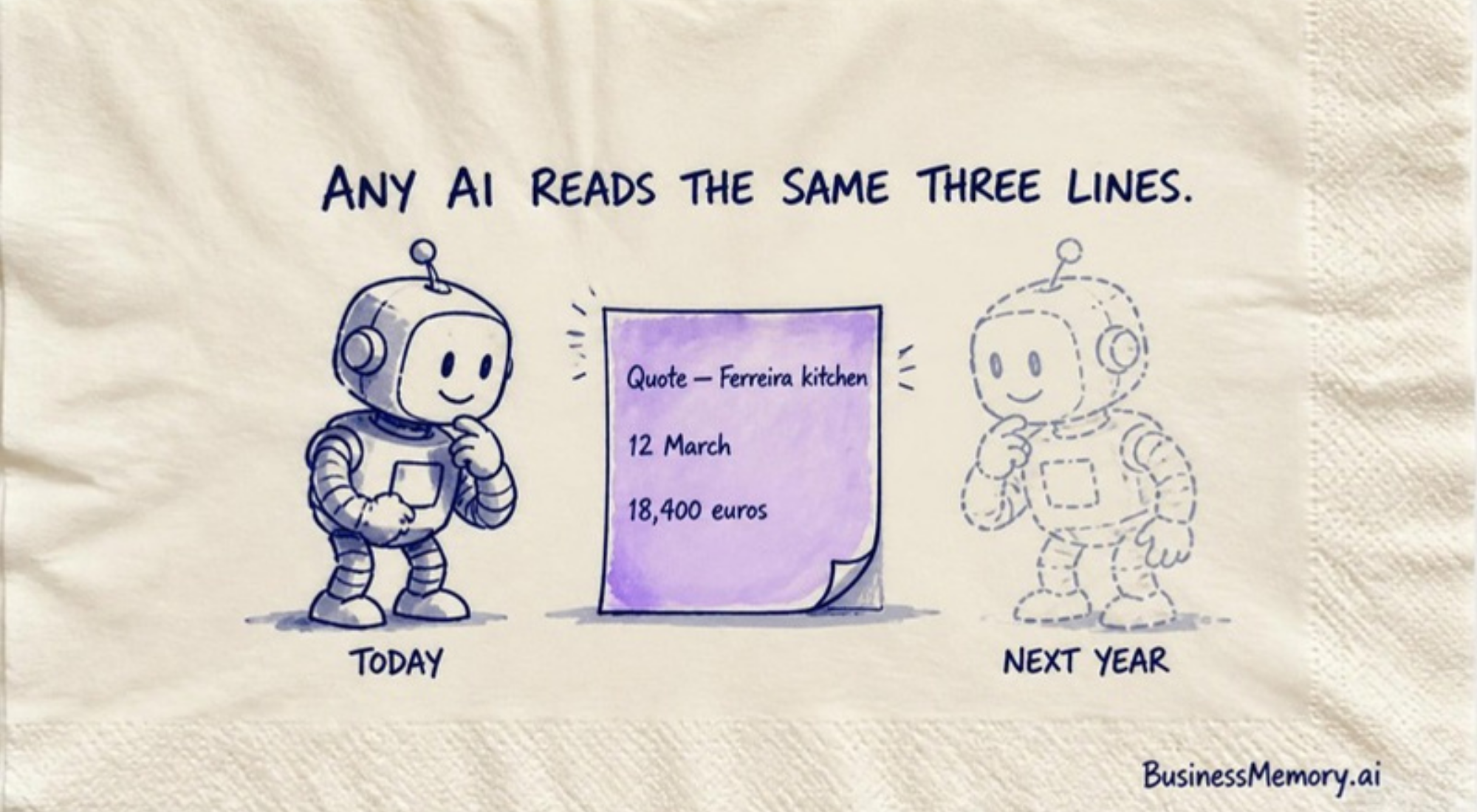
Here is the shape of one:
Quote — Ferreira kitchen
12 March
18,400 euros
An example, and the same one our home page uses.
Three lines. A date, a price, a name.
You do not need us to read that. No app, no account, no password. Open it on any computer you own and the words are sitting there.
And any AI you point at that folder reads the same three lines. Today's AI. Next year's AI, the one that is not built yet.
That is the object this whole product is built around: one file a person can read without help.
Why does the format decide where the record can live?
Because a record that needs software has to live wherever the software lives.
Think about what that means for a minute. If your record is locked inside one company's app, it has to sit where that app can reach it — on that company's computers, behind that company's login, inside that company's bill.
The software becomes the door. And somebody else holds the key.
Text has no door.
So the file can sit in a folder on your desk, on a drive in your drawer, on the laptop you carry home. It does not have to phone anybody to be readable.
Honestly, this is the part people get backwards. We did not put the record on your computer and then go looking for a format. We picked the format that could live there.
What happens when the software changes its mind?
It happens. And not because anybody is a villain.
A company changes its plan, and your own notes are suddenly counted. In December 2023, Evernote told its free users they could keep fifty notes and one notebook. People already over that line could still view, edit, export, share and delete what they had. They just could not write the next one.
Read that from the owner's chair. Every one of those notes was typed by the person who lost the right to add to them.
Evernote was fair about it. They said it in their own post, and they left the door out open. But somebody had to build that door, and somebody had to decide how wide it was.
A text file in a folder on your machine has no door to build. Nothing about it is counted, capped or renewed.
A record you need permission to read is NOT your record.
The honest part
Two things this does not give you, and you should hear them here instead of finding out later.
A computer that is off cannot answer a question. The record is on your machine, so your machine has to be awake when you ask it something.
And the record stays home — the question does not. When you ask, the AI you chose reads the part of the record it needs to answer, on that company's computers. That is the one half that leaves your desk, and we would rather say so on our own page.
Keeping a copy is still yours to do, too. Files on your own disk are exactly as safe as your own backup.
Why we built it this way
Because we run our own company on it.
Our contracts, our payments and our promises are in those files, on our own machines. We would not put them anywhere we could be locked out of, and we are not going to ask you to.
A business memory is a private record of everything your business knows — what was agreed, paid, promised and decided — kept on your own computer as plain text files any AI can read, so you can ask anything and get the answer with the exact reference behind it.
Every app you have ever paid for will be gone one day. The file with the 12th of March in it does NOT have to go with it.
Records were never meant for storage. Give your business a memory.
Questions
What does a business memory keep on my computer?
Plain text files. Each one holds a piece of what your business agreed, paid, promised or decided, written in words you can read. No database, no format only our app understands — files a standard text editor opens, and any AI can read.
Why does a business memory use plain text instead of an app's own format?
Because plain text needs nothing to read it. A record stored in one company's format has to live where that company's software can reach it. Text can live in a folder on your own machine, which is the whole point. The U.S. National Archives lists plain text among the formats it prefers for records it keeps permanently.
Can I read my business memory without your software?
Yes. Open the folder and open a file. Any text editor on any computer you own will show you the words, with us or without us. That is not a feature we added; it is what the format already does.
Which AI can read a business memory?
Any of them that can read a file. Because the record is plain text, it is not tied to one company's model — the AI you use today reads it, and so will the one you switch to next year. The record does not have to be rebuilt to move.