
Why Did Google Beat AltaVista When Both Read the Same Web?
AltaVista and Google read the same open web. One of them also wrote down which pages the web pointed at. Give your business a memory at BusinessMemory.ai.

AltaVista read every page Google read. Google kept one extra note about those pages — which ones the rest of the web pointed at. Today every business can rent the same AI, so the record you keep is the only part nobody else already has.
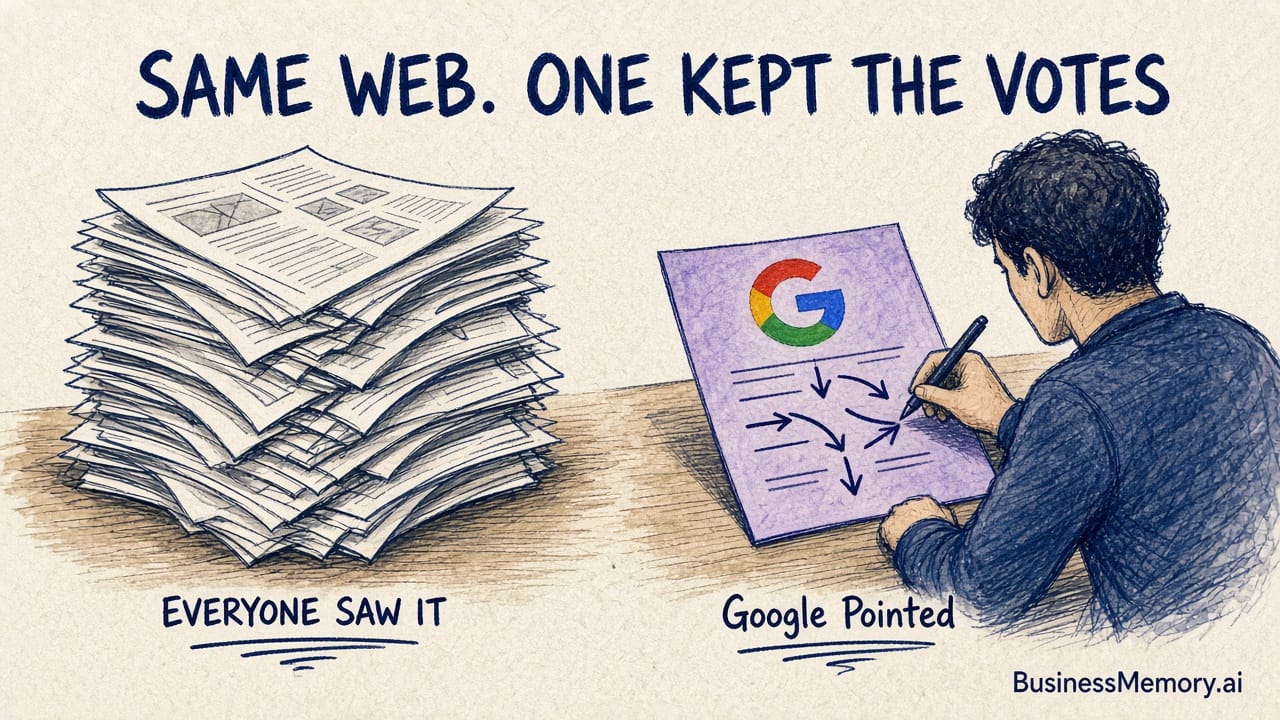
What did Google write down that AltaVista did not?
Which pages the rest of the web pointed at. The web was open to anybody who wanted to read it, and AltaVista read it well — launched in December 1995, it was "the first 'full text'/boolean searchable index of the World Wide Web," meaning you could search the real words on real pages, and it was taking more than 80 million hits a day by 1997. Google was incorporated on 4 September 1998 and read those same pages. Its founding paper says the system "makes heavy use of the structure present in hypertext." In plain words: it counted the links. Those links were already sitting on every page everybody was reading. Nobody hid them. One company wrote them down, and a written-down part like that is what a business memory is.
| Reading the same pages | Keeping a record of them | |
|---|---|---|
| What you look at | The words on the page | The words, and who points at the page |
| Where it comes from | The copy everybody has | The same copy, one note more |
| What it costs to start | Nothing. It is open to all. | The habit of writing it down |
| What a rival can copy today | All of it, this afternoon | None of it. Only start their own. |
| What you hold after ten years | Whatever you can remember | Ten years of it, still readable |
What did counting the links actually mean?
It meant asking the web what it already thought.
Every page on the web points at other pages. That is what a link is — one page saying, here, this one is worth your time.
Those pointers were free. They were printed right there in the pages everybody was already reading.
Counting them turned a page nobody could measure into a page you could. A page a thousand others pointed at was probably better than a page nobody pointed at.
So the extra information was not extra at all. It was in the same material. One company kept a note of it, and the others read straight past it.
Was AltaVista simply behind?
No. And this is the part people get wrong.
AltaVista stayed ahead for years after Google started. In 2000 — two years in — Media Metrix, the firm that measured web audiences then, found AltaVista was used by 17.7% of internet users and Google by only 7%.
It had the traffic. It had the money. It had the same pages.
Then the numbers went the other way. In June 1999, Compaq sold most of AltaVista to CMGI in a deal valued at nearly $2.3 billion. In February 2003, Overture bought the whole thing for $140 million — $80 million in stock and $60 million in cash. AltaVista was switched off for good in 2013.
Now the honest part, and you should hear it from me. Plenty went wrong at AltaVista at once — it was spun off, and in 1999 it was rebuilt as a general portal with news and traffic pictures on the front page. Nobody can say one decision killed it, and this post does not say that. What is certain is smaller and harder to argue with: the pages were the same for everybody, and only one company was writing down what the pages pointed at.
What does this have to do with AI in my business?
I see the same thing happening with AI in small businesses today.
Every owner on your street can rent the same AI you can. Same one, same price, same week. So the AI is not the edge.
The web was open too. Being able to read it was not the edge either.
Here is the uncomfortable part. Your business already reads everything. The quote you sent Tuesday. The call where the customer changed the order. The price you dropped once and never wrote down why. You saw all of it.
You just did not keep it. So the smartest machine in the world opens your business, finds nothing to read, and answers from the internet's average instead of from you.
Where does this show up in a small week?
In the answer you cannot get.
What did we charge this customer last year? Who agreed to that delivery date? Did we already try this supplier?
Every one of those went past your eyes once. Every one of them is gone now, unless somebody wrote it down.
And a record does not decide for you. It will not run the business or pick the customer. It only means that when you ask, you get what actually happened instead of your best guess about it.
So I'm committed to writing down the part I would otherwise only read once — the quote, the change, the promise — on the day it happens, not the day I finally need it.
A business memory is a private record of everything your business knows — what was agreed, paid, promised and decided — kept on your own computer as plain text files any AI can read, so you can ask anything and get the answer with the exact reference behind it.
Everybody read the same web.
One of them kept the note.
Records were never meant for storage. Give your business a memory.
Frequently asked questions
Why did Google beat AltaVista? Both read the same open web. AltaVista, launched in December 1995, was the first full-text searchable index of the World Wide Web and was taking more than 80 million hits a day by 1997. Google, incorporated in September 1998, read the same pages and also kept track of which pages the rest of the web pointed at. AltaVista was still ahead in 2000, used by 17.7% of internet users against Google's 7%, so this was not a head start. Many things went wrong at AltaVista at once; what is certain is that the raw material was identical and the record kept from it was not.
What is PageRank in plain English? It is a way of counting links. Every page on the web points at other pages, and each of those pointers is a small vote of confidence. PageRank works by counting the number and quality of links pointing at a page to estimate how important that page is. The links were public and free. The difference was writing them down and using them.
What happened to AltaVista? Compaq sold most of it to CMGI in June 1999 in a deal valued at nearly $2.3 billion. In February 2003, Overture Services bought AltaVista outright for $140 million. Yahoo acquired Overture later that year, and the AltaVista site was shut down for good in 2013.
Why does the AltaVista story matter for AI? Because it is the same shape. Every business can now rent the same AI at the same price in the same week, exactly as every search engine could read the same web. Access to the tool is not an advantage when everybody has it. What differs is the record each business keeps of its own work.
What is a business memory? A business memory is a private record of everything your business knows — what was agreed, paid, promised and decided — kept on your own computer as plain text files any AI can read, so you can ask anything and get the answer with the exact reference behind it.