AI Knowledge Base vs Business Memory: A Library You Specified vs A Record You Keep
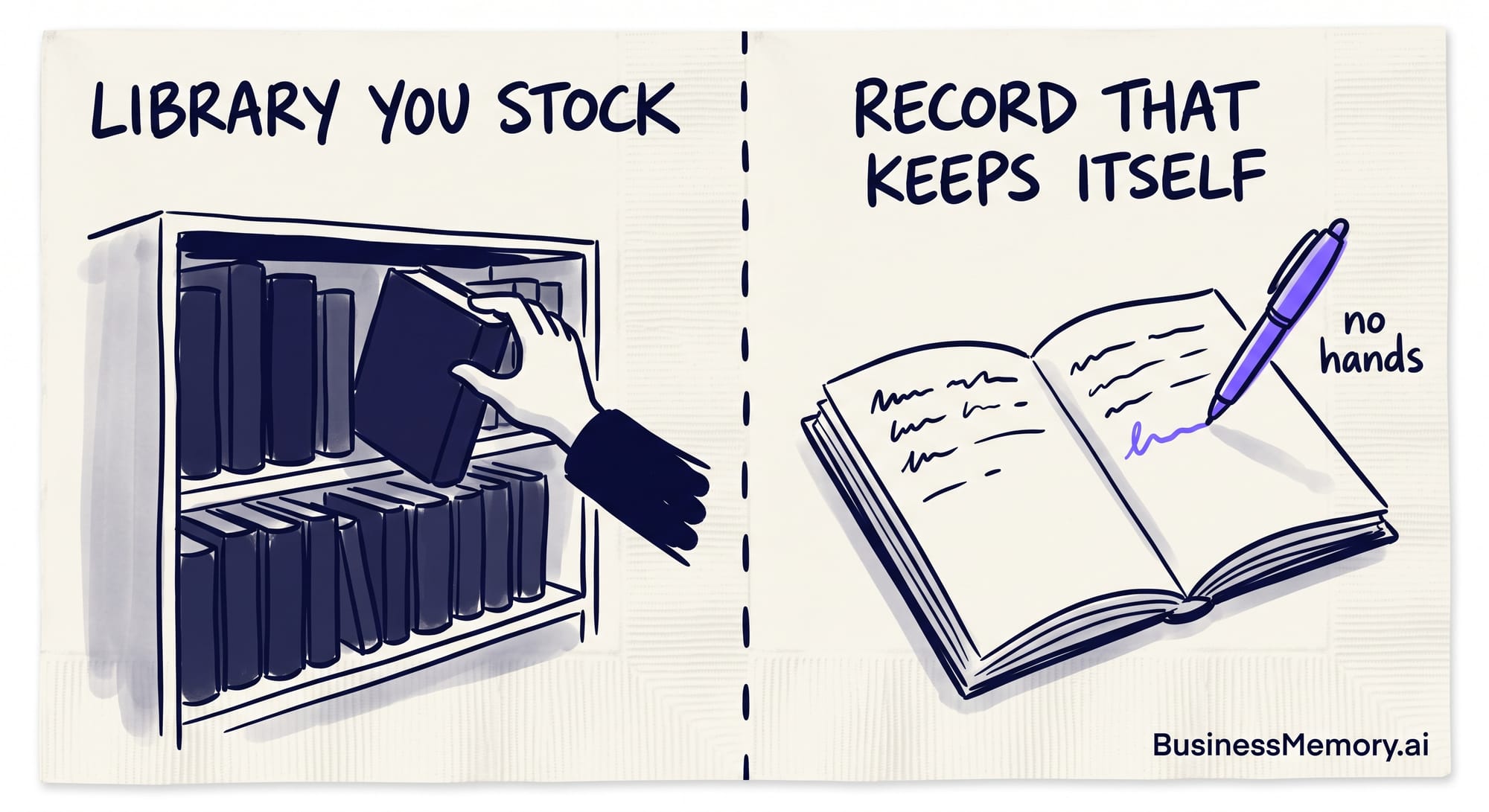
An AI knowledge base answers from a library you specified. A business memory keeps a running record of what was agreed, paid, promised and decided.

Subheadline: An AI knowledge base answers from a library you specified. A business memory keeps a running record of what was agreed, paid, promised and decided.
What is the difference between an AI knowledge base and a business memory?
An AI knowledge base is a library of documents, FAQs, policies, and specs. It retrieves from a specified set, then answers. A business memory is a private record of everything your business knows — what was agreed, paid, promised and decided — kept on your own computer as plain text files any AI can read, so you can ask anything and get the answer with the exact reference behind it. One answers from a library you specified. One keeps a running record of what was agreed, paid, promised and decided.
That first move has a name. Retrieval-augmented generation, proposed in 2020, means the model refers to a specified set of documents — including uploads, databases, or web sources — then responds. A knowledge base, by itself, does not remember a specific past event. A business memory records the business itself.
How do an AI knowledge base and a business memory compare?
| AI knowledge base | Business memory | |
|---|---|---|
| What it holds | Documents, FAQs, policies, specs you chose | What was agreed, paid, promised, decided |
| Where the answer comes from | A specified set: uploads, databases, or the web | The record of the business itself |
| Who feeds it | A specified set — uploads, databases, or the web | It files itself |
| What it does not do by itself | Remember a specific past event | It keeps that running record |
| Teamwork | A shared library the team can search | The whole team works from the same company context in a shared vault. Everyone in that vault sees the whole vault. |
| How you verify | The document it retrieved | The source on every answer — and a morning page that proves it ran |
What does an AI knowledge base do well?
Plenty. Say it plainly.
It puts the handbook, the FAQ, the policy, and the spec in one place a machine can read. That is a real library.
Most teams who built one were not lazy.
A library is not that record.
A 2026 explainer put the owner's job in four words: knowledge is "manually uploaded by you." That is one writer's line, not a law that every knowledge base is upload-only.
Is a knowledge base a system of record?
A system of record is the single authoritative system where one type of business data officially lives.
Some knowledge bases are assembled from those records. That is allowed. It does not turn the library into a memory of the deal, the payment, the promise, or the decision.
In 1991, Walsh and Ungson called organizational memory the history a company can bring to a present decision. That is a cousin. This page is the owner's version: a record of what the business itself did.
The honest limit on our side is the same one we tell you every time. Sharing is per-vault, not per-person. Everyone you invite to a vault sees the whole vault. For a small team that line is simple, and you can see it. It is not enterprise permissions. I would rather say so.
A business memory is a private record of everything your business knows — what was agreed, paid, promised and decided — kept on your own computer as plain text files any AI can read, so you can ask anything and get the answer with the exact reference behind it.
I will not call a library a memory.
#BeBusinessSmart
Frequently asked questions
What is an AI knowledge base?
It is a chosen library of documents, FAQs, policies, and specs. When you ask a question, retrieval-augmented generation (proposed in 2020) looks through a specified set — including uploaded documents, databases, or web sources — and then writes an answer.
Is an AI knowledge base the same as a business memory?
No. A knowledge base answers from a library you specified. A business memory keeps a running record of what was agreed, paid, promised and decided.
Does a knowledge base remember a specific past event?
Not by itself. Current writing on agents says a knowledge base does not, on its own, remember a specific past event. It holds the documents. It does not keep that running record.
Who can read a business memory?
Everyone you hand that vault to. Sharing is per-vault, not per-person. The whole team can work from the same company context in a shared vault. Private records belong in a vault you do not share.