What Is a Business Memory? Private Record for AI
Private record of deals, payments, promises — kept on your computer so AI answers with the source. Plain definition for owners. BusinessMemory.ai

The plain-English definition of business memory — and why it is the foundation every AI tool needs before it can tell you the truth about your own business.
What is a business memory?
A business memory is a private record of everything your business knows — what was agreed, paid, promised and decided — kept on your own computer as plain text files any AI can read, so you can ask anything and get the answer with the exact reference behind it.
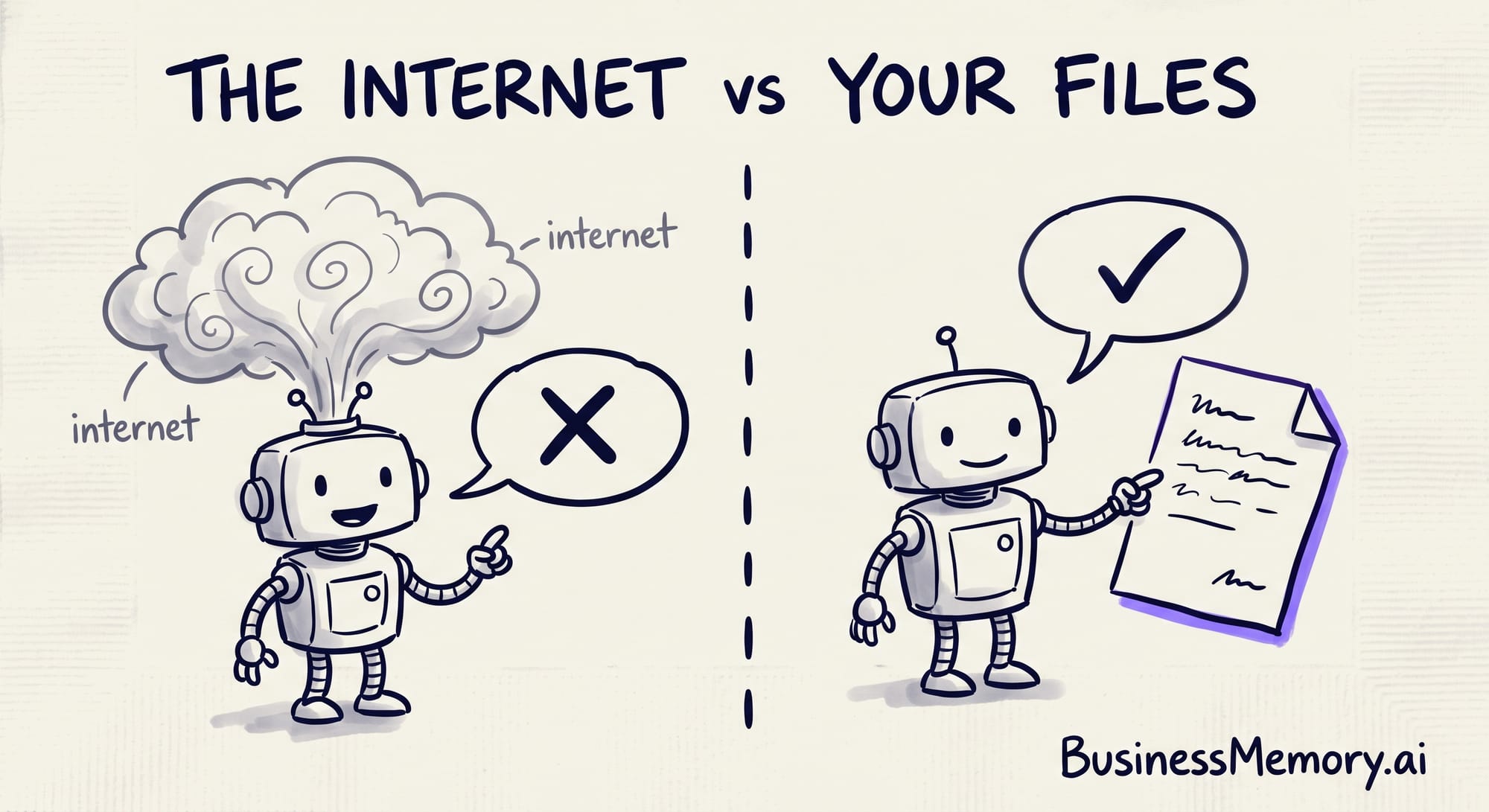
It exists because AI can only answer from what a business has recorded: an AI with no business memory answers from the general internet, not from your reality. A business memory is not a personal second brain and not a note-taking app — those hold one person's notes and depend on that person's discipline. It records the business itself, so the owner and every AI tool the business uses can ask a question — what did we agree, when was it paid, what is waiting on me — and get an answer backed by the real document behind it.
Start here: BusinessMemory.ai — private files on your computer, answers with the source.
Why does every business suddenly need one?
Management writers named this problem long before AI. They call it corporate amnesia: the know-how of a business "walks out of the front door on a regular basis" — when an employee leaves, when an inbox fills up, when a busy week buries a decision nobody wrote down.
Businesses survived corporate amnesia for decades. It was expensive, but it was survivable.
AI changed the price.
Every business is now being told to hand its work to AI. But an AI is only as good as the records behind it. Feed it nothing, and it will still answer — confidently, fluently, and from the average of the internet instead of from your business.
The pain was forgetting. The danger now is being answered wrongly about your own company, and not being able to check.
That is why the load-bearing word in business memory is not memory.
It is trust.
Is a business memory the same as a second brain or a company brain?
No — and the differences decide who it serves and who holds your data.
| Personal second brain | Company brain (cloud) | AI agent memory | Business memory | |
|---|---|---|---|---|
| Built for | One person's notes and ideas | A team, through the vendor's platform | Developers building AI agents | The business and its owner |
| What it holds | What you typed into it | Your files, indexed on their servers | An agent's past interactions | What was agreed, paid, promised, decided |
| Who does the filing | You do, every day | The vendor's software | The developer's code | Can file itself overnight (trust feature) |
| Where your data lives | Usually the app's cloud | The vendor's cloud | Wherever the system runs | Your own computer |
| How you know it's true | You trust your own notes | Citations inside their platform | Logs | Source shown on every answer — plus a morning-page trust check that proves it ran |
The technical world already has a well-defined cousin: AI agent memory, an AI system's ability to store and recall past interactions. That is a feature for developers. A business memory is the owner's version of the same idea: not a feature inside somebody's software, but a record the business itself owns.
Where should a business memory live?
On your own computer, in your own files.
Here is the plain reason. A cloud company can promise not to misuse your data. That is a policy, and a policy can change with the next update to the terms of service.
A memory that never leaves your machine is not a policy. It is architecture. There is nothing to promise, because there is nothing of yours on anyone else's servers.
For a personal note, that difference is a preference. For your contracts, your payments and your customer promises, it is the whole question.
What makes a business memory trustworthy?
Four tests, and a real one passes all four:
- It files itself. If the owner has to become the librarian, it will be abandoned by February.
- It never guesses. When it does not know, it says so.
- It shows the source. Every answer points at the document, the email, the record it came from. An answer without a source is an opinion.
- It proves every morning that it ran. A memory that fails silently is worse than no memory at all — silence should never look like success.
Why I care about this
I run real businesses — manufacturing supply, equipment rental, real estate. For the past year I have been putting AI inside them, and I learned the expensive lesson early: it is almost never the technology that fails. It is that the business underneath it cannot remember.
So we built our company a memory first — for ourselves, before anyone else. It files itself every night. Every morning it shows me a page that proves nothing was lost while I slept.
Memory first. Then the machines have something to stand on.
The question worth asking is not whether AI is smart enough for your business.
It is whether your business remembers enough for AI.
Give your business a memory it can trust — start at BusinessMemory.ai.
#BeBusinessSmart
Frequently asked questions
What is a business memory?
A business memory is a private record of everything your business knows — what was agreed, paid, promised and decided — kept on your own computer as plain text files any AI can read, so you can ask anything and get the answer with the exact reference behind it.
Is a business memory the same as a second brain?
No. A second brain is a personal tool: one person's notes, kept up by that person's discipline. A business memory records the business itself — deals, payments, promises, decisions — and files itself, so it does not depend on anyone becoming a note-taker.
Does AI need a business memory?
Yes. AI can only answer from what a business has recorded. Without a business memory, an AI answers from general internet knowledge — fluent, confident, and blind to your actual deals, payments and promises.
Where should a business memory live?
On the business's own computer, in its own files. Data that never leaves your machine is protected by architecture, not by a vendor's policy — there is nothing of yours on anyone else's servers to leak, sell or lose.