Second Brain vs Business Memory: One Is for You, One Is for Your Business
A second brain remembers what you learned. A business memory remembers what your business did. The difference decides whether AI can tell you the truth about your own company.

A second brain holds one person's notes. A business that wants AI to tell it the truth needs something different — a memory of the business itself.
What is the difference between a second brain and a business memory?
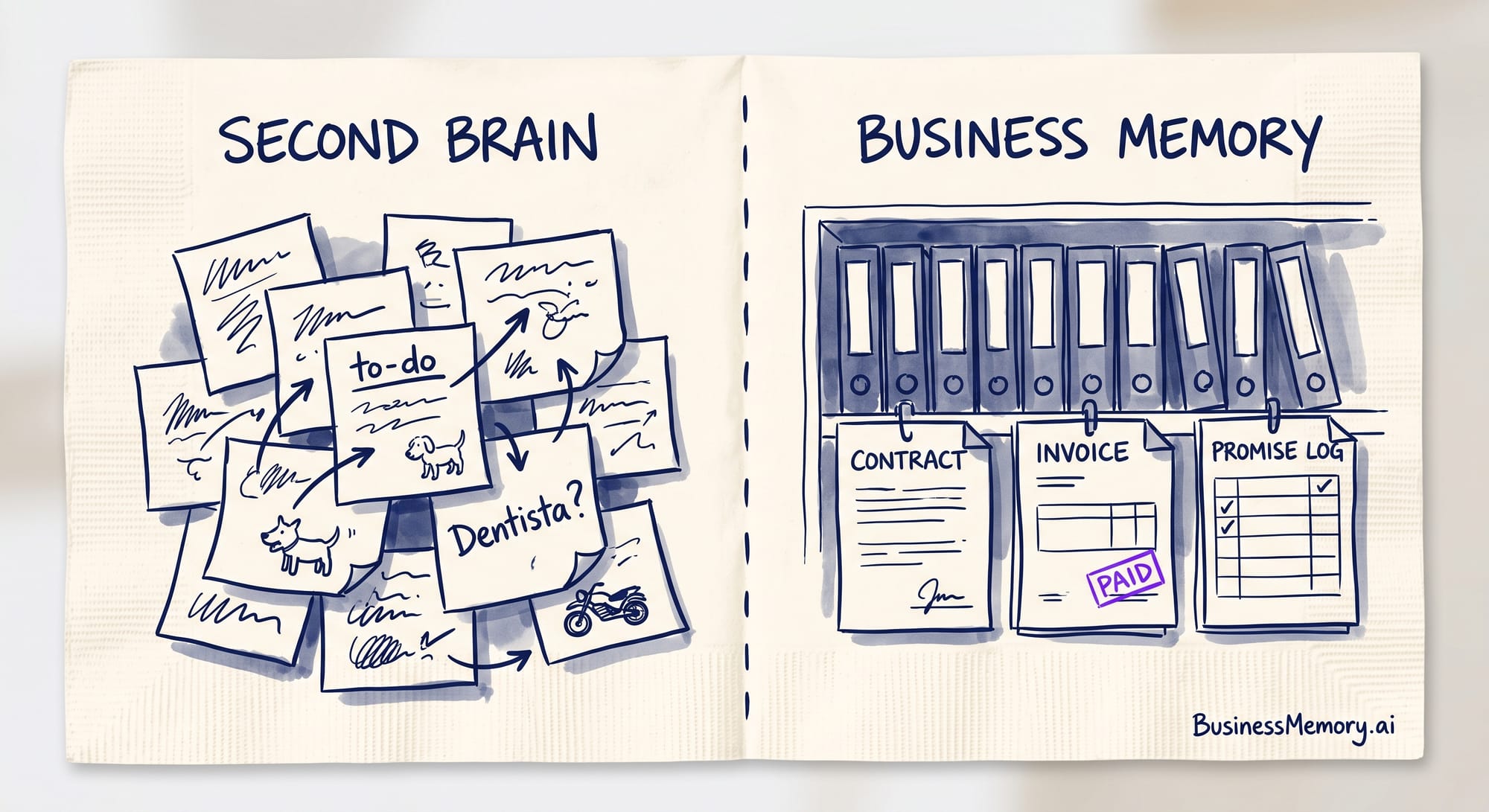
A second brain is a personal knowledge system — in Tiago Forte's words, "an external, centralized, digital repository for the things you learn." It holds what one person chooses to capture: notes, ideas, insights, highlights. A business memory is a private record of everything your business knows — what was agreed, paid, promised and decided — kept on your own computer as plain text files any AI can read, so you can ask anything and get the answer with the exact reference behind it.
It files itself from the work as it happens — the payment that clears, the message that goes out, the contract that gets signed — not from anyone stopping to type a note. That is the whole trick, and it is why the record keeps going in the weeks nobody has time to write anything down.
The difference is the subject being remembered. A second brain remembers what YOU learned. A business memory remembers what your BUSINESS did. One depends on a person's discipline to type notes; the other records events — deals, payments, promises — whether anyone took a note or not. A growing business needs both minds: yours, and its own.
How do the two compare?
| Personal second brain | Business memory | |
|---|---|---|
| Built for | One person's ideas and learning | The business and its owner |
| What it remembers | What you read, thought, and chose to save | What was agreed, paid, promised, decided |
| Who feeds it | You do, by typing notes | It files itself, from the work |
| In a busy week | The notes stop | The record keeps going |
| Teamwork | Built for one mind — sharing it is the exception | The whole team feeds shared vaults — and you decide who joins which one, so the books reach whoever keeps them and the calendar whoever runs the day, while your private records stay in a vault you never shared. |
| Where it lives | Usually an app's cloud | Your own computer |
| How you check an answer | You trust your own notes | Source shown on every answer |
Can a second brain run a business?
No — and not because the tools are weak. Because of what a second brain is built to hold.
Forte's own method says to capture what "resonates" with you, and that each note is "a record of something you've experienced." That is the design, and for a person it is the right design.
But most of what a business knows was never anybody's experience to note down.
The payment that cleared while you slept. The price your partner agreed to on a call you were not in. The promise a customer is holding you to from eleven months ago.
Nobody's second brain saw any of it.
A note system remembers the thinking. It has no way to remember the business.
Why does a business need its own memory?
Management writers named the disease decades ago: corporate amnesia — the know-how of a business "walks out of the front door on a regular basis."
For years, the cure offered was more note-taking. Wikis, handbooks, organizational memory projects. All of them fed by the same fragile fuel: somebody's discipline.
AI changed the stakes.
An AI can only answer from what a business has recorded. Hand it one person's notes and it answers with one person's opinions — confidently, and blind to every deal, payment and promise nobody typed in.
The wrong fix is asking the owner to take better notes. That just makes the owner the librarian, and the busy months always win.
The fix is a memory that records the business itself.
Do you need both?
Yes — and they are not rivals.
Keep your second brain. I keep mine. It is where my ideas, my reading and my lessons live, and I would not run my week without it.
But my notes only ever knew what I learned.
Nothing in my companies knew what my companies did — until we built them their own memory. It files itself every night. Every morning it shows me a page that proves nothing was lost while I slept — and because each person is only invited into the vaults for their job, the team can lean on a shared record while my payroll and private agreements stay in a vault I never shared.
Your mind now has a backup. It is time your business got one too.
Your second brain is for you. A business memory is for your business.
Give your business a memory it can trust.
#BeBusinessSmart
Frequently asked questions
What is the difference between a second brain and a business memory?
A second brain is a personal knowledge system: one person's notes, ideas and insights, kept up by that person's discipline. A business memory is a private record of everything your business knows — what was agreed, paid, promised and decided — kept on your own computer as plain text files any AI can read, so you can ask anything and get the answer with the exact reference behind it. One remembers what you learned; the other remembers what your business did.
Can I use a second brain to run my business?
Not on its own. A second brain only holds what someone typed into it, so it misses everything nobody experienced or noted — payments, agreements, promises made across the whole company. It is a tool for your thinking, not a record of your business.
Do I need both a second brain and a business memory?
They solve different problems, so many owners end up with both. A second brain serves your personal learning and creativity. A business memory serves the company: it records deals, payments, promises and decisions so the owner — and any AI the business uses — can get answers backed by real documents.
Why can't my whole team just share one second brain?
Because a second brain is built around one person's judgment about what to save. A business needs a record of what actually happened, filed automatically, with the source behind every answer — not a shared notebook that goes quiet whenever people get busy. And a shared notebook is all-or-nothing: everyone sees everything or the sharing breaks. A business memory is built for teamwork the way a business actually works — you keep more than one shared vault and invite each person only into the ones for their job, so the team works from shared records while the owner's private numbers and agreements stay in a vault nobody else was invited to.