Company Brain vs Business Memory: One You Rent, One You Own
A company brain is a rented search layer on a vendor's servers. A business memory is a private record you keep on your own computer. One you rent. One you own.

Subheadline: In 2026, "company brain" is how a search layer on someone else's servers is being sold. A business memory is a record you keep on your own computer.
What is the difference between a company brain and a business memory?
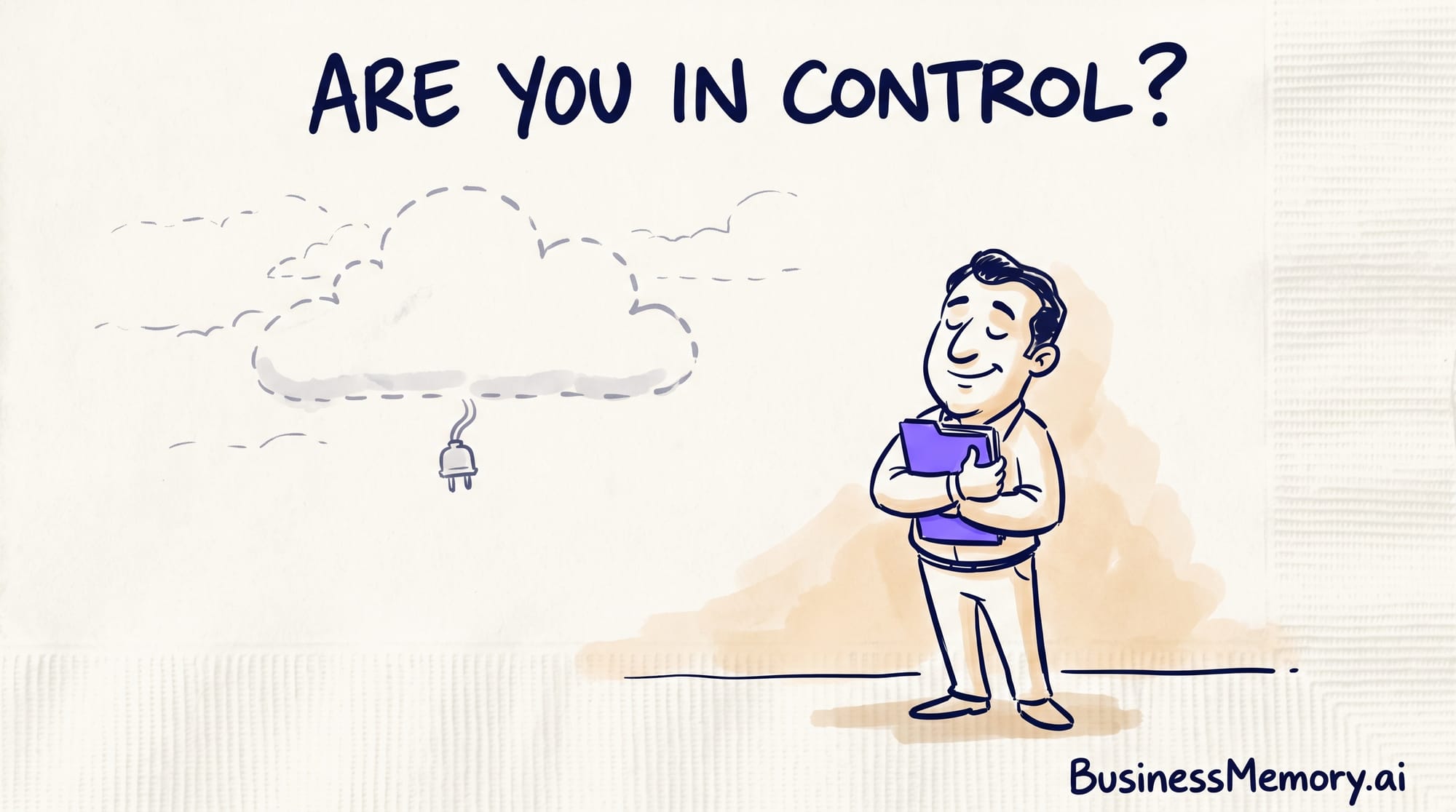
A company brain is a rented search layer. The vendor indexes your files, intranet, documents, email and databases, and builds that index on their servers. A business memory is a private record of everything your business knows — what was agreed, paid, promised and decided — kept on your own computer as plain text files any AI can read, so you can ask anything and get the answer with the exact reference behind it. One you rent. One you own.
Both fight corporate amnesia: the know-how that "walks out of the front door" as people leave. The 2026 label "company brain" is how enterprise search is being sold. The provider builds the index. A business memory grows in your own files, so the record stays yours.
How do a company brain and a business memory compare?
| Company brain (rented) | Business memory (yours) | |
|---|---|---|
| Where the record lives | The vendor's servers | Your own computer |
| Who builds the index | The provider | Your files, on your disk |
| As time passes | Data files and brand training pile up. Switching costs rise. | The record grows. It is still yours. |
| If you leave | In the EU, some cloud contracts get at least 30 days to retrieve data, then erasure | The files stay on your disk |
| Teamwork | One shared index the vendor built | The whole team works from the same company context in a shared vault. Everyone in that vault sees the whole vault. |
| What you signed | A clickwrap. Take it or leave it. | Architecture. The files never left. |
| How you verify | Inside their platform | Open the folder — and a morning page that proves it ran |
What does a company brain do well?
Plenty. Say it plainly.
It pulls answers out of buried file systems, old intranets, document piles, email, and databases. It fights corporate amnesia. That work is real.
The argument is not that a rented brain does nothing.
It is that the record lives on their servers. Vendor lock-in is the name for a customer who cannot leave without a real cost.
A clickwrap is take-it-or-leave-it. NIST wrote in 2011 that non-negotiable service agreements are generally the norm. Negotiated terms are possible. Size and influence decide who gets them.
Now the honest limit on our side.
A business memory does not give per-person permissions inside one vault. Everyone you invite to a vault sees the whole vault. For a small team that line is simple, and you can see it. It is not enterprise permissions. I would rather say so.
Public-cloud providers collect logs and audit trails of customer activity. That is NIST, 2011.
Our claim stops at the files. Data on your disk. You do not depend on another company's servers. The work stays accessible if you have the files. That is all.
Why do switching costs rise the longer you stay?
Carl Shapiro and Hal Varian wrote it in Information Rules in 1998. Lock-in comes from the stuff that piles up around a product: your data files, and the training that only works with that brand. Both get bigger with time.
On 21 February 1997, Aaron Contorer wrote in an internal Microsoft memo — later quoted by the European Commission — that switching costs had "given customers the patience to stick with Windows through all our mistakes."
I see the same switching-cost shape when a business rents a brain.
The local-first software movement named the other side in 2019. Your data should remain accessible if the vendor goes away. Files on your own computer do not need their servers to exist.
In the EU, the Data Act (Regulation 2023/2854, 13 December 2023, Article 25) gives the cloud services that law covers at least 30 calendar days to retrieve data after switching, then erasure. That is an EU rule. It is not a worldwide custom.
A memory in your own files is already on your disk. You do not wait for a retrieval window.
Who can read a business memory?
Everyone you hand that vault to.
Sharing is a vault you can see. Invite a person to the company vault and they work from the same company context. Keep a private vault and it stays off that shared floor.
Everyone in a vault sees the whole vault.
That is the honest line. It is also the advantage. The whole team can feed one record and work from it together.
I built a business memory for my own companies first.
It lives in our files, on our machines.
I will not rent that record.
A business memory is a private record of everything your business knows — what was agreed, paid, promised and decided — kept on your own computer as plain text files any AI can read, so you can ask anything and get the answer with the exact reference behind it.
Give your business a memory it can trust.
#BeBusinessSmart
Frequently asked questions
What is a company brain?
In 2026, "company brain" is how a category is being sold: a search layer that indexes a company's internal sources — file systems, intranets, document systems, email, databases — with the provider building the index on their servers. That is enterprise search, rented.
Is a company brain the same as a business memory?
No. They fight the same problem — a business that cannot remember — but a company brain lives on the vendor's servers and is rented, while a business memory lives on the business's own computer and is owned.
What happens to a company brain if you cancel?
In the EU, the Data Act gives in-scope cloud contracts at least 30 calendar days to retrieve data after switching, then erasure. That is an EU rule, not a worldwide custom. A business memory is already on your disk.
Who can read a business memory?
Everyone you hand that vault to. Sharing is per-vault, not per-person. The whole team can work from the same company context in a shared vault. Private records belong in a vault you do not share.
Why do switching costs rise over time?
Carl Shapiro and Hal Varian showed in 1998 that lock-in comes from complementary durable assets, including data files and brand-specific training. Both rise with time.