Why the Boss Is the Last to Notice the Broken Tools
I washed the dishes with a falling-apart sponge and found out what my team puts up with every day — and that the worst tool on the team was me.

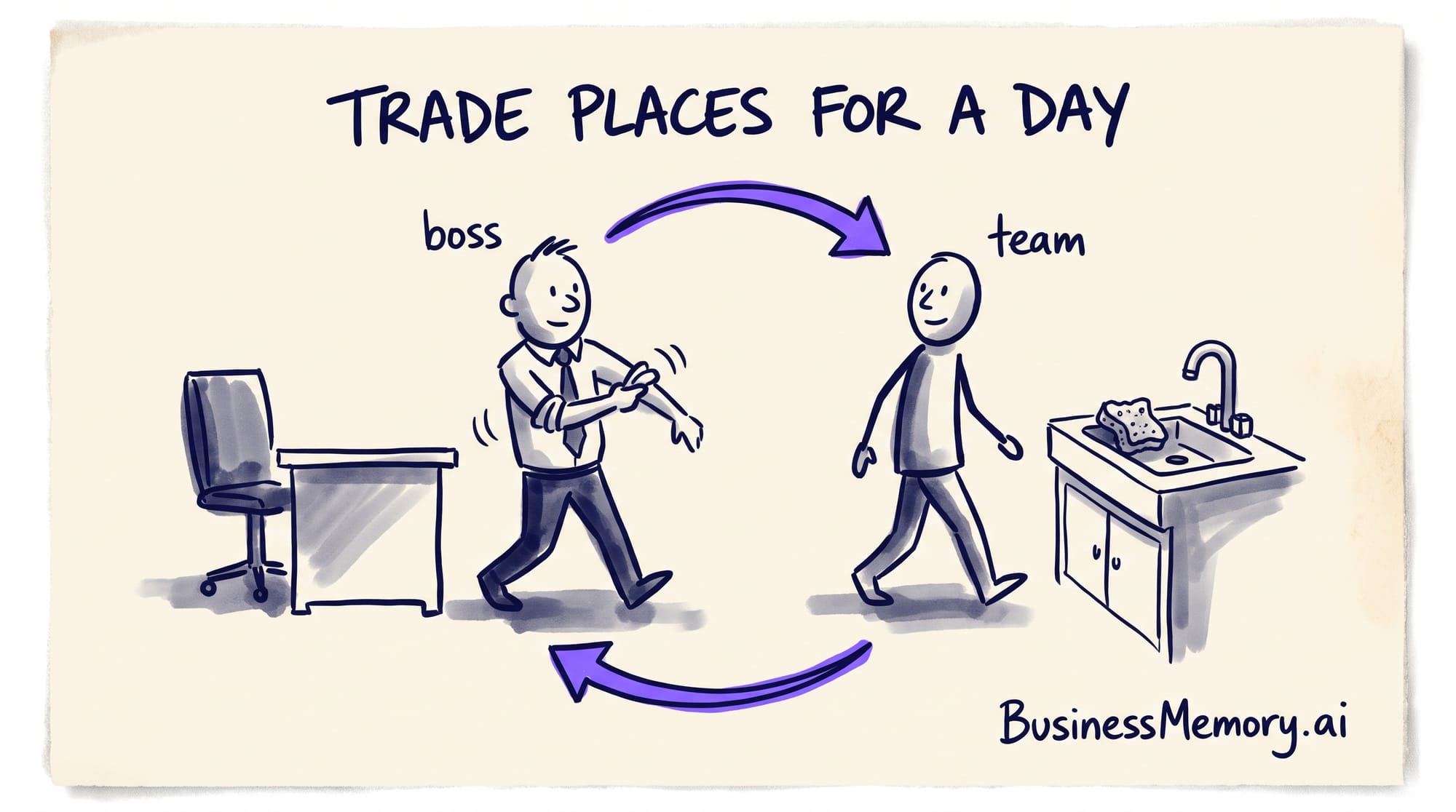
Most owners pick the tools but never use them all day. So the worst ones stay hidden — and often the slowest tool on the team is the owner's own head.
Why don't business owners notice when their team has bad tools?
Because the person who buys the tools is rarely the person who uses them all day.
You only feel a bad tool when you do the work with it. The owner signs the check, then goes back to his own desk.
This is not a small problem. In a Microsoft survey of 9,600 workers and managers in eight countries, about one in three said they don't have the right tools to work well.
And one of the slowest tools in a small business is not a machine. It is the owner's head.
When every answer lives there, the team has to stop and wait.
A business memory fixes that part: the business written down in one place the team can ask, so they stop waiting on one person.
| What the boss sees | What the team lives with |
|---|---|
| The tool he paid for | The tool falling apart in their hands |
| "It works fine" | "It works if you push it twice" |
| The answer, because it is in his head | Waiting for him to answer |
| One question a day | The same question ten times a week |
| A busy morning | A morning lost looking for things |
| His own records | One shared record the whole team works from |
What happened at my kitchen sink?
Yesterday, a worn-out sponge made me feel like a bad boss...
I was washing the dishes at home.
The sponge was falling apart. The soap was almost gone. And the pan just would not come clean.
I caught myself thinking, "How can anyone do this with such terrible tools?"
Then it hit me.
I had never paid enough attention to this, because I rarely do it.
And the same thing happens in my business!
How much time does a team lose to the wrong tools?
More than most owners think.
A Coveo study of 4,000 workers in the US and the UK found people spend about 3.6 hours a day looking for information at work.
A Glean survey run by The Harris Poll put it at two hours a day or more — a quarter of the work week. Both companies sell search tools, so read the exact number with care.
Even the low number is a lot.
Two hours a day is not a lazy team.
It is a team using a dull sponge.
So what is the worst tool on my team?
So today I will start auditing my team's daily tasks AND tools.
Not from my desk. From their chair.
And honestly, I feel the worst tool they have is not an old program or a broken machine.
It is me.
When the price, the old decision, or "how did we do this last time?" lives only in my head, every question has to wait for me.
I never feel that pain, because I never have to ask myself.
When you never do the work, you never notice the broken tools.
The honest part: as of now, a business memory does not fix a broken machine or a dull sponge. Those you still have to buy. What it fixes is the waiting — the answers that only live in one person's head.
So I'm committed to washing more dishes. At home, and at work.
A business memory is a private record of everything your business knows — what was agreed, paid, promised and decided — kept on your own computer as plain text files any AI can read, so you can ask anything and get the answer with the exact reference behind it.
When was the last time you did your team's job for a whole day?
Records were never meant for storage. Give your business a memory.
#BeBusinessSmart
Frequently asked questions
Why don't business owners notice when their team has bad tools?
Because the person who buys the tools is rarely the person who uses them all day. You only feel a bad tool when you do the work with it. The owner pays, then goes back to his own desk.
How many workers say they don't have the right tools?
In a Microsoft survey of 9,600 workers and managers in eight countries, about one in three said they don't have the right tools to work well.
How much time do workers lose looking for information?
A Coveo study of 4,000 workers in the US and the UK found about 3.6 hours a day. A Glean survey run by The Harris Poll found two hours a day or more. Both companies sell search tools, so treat the exact number with care.
How does a business memory help a team?
It writes the business down in one place the team can ask — what was agreed, paid, promised and decided. So the team stops waiting on the one person who holds the answer in his head.
A business memory is a private record of everything your business knows — what was agreed, paid, promised and decided — kept on your own computer as plain text files any AI can read, so you can ask anything and get the answer with the exact reference behind it.