The Most Valuable Thing an Airline Ever Built Could Not Fly
The most valuable thing American Airlines ever built could not fly. It was a record — and every rival with the same planes could not copy it. AI just made that asset affordable for every owner.

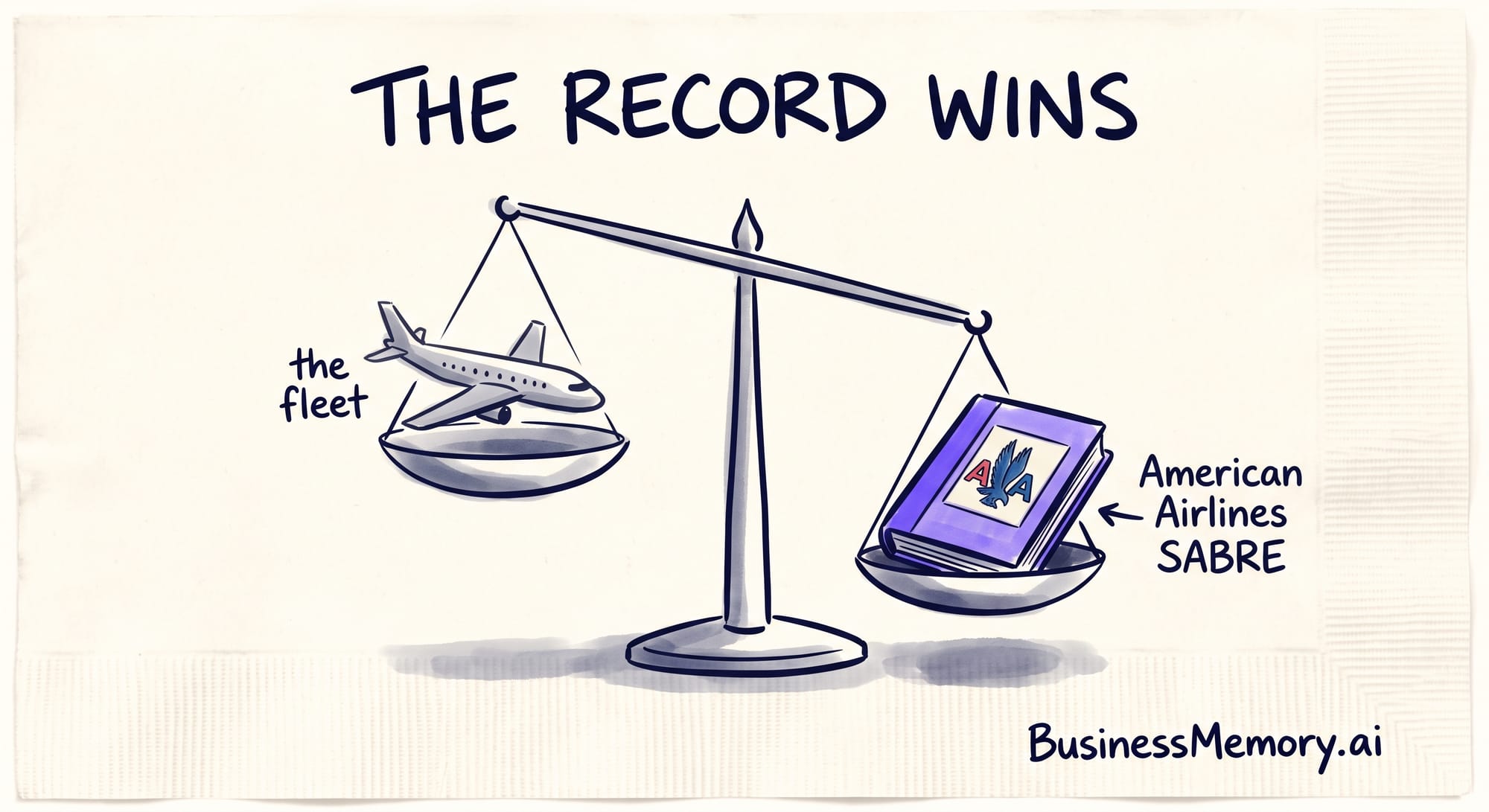
Every rival could buy the same planes. What they could not buy was the record. AI just made that same kind of asset — a business memory — something any owner can afford.
Why is a business memory a competitive asset?
Because it is the one input your rivals cannot copy. Any business can rent the same AI today — the same models, the same price, the same upgrades on the same day. What none of them can rent is your record: a business memory of what was agreed, paid, promised and decided in your company. That record is what makes an AI answer about YOUR business instead of business in general — and it compounds every day you keep it. Airlines proved this before computers fit on a desk. In 1964, American Airlines switched on SABRE, the world's first fully operational computer reservation system, and turned a booking that took about 90 minutes by hand into one that took seconds. The planes stayed equal. The record did not.
| The tools everyone rents | The record only you own | |
|---|---|---|
| Who can get it | Any rival with a credit card | Nobody — it is your business's own past |
| What it costs | A monthly subscription | Writing things down as they happen |
| When you switch tools | The new tool starts from zero | The record moves with you — plain files any AI can read |
| How it grows | Upgrades arrive for everyone at once | It compounds, one day of business at a time |
| What it knows | The whole internet | What was agreed, paid, promised and decided — with the file behind it |
What did American Airlines actually build in 1964?
Before SABRE, booking one seat — from the first call to the ticket in hand — took about 90 minutes.
Eight operators sat around a rotating file of cards, one card per flight. Only eight could work at once, because only eight fit around the drum. The error rate was 8% — and that was the BEST in the industry.
Then, in 1953, an IBM salesman named Blair Smith boarded a flight from Los Angeles to New York and found himself next to C. R. Smith, the president of American Airlines. Two Smiths, one row. They talked about the mess.
Eleven years, 400 man-years of work and about $40 million later, American switched the system on. A booking now took seconds. SABRE handled 7,500 reservations an hour.
Here is the part most people miss: every airline could order the same jets from the same factories. The planes were never the edge.
The record was.
How did a record beat the planes?
In 1976, American put SABRE terminals on travel agents' desks. By 1985, about 10,000 agencies were booking through it, and AMR — American's parent — had become, in one historian's words, "a service company for the airline industry as well as an airline company."
Whoever owned the record now sat between every traveler and every seat. American's own 1982 annual report admitted that SABRE's profits came partly from showing American's flights first on the screen. The record did not just serve the business. It steered the market.
By 2000, the record had grown so valuable it left home — Sabre split from American entirely and still runs travel bookings today.
The planes made money. But the asset that changed the game was a written record of the business: who agreed to what, who paid, who was promised a seat.
Why does this matter to your business now?
Because AI just did to software what the jet makers did to planes: it made the tools equal.
I see the same thing happening with AI in small businesses today. Every owner can rent the same AI for a few dollars a month. Same models. Same upgrades. Same day. If we all fly the same fleet, the tool cannot be the edge.
The edge is what your AI can read that your rival's cannot.
And here is the door standing open: what cost American Airlines $40 million and eleven years in 1964 costs an owner almost nothing today. A business memory is plain text files on your own computer. The price of the asset collapsed. The value did not.
Now the honest part. A record is only an asset if you keep it. In most small businesses, the record evaporates — the deal lives in a chat, the price lives in somebody's head, the promise lives in a phone call. No AI can read what was never written down. The asset is cheap now, but it is not automatic.
So I'm committed to keeping mine — every deal, every payment, every promise, written down the day it happens.
A business memory is a private record of everything your business knows — what was agreed, paid, promised and decided — kept on your own computer as plain text files any AI can read, so you can ask anything and get the answer with the exact reference behind it.
Your rivals can copy your tools by tomorrow morning. They will NEVER copy your record.
Records were never meant for storage. Give your business a memory.
#BeBusinessSmart
Frequently asked questions
Why is a business memory a competitive asset?
Because every business can rent the same AI, but only you own the record of your own business — what was agreed, paid, promised and decided. That record is what makes an AI's answers specific to your company, and it compounds every day you keep it. A rival can match your tools in an afternoon. Your record took your whole history to write.
What was SABRE, and what does it prove?
SABRE was the world's first fully operational computer reservation system, switched on by American Airlines in 1964 after eleven years and about $40 million of work. It cut a 90-minute manual booking to seconds, reached about 10,000 travel agencies by 1985, and split off as its own company in 2000. It proves the lesson: every rival could buy the same planes, but not the record.
Can competitors copy a business memory?
They can copy the method, never the memory. The files, the format and the AI are available to everyone. What cannot be copied is the content — your deals, payments, promises and decisions, recorded as they happened. That content is the asset, and it only exists if the business keeps it.
Do you need expensive software to build a business memory?
No. What cost American Airlines $40 million in 1964 costs an owner almost nothing today: a business memory is plain text files kept on your own computer, readable by any AI. The real cost is not money — it is the habit of writing the business down.