What a Business Memory Keeps When the Crown Moves
In 1900 the railroads were the future, and everyone was right. Today they are under 1% of the market. The trains still run.

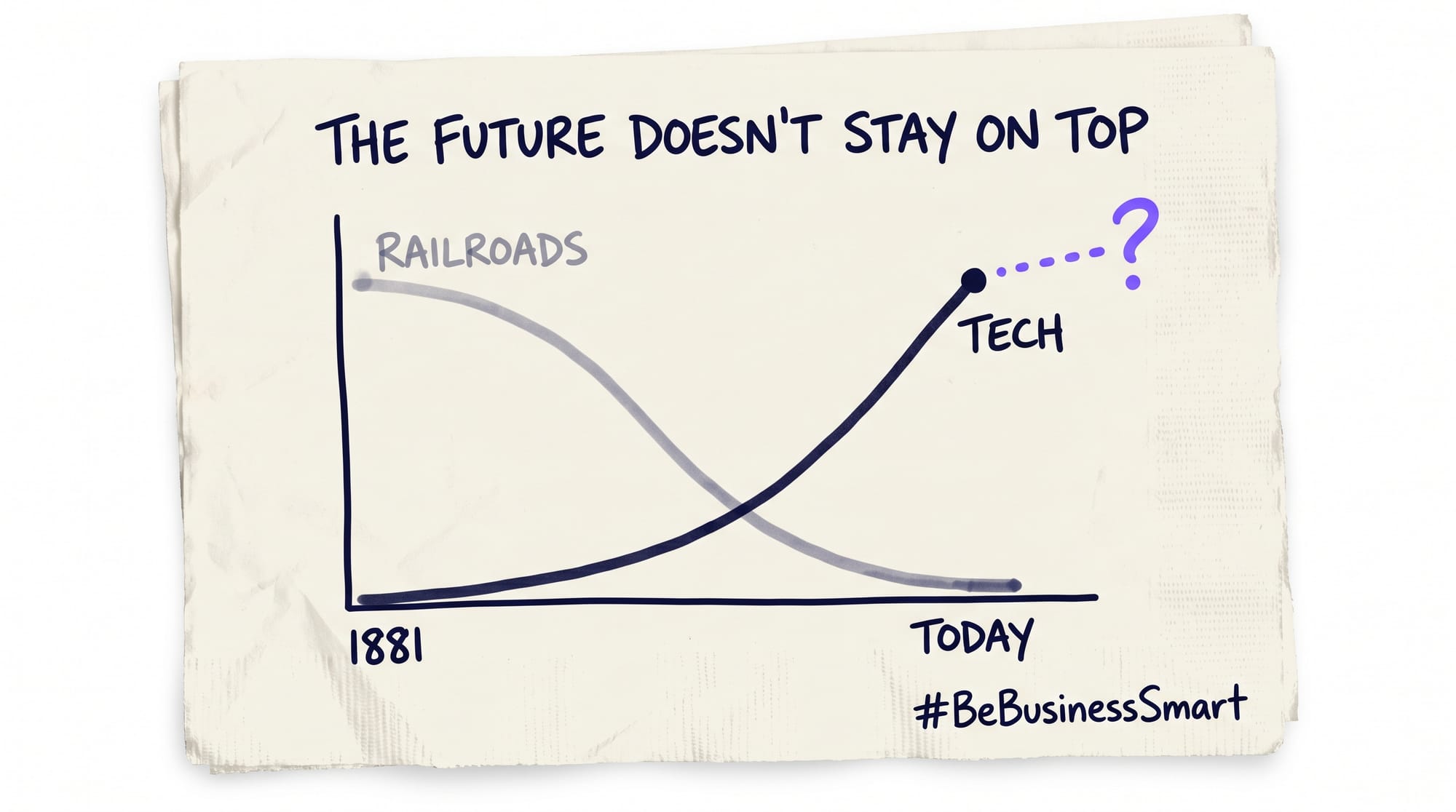
You do not have to guess which industry wears the crown in thirty years. In 1900 the railroads held 63% of the U.S. market, and today they hold under 1%.
Is tech the new railroad?
By 1900, about six of every ten dollars in the U.S. stock market sat on one industry.
The UBS history of the market puts the railroads at 63% that year. Today they are less than 1%.
Everyone knew it was the future.
And everyone was right.
The trains still run. The crown moved anyway.
Now tech is about 40% of the S&P 500, counted at the close on October 5, 2026.
That is heavier than oil was in 1980, heavier than tech was in 2000, and heavier than the banks were before 2008, in the peaks CME lists.
Is tech the new railroad?
Honestly, I don't know. Nobody does.
Being the future does not mean staying on top.
A business memory keeps the record of your own shop, so you can ask what you charged, what you promised, and what the customer asked, and get the answer from your files.
| 1900 | Today | |
|---|---|---|
| Railroads' share of the U.S. market | 63% | Under 1% |
| Do the trains still run? | Yes | Yes |
| Tech on the stock market | Almost none | About 40% of the S&P 500 |
What happened to the railroads?
They moved the crops, the mail, the steel and the people.
Whole towns lived or died by where the tracks went.
So the railroad was not a guess. It was the road everything else had to use.
Then the share of the market fell. Slowly. All the way under 1%.
The trains still run.
The business never died.
What did the world build after the railroad?
The world built bigger things on top of that road.
Oil. Cars. Phones. Computers.
Cars and trucks took a lot of the freight the railroad used to own. Bridgewater tells that part plain: the railroad was the only reliable way to move goods across the country, and then it was not.
And UBS says about 70% of today's U.S. companies come from industries that were small, or not there at all, in 1900.
Technology was almost absent from the stock market then.
What does a business memory keep when the crown moves?
Most of us will never own the industry on top of that list.
I will not own 40% of the S&P 500 either.
What I can own is the record of my own customers.
The price I charge.
The promise I made.
The last thing they asked for.
Being the future does NOT mean staying on top.
As of now, a business memory does not tell you which industry wears the crown in 30 years.
I cannot tell you either.
So I'm committed to keeping mine. Every price. Every promise. Every customer. Written down.
A business memory is a private record of everything your business knows — what was agreed, paid, promised and decided — kept on your own computer as plain text files any AI can read, so you can ask anything and get the answer with the exact reference behind it.
So, which industry do you think wears the crown 30 years from now?
Records were never meant for storage. Give your business a memory.
#BeBusinessSmart
Frequently asked questions
Is tech the new railroad?
Honestly, I don't know. Nobody does. In 1900 the railroads were 63% of the U.S. market, and everyone was right that they were the future. Today they are under 1%, and the trains still run. Being the future does not mean staying on top.
Did the railroad business die?
No. The trains still run. The share of the stock market collapsed. Cars and trucks later took a lot of the freight. The work did not vanish.
Has any industry been a bigger share of the S&P 500?
Tech's about 40% is heavier than the single-industry peaks CME lists: oil near 28% in 1980, tech near 33% in 2000, and the banks between 20% and 22% before 2008. A 1957 label put "industrials" at 85%. That pile mixed factories, steel mills, and oil rigs. It was not one industry.
What does a business memory keep when the crown moves?
It keeps what your shop already knows. The price, the promise, the customer. It does not guess the next king. You ask your own files, and the answer comes with the paper behind it.
A business memory is a private record of everything your business knows — what was agreed, paid, promised and decided — kept on your own computer as plain text files any AI can read, so you can ask anything and get the answer with the exact reference behind it.