"Chat with Your Documents" vs "Ask Your Business"
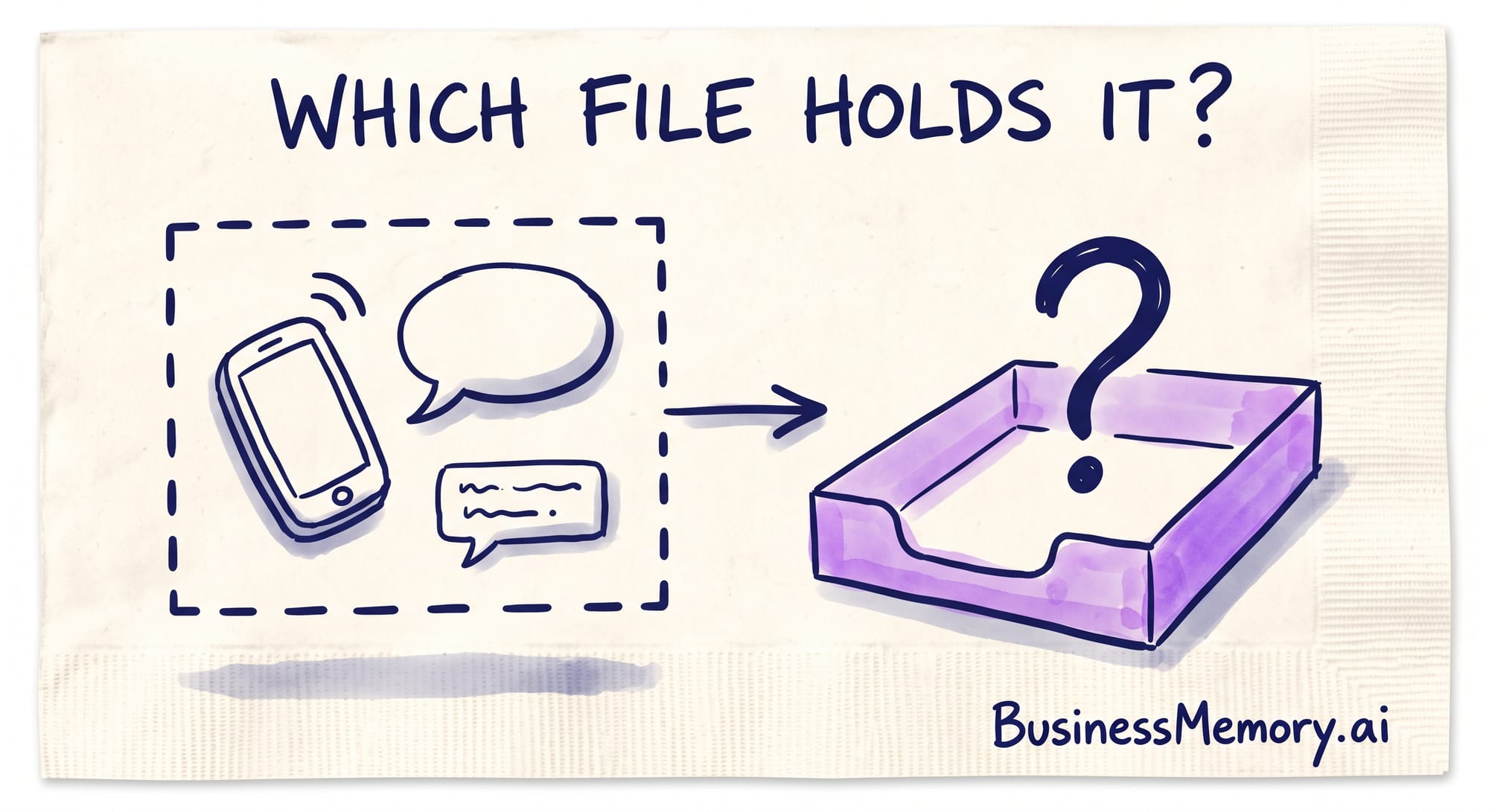
The price was agreed on a call. The change was accepted by text. The promise was made in a meeting. Which document would you upload? The deal happened — it was never told to any file.

Documents are what your business was told. What you need on demand is what your business did — and most of that never became a document at all.
What is the difference between chatting with your documents and asking your business?
A chat-with-your-documents tool answers from the files you uploaded. Asking your business means getting an answer from the record of what actually happened — what was agreed, paid, promised and decided — with the source behind it. The technique behind every document-chat tool has a name: retrieval-augmented generation, described in a 2020 paper — the model reads a specified set of documents, then answers. That is real and useful, for what somebody wrote down and uploaded. But most of what a business does never becomes an uploadable file: the price agreed on a call, the change accepted by text, the promise made in a meeting. A document tool cannot answer for what no document holds. A business memory exists to keep that record.
| "Chat with your documents" | Ask your business | |
|---|---|---|
| What it reads | The files you chose and uploaded | The running record: agreed, paid, promised, decided |
| What it answers well | What a document says | What actually happened, with the reference behind it |
| What it misses | Everything nobody wrote down and uploaded | Whatever never reached the record — the honest limit on any memory |
| Who feeds it | You, upload by upload | The memory files itself as work arrives |
| Teamwork | A folder per person or per project | The whole team asks the same record, in a shared vault |
What does a chat-with-your-documents tool do well?
Plenty — say it plainly.
These tools are amazing with the pages you give them. Hand one a forty-page contract and ask what the cancellation clause says, and it will find it faster than any of us. Manuals, reports, policies, a stack of PDFs — real work, done well.
Researchers have a name for what those pages hold. Back in 1991, Walsh and Ungson called it organizational memory — the stored history a company can bring to a decision.
But notice what all of it has in common: somebody had to write it down first.
What can a document tool never answer?
Take one ordinary deal from last month.
The price was agreed on a phone call. The extra work was accepted in a text. The deadline moved in a meeting. The invoice went out of your billing software, and on the way out you promised a discount on the next order.
Now open your document tool and try to upload that deal.
Which file holds it?
The quote is version one — the phone call changed it. The text lives on somebody's phone. The meeting had no minutes. The promise sits in an outbox.
The deal happened. It was just never told to any document.
So here is the line that separates the two tools: documents are what your business was told. The record a business needs is what it did.
And the honest line, on our side too: if a deal lives only in a call nobody noted, no memory holds it either. The difference is the habit the tool builds — a memory is fed as the work happens, not on upload day, so the record exists before anybody needs to prove it.
That is the job. A business memory is a private record of everything your business knows — what was agreed, paid, promised and decided — kept on your own computer as plain text files any AI can read, so you can ask anything and get the answer with the exact reference behind it.
Your documents can already talk. Now the rest of your business should get a voice.
Records were never meant for storage. Give your business a memory.
#BeBusinessSmart
Frequently asked questions
What is the difference between "chat with your documents" and a business memory?
A document-chat tool answers from the files you uploaded; a business memory answers from the running record of what the business did — what was agreed, paid, promised and decided — and names the source behind every answer. One holds what was written down for it. The other keeps the record itself.
What is retrieval-augmented generation in plain words?
It is the technique behind every "chat with your documents" tool, described in a 2020 research paper: instead of answering from memory alone, the model first reads a specified set of documents and then answers from them. It is real and useful — for whatever those documents contain.
Can a document-chat tool tell you what your business agreed to?
Only if that agreement became a document somebody uploaded. Prices agreed on calls, changes accepted by text, and promises made in meetings usually never become files at all — and a tool that reads documents cannot answer for what no document holds.
Who can read a business memory?
Everyone you hand that vault to. Sharing is per-vault, not per-person: the whole team works from the same record in a shared vault, and everyone in a vault sees that whole vault. Private records belong in a vault you do not share.
What is a business memory?
A business memory is a private record of everything your business knows — what was agreed, paid, promised and decided — kept on your own computer as plain text files any AI can read, so you can ask anything and get the answer with the exact reference behind it.