Claude's New Memory Remembers You — Not Your Business
Claude just got its biggest memory upgrade — and it is genuinely good. It remembers you. It still does not record your business. Here is the difference.

Anthropic just gave Claude its biggest memory upgrade yet, and it is genuinely good. It also leaves the most valuable record in your company with no owner.
Does Claude's new memory remember your business?
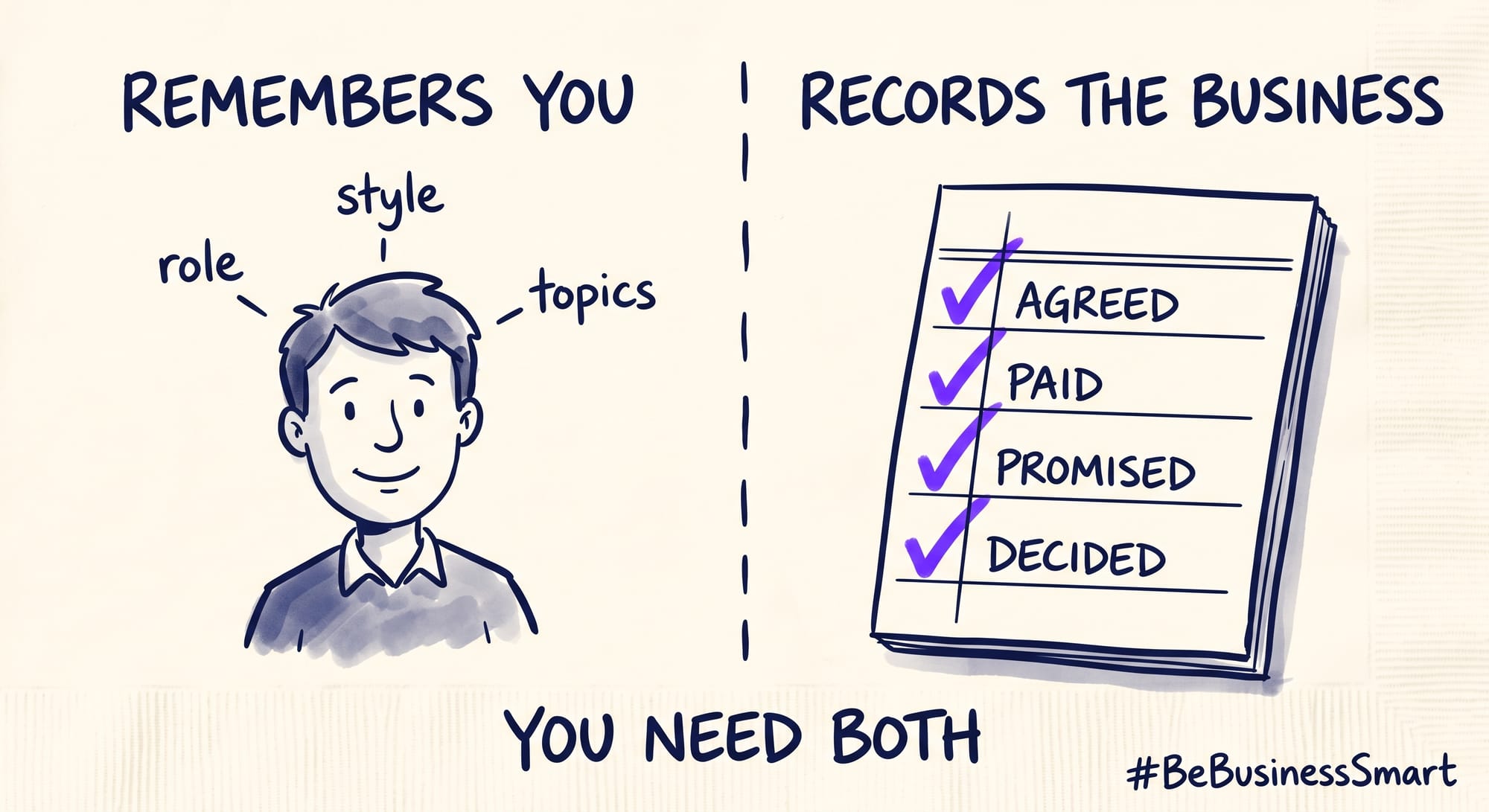
No. On August 25, 2026, Anthropic gave Claude one shared memory across its chat and its Cowork desktop agent. It remembers you — your role, your preferences, the topics you bring up often — and for the first time you can open every remembered topic, read it, edit it, or delete it. What it still does not hold is the record of your business: what was agreed, paid, promised and decided. Anthropic says so itself — memory is for the everyday context about you and how you work. A business memory is the other thing: that record, kept on your own computer as plain text files any AI can read, with the exact reference behind every answer.
One remembers the person. The other records the business. You need both.
What did Claude's memory update actually change?
A lot, and it is real progress.
Claude's memory now updates while you talk, instead of writing a summary at the end. What you tell it in chat follows you into Cowork, and what comes up in Cowork carries back to chat. Everything it remembers sits in Settings under Topics, where you can read each entry and change it or remove it.
It is careful, too. By default it does not store sensitive things — your health, your religion, your politics — unless you turn that on yourself.
This is an amazing step. For years, an AI's memory was a drawer you could not open. Now Claude hands you the drawer and lets you read every card in it.
So why am I writing this?
Because of what is on those cards.
| Claude's new memory | A business memory | |
|---|---|---|
| What it remembers | You — your role, your style, your recurring topics | The business — what was agreed, paid, promised, decided |
| Who writes it | Claude writes the entries; now you can edit them | A trained model files it into files you own |
| Where it lives | Your account, on Anthropic's servers | Your own computer, as plain text any AI can read |
| Behind each answer | A remembered note, no source | The exact reference — the real document |
| Who works from it | One account: you | The team, through shared vaults — everyone in a vault sees the whole vault |
Why is that not enough for a business?
Ask yourself what your company actually needs remembered.
Not that you prefer short answers. Not that you run a supply business.
What did we agree with the customer in March? What did we pay, and what did they promise back? Why did we decide against that supplier?
Claude's memory holds none of that, and honestly, it is not trying to. Anthropic's own help page draws the line: memory carries who you are and how you work, and each project keeps its own separate space for one piece of work.
There is a deeper difference too. A memory entry is a recollection. A record is proof. When money is on the line, you do not want the AI's recollection of the deal — you want the answer with the real document behind it.
Can Claude use a business memory?
Yes — and this is the part I love. Ours runs on Claude.
Anthropic's own documentation describes the mechanism: plain files kept on your machine, written as simple text — "Claude reads them at the start of every session." The new memory makes Claude remember you. Your own files make it remember your business. They are not rivals. One is the assistant knowing its owner. The other is the owner keeping the books.
Now the honest part, from our side. As of now, a business memory does not give per-person permissions inside one vault — everyone you invite to a vault sees the whole vault. Records meant for different people belong in different vaults. For a small team that line is simple, and you can see it.
And credit where it is due: letting you open the drawer and edit what the AI remembers is exactly the direction we want this whole field to go.
A business memory is a private record of everything your business knows — what was agreed, paid, promised and decided — kept on your own computer as plain text files any AI can read, so you can ask anything and get the answer with the exact reference behind it.
I use Claude every single day. I will keep using it. But I will never again let anyone's memory of my business — human or AI — be the only copy.
Records were never meant for storage. Give your business a memory.
#BeBusinessSmart
Frequently asked questions
Does Claude's new memory remember your business?
No. The memory Anthropic launched on August 25, 2026 remembers the person — your role, preferences and recurring topics — across chat and Cowork, and lets you read, edit or delete every topic. It does not hold the business record: what was agreed, paid, promised and decided. A business memory keeps that record on your own computer, with the exact reference behind every answer.
What changed in Claude's August 2026 memory update?
Claude's memory now works across both chat and the Cowork desktop agent, updates continuously during conversations instead of summarizing at the end, and is visible topic by topic in Settings, where any entry can be edited or deleted. Sensitive topics like health and politics stay out unless the user turns them on. It is on by default for Free, Pro and Max plans.
What is the difference between AI memory and a business memory?
AI memory is the assistant's recollection of its user — written by the AI, kept in your account on the vendor's servers, with no source behind an entry. A business memory is a record of the business itself — what was agreed, paid, promised and decided — kept on your own computer as plain text files any AI can read, and every answer points back at the exact document behind it.
Can Claude read a business memory?
Yes. Anthropic's own documentation describes the mechanism: plain text files kept on your own machine that Claude reads at the start of every session. Claude's built-in memory remembers the user; a business memory in owned files is how the same AI remembers the business.
Can a team share a business memory?
Yes, through shared vaults — the whole team works from the same company context. As of now sharing is per-vault, not per-person: everyone invited to a vault sees the whole vault, and records meant for different people belong in different vaults.