In 1841, Your Word Stopped Getting You Credit. Your Record Did.
After the crash of 1837, lenders stopped taking merchants at their word. Lewis Tappan built the first credit agency — and the money started flowing to businesses that could prove themselves. A business memory means the answer is minutes away.

After the crash of 1837, lenders stopped taking merchants at their word. Lewis Tappan built the first credit agency — ledgers of who kept clean, checkable records — and the money started flowing to the businesses that could prove themselves. Every loan and every investor still asks the same thing: can you show me the record? A business memory means the answer is minutes away.
Why do lenders and investors trust a record more than your word?
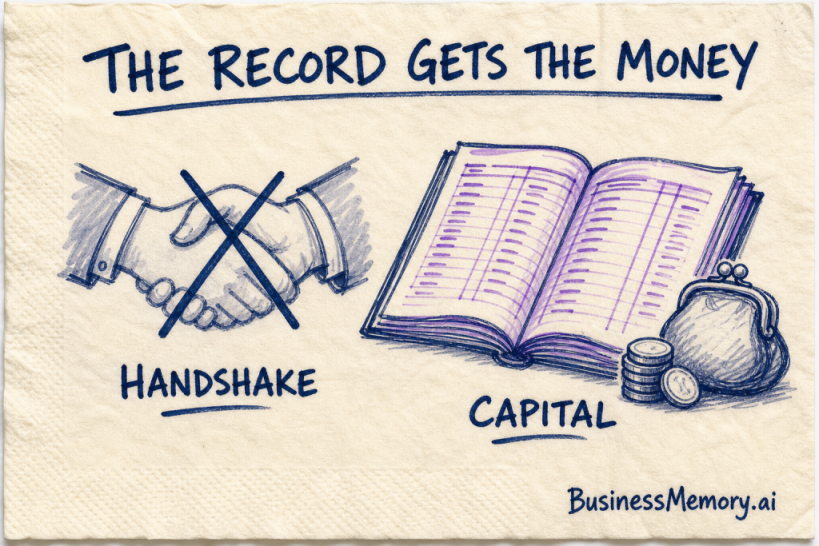
Because a record can be checked, and your word cannot. Anyone can say business is good; only a record can show it. So when money is on the line, the person handing it over trusts what they can check. America learned this the hard way. The crash of 1837 wiped out lenders who had trusted the handshake, so in 1841 a merchant named Lewis Tappan built the Mercantile Agency — the first big credit-reporting agency, later known as Dun & Bradstreet. It kept ledgers on which businesses had clean, checkable records. From then on, the money flowed to the ones who could prove themselves — not the ones who talked the best. A business memory is how you keep that record today: when a lender or investor asks you to show it, the answer is minutes away, not a week of digging.
| When someone is deciding whether to fund you | Answering from memory | Answering from your record |
|---|---|---|
| "Show me last year's numbers" | A week in a shoebox | Pull it up in minutes |
| "Prove this customer pays on time" | You think so | Here is every invoice and date |
| "What are you actually owed right now?" | A rough guess | The exact figure, with the proof |
| How it makes you look | Disorganized, risky | In control — worth the money |
What is a business memory, and what does 1841 prove?
1841 proves that money follows the record, not the talk.
Tappan did not lend anyone a dollar. He just kept the record of who was good for it — and that record decided who got funded. The business with clean books did not have to be the loudest or the biggest. It had to be the one that could be checked.
A business memory is that same record, kept for your own company — what you sold, what you are owed, what you paid, what you agreed. When the bank or the investor asks their one real question, you are not scrambling. You are showing. And because it is plain files, the AI you already use can pull the numbers and the proof together while you are still on the call.
What did Lewis Tappan build in 1841?
A way to trust a stranger's business from far away.
Tappan had been burned in the 1837 crash, when lenders handed out credit on reputation and got wiped out. So he built the Mercantile Agency: a network of local people — often lawyers and ministers — who reported back on whether a merchant paid his bills and kept his word. All of it went into one central ledger.
For the first time, a lender in New York could check a shopkeeper in Ohio without ever meeting him. The record traveled where the handshake could not. The agency grew into R.G. Dun and finally Dun & Bradstreet, still rating businesses today.
Why did the record beat the handshake?
Because a handshake feels the same whether or not you can pay.
A warm meeting tells a lender nothing they can count on. A record tells them everything: did you pay last time, are you owed money, is the business real. Once that could be checked, trusting the handshake alone became a bad bet — and the money moved to whoever could show the receipts.
That is the whole game of getting funded, then and now. It was never about being liked. It was about being checkable.
Why does this matter to your business now?
Because AI made the tools equal, but it did not change what a lender wants to see.
I see it every time an owner goes for a loan, a line of credit, or an investor. It always comes down to one question: can you show me the record? And most owners answer with a shoebox — a scramble through old statements, contracts, and inboxes, hoping the numbers line up.
Every owner can rent the same AI now. But an AI with nothing to read cannot answer for you. An AI reading your business memory can — it brings the number and the proof behind it, the moment you are asked.
That is the 1841 lesson, brought to your desk: the business that can show its record gets the money. The one that cannot, waits.
Now the honest part, so you hear it from me. This only works if the record is kept clean as you go. You cannot build a year of clean books the night before the bank meeting. The tool is cheap now; keeping the record straight, day by day, is the work.
So I'm committed to keeping mine clean — every sale, every bill, every agreement written down when it happens, ready to show.
A business memory is a private record of everything your business knows — what was agreed, paid, promised and decided — kept on your own computer as plain text files any AI can read, so you can ask anything and get the answer with the exact reference behind it.
Records were never meant for storage. Give your business a memory.
FAQ
What was the Mercantile Agency? The first large-scale credit-reporting agency, started by Lewis Tappan in New York in 1841 after the crash of 1837. It used local correspondents — often lawyers and ministers — to report whether a merchant paid his bills and kept his word, kept in one central ledger. It later became R.G. Dun and then Dun & Bradstreet, which still rates businesses today.
Why did credit start flowing to businesses with good records? Because a record can be checked and a handshake cannot. After lenders were burned in 1837 trusting reputation alone, they began trusting written, checkable records of who paid and who did not. The businesses that could be checked got the money; the ones that could only talk did not.
What does an 1841 credit agency have to do with my business? Every loan, line of credit, and investor conversation comes down to one question: can you show me the record? A business memory means your sales, invoices, and agreements are kept in one place with the proof, so you can answer in minutes instead of digging through a shoebox for a week.
How does a business memory help me get funded? It keeps the numbers and the proof together and current, so when a bank or investor asks, you show instead of scramble — last year's figures, what you are owed, which customers pay on time, each with the record behind it. It only helps if the record was kept clean as you went, not thrown together the night before.
What is a business memory? A business memory is a private record of everything your business knows — what was agreed, paid, promised and decided — kept on your own computer as plain text files any AI can read, so you can ask anything and get the answer with the exact reference behind it.