
Two Identical Ships. Only One Was "A1" — and It Was Worth More.
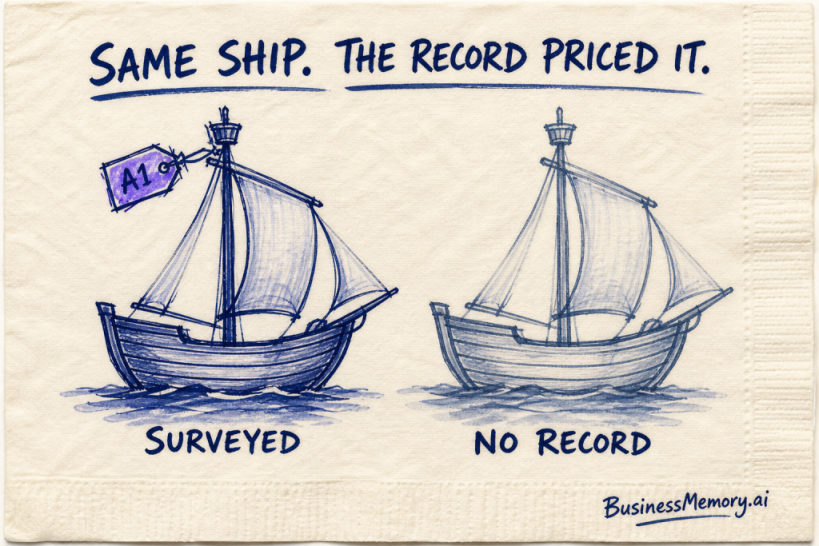
From 1764, Lloyd's Register surveyed ships and wrote down their condition. A ship rated "A1" fetched better insurance and a better price than an identical ship with no record. Same timber, same sails; the record priced them apart.

From 1764, Lloyd's Register surveyed ships and wrote down their condition. A ship rated "A1" — that is where the phrase comes from — fetched better insurance and a better price than an identical ship with no record. Same timber, same sails; the record priced them apart. When you sell your business, the buyer buys the record too — and a business memory is the survey that is always current.
Why does a documented business sell for more than an identical one?
Because the buyer is not really buying the shop — they are buying the record of it. Proof of what it earns, who the customers are, what is owed and what is promised. Two businesses can look the same from the street; the one that can show its record commands the price, and the one that cannot gets marked down for every unknown. Ships taught us this in 1764. Lloyd's Register began surveying vessels and writing down their condition, so the people insuring and buying them could tell a sound ship from a rotten one without climbing inside. A top ship was rated "A1" — first-class hull, first-class gear — and that record was worth real money. Same timber as the ship next to it; the survey priced them apart. A business memory is that survey for your company, always current — so when someone values your business, you are the A1 one.
| Two identical shops, one for sale | The one kept in the owner's head | The one with a record |
|---|---|---|
| What the buyer can see | "Trust me, it does well" | The books, the contracts, the history |
| The price | Marked down for every unknown | Full value — it is all provable |
| The risk to the buyer | High — they are guessing | Low — they can check |
| If the owner leaves | It walks out with them | It stays in the record |
What is a business memory, and what does "A1" prove?
"A1" proves that a record can be worth more than the thing it describes.
The ship did not get better when it was surveyed. The record just let a stranger trust it — and trust is what people pay for. A rotten ship with no papers and a sound ship with no papers looked the same and sold the same. The survey was the difference, and the difference was money.
A business memory is that survey for your company, and it never goes out of date because it is kept as you work. It holds what you sold, what you are owed, what you agreed and who your customers are — the exact things a buyer, a partner or an investor asks to see. And because it is plain files, the AI you already use can lay the whole record out the moment someone wants to check it.
What was Lloyd's Register, and where does "A1" come from?
It started in a coffee house.
In the 1760s, London merchants and the men who insured ships met at Lloyd's coffee house on Lombard Street. They needed a way to know which ships were sound before they bet money on a voyage. So they formed a society to survey ships and print the results, and in 1764 the first Register of Ships appeared.
It graded a ship in two parts: the hull got a letter, with A the best, and the gear — masts, rigging, sails — got a number, with 1 the best. The very best ships were "A1." The phrase caught on so completely that people still say "A1" today to mean top quality, usually without knowing it came from a shipping record.
Why did the record change the price?
Because you cannot see the inside of a hull from the dock.
A buyer or an insurer looking at two ships could not tell which one was sound and which was rotting below the waterline. The record could. So the ship with a good survey was safe to bet on, and the one without was a gamble — and people pay less for a gamble. The record did not change the wood. It changed what a stranger could safely believe about the wood.
Your business is the same. A buyer cannot see inside it from the outside. The record is the only thing that lets them believe what you say — and pay for it.
Why does this matter to your business now?
Because AI made the tools equal, but it did not change what a business is worth when you go to sell it.
I see it whenever an owner tries to sell, raise money, or bring in a partner. It always comes down to the same thing: show me the record. And most owners cannot, not really — the numbers are in their head, the contracts are in an inbox, the customer history is a feeling. So the buyer does what buyers have always done. They price the unknowns as risk, and the offer comes down.
Every owner can rent the same AI now. But an AI with nothing to read cannot make you A1. An AI reading your business memory can lay the whole survey out — clean, current, provable — the day a buyer asks.
That is the Lloyd's lesson, brought to your desk: the record does not just run your business. It is a large part of what your business is worth.
Now the honest part, so you hear it from me. A record only lifts the price if it was kept as you went. A survey thrown together the week before the sale looks exactly like what it is, and buyers have seen it a thousand times. The tool is cheap now; keeping the record current, year after year, is the work.
So I'm committed to keeping mine current — so that on the day I ever need to show what my business is worth, the answer is already A1.
A business memory is a private record of everything your business knows — what was agreed, paid, promised and decided — kept on your own computer as plain text files any AI can read, so you can ask anything and get the answer with the exact reference behind it.
Records were never meant for storage. Give your business a memory.
FAQ
What was Lloyd's Register, and when did it start? It grew out of Lloyd's coffee house in London, where merchants and ship insurers met in the 1760s. They formed a society to survey ships and record their condition, and printed the first Register of Ships in 1764, so people could tell a sound vessel from a rotten one before risking money on it.
Where does the phrase "A1" come from? From Lloyd's Register. It graded a ship's hull with a letter (A was best) and its gear with a number (1 was best), so the finest ships were "A1." The best rating first appeared in the 1775–76 edition, and the phrase passed into everyday English for top quality.
Why does a documented business sell for more? Because a buyer is really buying the record — proof of what the business earns, who its customers are, and what is owed. A business that can show all this commands full price; one that cannot gets marked down, because the buyer prices every unknown as risk. Same as two identical ships, one surveyed and one not.
How does a business memory raise what my business is worth? It keeps the record current as you work — the sales, contracts, customers and decisions a buyer, partner or investor asks to see — so the proof is ready and clean, not scrambled together before a sale. A record kept all along is believed; one thrown together at the end is discounted.
What is a business memory? A business memory is a private record of everything your business knows — what was agreed, paid, promised and decided — kept on your own computer as plain text files any AI can read, so you can ask anything and get the answer with the exact reference behind it.