Why the First Filing Cabinets Were Sold as Machines, Not Furniture
The companies selling the first filing cabinets refused to call them furniture. They called them machines — because standing paper on edge made records work.

The 1890s office learned that records can be a working part of the business, not a pile in storage. Small businesses are learning the same lesson right now with AI.
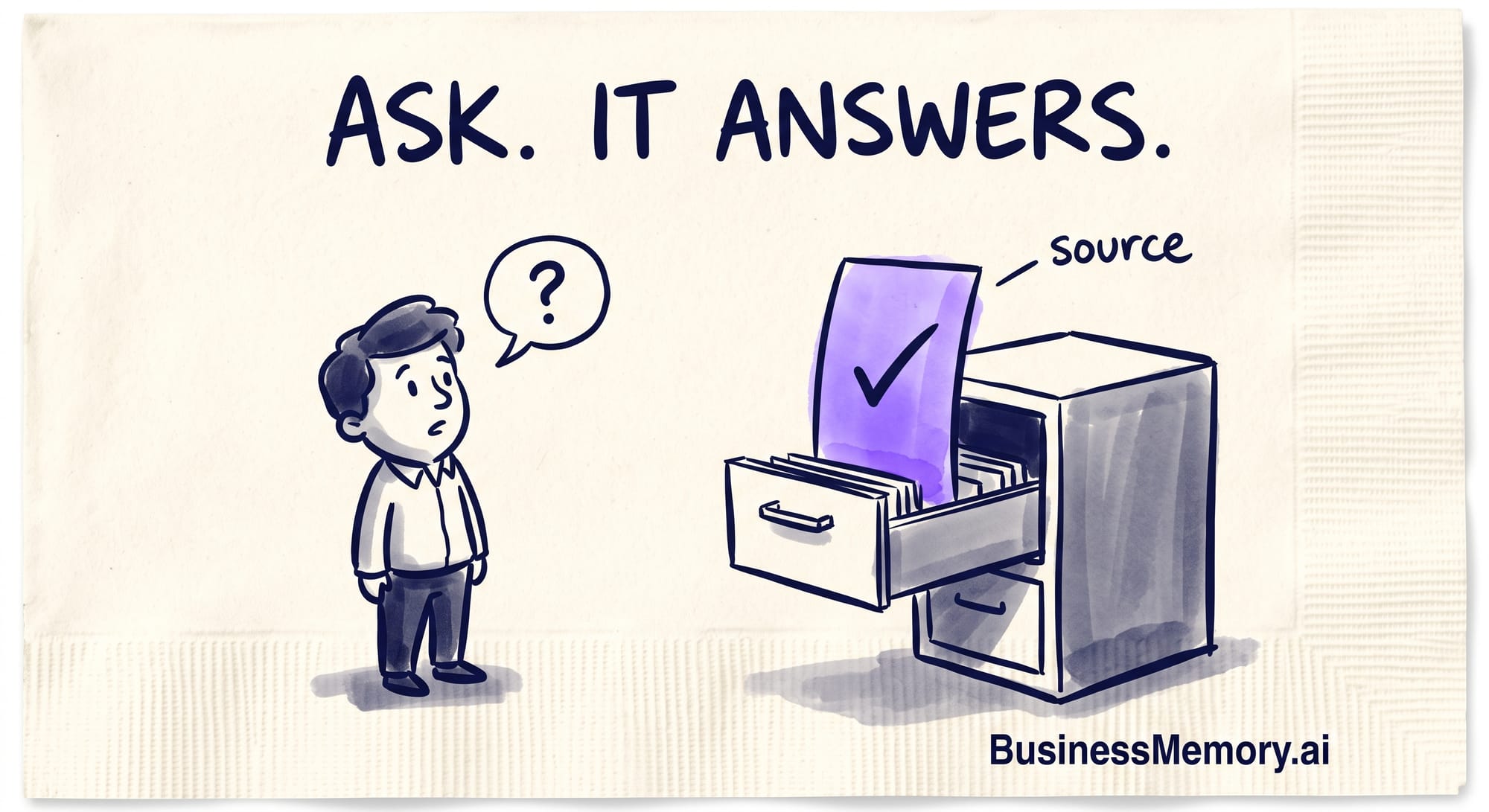
Why were the first filing cabinets sold as machines, not furniture?
The first filing cabinets were sold as machines because standing paper on edge made records a working part of the office. Historian Craig Robertson records in Places Journal that the industry called its cabinets "equipment," "appliances," and "machines" — never furniture. That was not one clever ad. It was how the whole industry talked. The accepted invention story starts with the Library Bureau, the Boston company Melvil Dewey founded in 1876 — though Robertson finds at least two inventors, and likely more lost to the record. And the machine talk was earned. A typical patent describes steel plates, rollers, slides and ball bearings, built so one drawer could open and close smoothly while holding 75 pounds of paper or more. Loose paper cannot stand up on its own. A drawer that held it upright, gathered by customer or subject, let paper do the work of paperwork.
This story has famous cousins, and here is how they compare:
| Robertson's cabinet | Forte's digital cabinet | Maguire's "build minds" | A business memory | |
|---|---|---|---|---|
| What it is | Vertical filing that made records a working part of the office | A digital cabinet for one person's notes | A mind, not a better cabinet | The record the business itself owns |
| Built for | The office | One person | One builder | The business |
| Who files | Guides, folders, clerks | You, then the search bar | AI agents | The memory files itself, on your computer |
| Who works from it | The office that shares the files | One mind | One mind, with agents | The team invited into the same vault |
What did standing paper on edge change?
The paper was the same paper. The change was how it stood.
Before the cabinet, letters were folded, put in envelopes, and pushed into pigeonholes — or copied into bound books, in date order, with thin indexes. Finding something meant asking the person who filed it.
Standing on edge, behind guides, every paper to, from, or about one customer sat together in one place.
One customer. One subject. One drawer.
Robertson is plain about the result: papers stored this way were easy to find and easy to reach. That is why the makers built the cabinet like a machine — those steel plates and rollers had one job, to let a full drawer open every time.
So the cabinet did not invent paper. It stood the paper up so the office could use it.
Who invented the filing cabinet?
Honestly, nobody can name one inventor — and I will not pretend to.
Robertson writes it straight: the filing cabinet had at least two inventors, and likely several others lost to the historical record. The Library Bureau proudly claimed the invention. Critical developments happened elsewhere.
So this page has no hero. The useful fact was never the inventor. It is the job the cabinet did.
Is a business memory just a filing cabinet with AI?
No. And the cousins of this story deserve their credit first.
In January 2023, Tiago Forte told this same history beautifully and took the cabinet toward a digital second brain — a cabinet for one person's notes. In March 2026, John Maguire pushed the opposite way: "Everyone is optimizing filing cabinets when they should be building minds." Both are amazing pages. Neither one lands on an owner's desk.
Because a business does not need a smarter cabinet or a dreaming mind. It needs something plainer: what was agreed, what was paid, what was promised, what was decided — standing where any AI can read it, with the source behind every answer.
And two honest lines, so you hear them from me. The old cabinets were not hard to search — papers on edge were easy to find, and that is the point of the machine, not a problem we are here to fix. And as of now, sharing in a business memory is controlled by vaults, not by person — everyone you invite to a vault sees that whole vault.
I see the same thing happening with AI in small businesses today.
Most of us bought the smart tool. Yet the answers are still sitting down — in an inbox, in a thread, in one person's head.
The cabinet makers knew the difference between furniture and a machine. Furniture holds things. A machine works.
Standing your records up, on your own computer, has a name. A business memory is a private record of everything your business knows — what was agreed, paid, promised and decided — kept on your own computer as plain text files any AI can read, so you can ask anything and get the answer with the exact reference behind it.
The first cabinets were sold as machines because the records had to work.
I'm committed to records that work — not storage.
Records were never meant for storage. Give your business a memory.
#BeBusinessSmart
Frequently asked questions
Were the first filing cabinets sold as furniture?
No. Historian Craig Robertson records in Places Journal that the industry called its cabinets "equipment," "appliances," and "machines" — not furniture. That was the whole industry's language, not one ad. The name was earned: standing paper on edge made records a working part of the office.
Did one person invent the filing cabinet?
No. Robertson finds the filing cabinet had at least two inventors, and likely several others lost to the historical record. The accepted version credits the Library Bureau, the Boston company Melvil Dewey founded in 1876, but critical developments happened elsewhere. This page names no single inventor.
Were filing cabinets hard to search?
No. Papers stored on edge, behind guides, gathered by customer or subject, were easy to find and easy to reach — that is exactly why offices adopted them. A business memory is not a fix for a cabinet that could not be searched; it is the same job — records that work — done for a business today.
Is a business memory a second brain or a digital filing cabinet?
No. A second brain is a digital cabinet for one person's notes. A business memory is the record the business itself owns: what was agreed, paid, promised and decided, kept on the owner's own computer as plain text files any AI can read, with the exact reference behind every answer, shared with a team by inviting them into the same vault.
Is a business memory a filing cabinet with AI?
No. The filing cabinet made paper records a working part of the office. A business memory does that job for a business today — a private record on the owner's own computer that any AI can read and answer from, with the source shown. It is not an old cabinet with a model dropped in the drawer.