AI Needs a Business Memory. Retail Learned That in 1974.
The first barcode scan did more than speed up checkout. It revealed the reliable business memory that today's AI systems still need.

The first barcode scan did more than speed up checkout. It revealed the foundation AI needs to understand a business: reliable records of what actually happened.
Why does AI need a business memory?
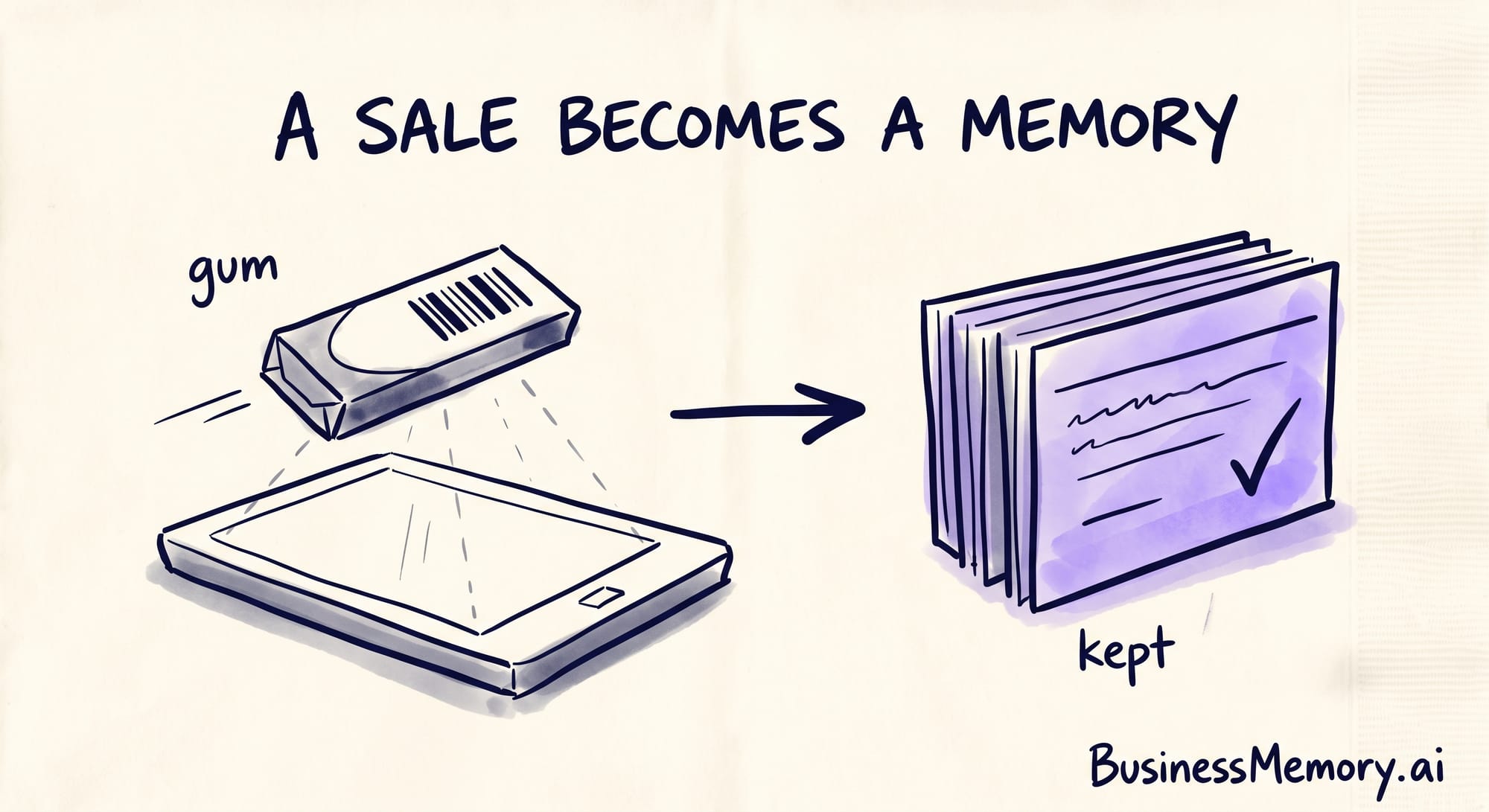
AI can only use what a business has recorded. If decisions, sales, promises, and exceptions disappear into inboxes or people’s heads, the AI may be intelligent, but the business memory behind it is incomplete. Retail learned this lesson long before AI. On June 26, 1974, a pack of Wrigley’s Juicy Fruit became the first UPC-marked item scanned at a retail checkout. The Universal Product Code gave each product a standard identity that a scanner and computer could record. Retailers could then build product-level purchase histories, see demand, and manage stock from evidence. The barcode did not make the store intelligent. It gave the store a reliable memory of what happened. Anyone building a business second brain today is solving the same first problem: turning daily work into consistent records AI can retrieve and use.
What changed when a sale became a record?
| Question | Before UPC scanning | After UPC scanning |
|---|---|---|
| What sold? | A total at the register and limited product-level visibility | A purchase record tied to a specific product |
| What remained? | Shelf checks and manual stocktaking | Inventory history and a clearer reorder signal |
| What could improve? | Checkout speed, pricing accuracy, and labor use | All three, using the same underlying record |
The barcode did not create the product, the customer, or the sale. It connected them in a form a computer could use.
That distinction matters. The visible benefit was a quicker checkout. The larger benefit was what happened after the customer left.
IBM’s history of the UPC says retailers had little visibility into inventory or consumer buying before the system. Once every purchase created a record, stores could see demand and align supply with it. A U.S. Census Bureau study found that early scanners also raised store labor productivity by about 4.5% in their first few years.
Faster work mattered.
But remembered work compounded.
How did a pack of gum make history?
The first thing a store ever remembered was a pack of gum.
Not a car.
Not a machine.
Juicy Fruit.
The story had started decades earlier. In 1948, graduate student Bernard Silver overheard a supermarket executive asking whether product information could be captured automatically at checkout. Silver brought the problem to Norman Joseph Woodland. Woodland later described drawing lines in the sand on a Miami beach, turning Morse code into a machine-readable pattern.
Woodland and Silver received their patent in 1952. Retail still had to wait for cheaper lasers, better computers, and an industry standard. The Universal Product Code arrived in 1973.
Then, on that June morning in 1974, cashier Sharon Buchanan scanned the gum for shopper Clyde Dawson at a Marsh Supermarket in Troy, Ohio. A small package was chosen because people had doubted whether a readable code could fit on one. The gum package from that first transaction now sits in the Smithsonian’s collection.
The scan took a moment.
The record lasted.
Why was the barcode bigger than checkout speed?
The original request sounded like a checkout problem: How can a store identify products automatically?
What retail got was a memory system.
A barcode gave the same product the same name wherever it moved. The scanner captured that name at the moment of sale. The computer kept the record. One transaction could now help answer the next inventory question.
That is the part worth carrying forward.
Technology becomes useful when it gives a business a better memory of what actually happened.
What does a 1974 barcode have to do with AI?
Here is why I keep coming back to this story.
The supermarket already had products, people, shelves, and cash registers. What it lacked was a stable identity for each item and a reliable record of each sale.
Many businesses are buying AI while their important decisions, promises, exceptions, and results still live in someone’s head, inbox, or chat history.
AI can produce an impressive answer.
But if the business did not record what happened, there is no business fact for it to retrieve.
Before asking what AI can do, I am asking a simpler question:
What does my business remember?
The first barcode did not make the store intelligent. It gave every sale somewhere to live.
A business memory is a private record of everything your business knows — what was agreed, paid, promised and decided — kept on your own computer as plain text files any AI can read, so you can ask anything and get the answer with the exact reference behind it.
What happened in your business today that will disappear by tomorrow?
#BeBusinessSmart