
Hudson's Bay Is Gone. Its Journals Are Still Being Read.
Hudson's Bay is gone. Its clerks wrote the weather for centuries. Those journals are still being read — a record that outlived the business.

For two centuries, clerks at Hudson's Bay trading posts wrote down the weather every day. The company closed its last store in 2025. People are still reading what those clerks wrote.
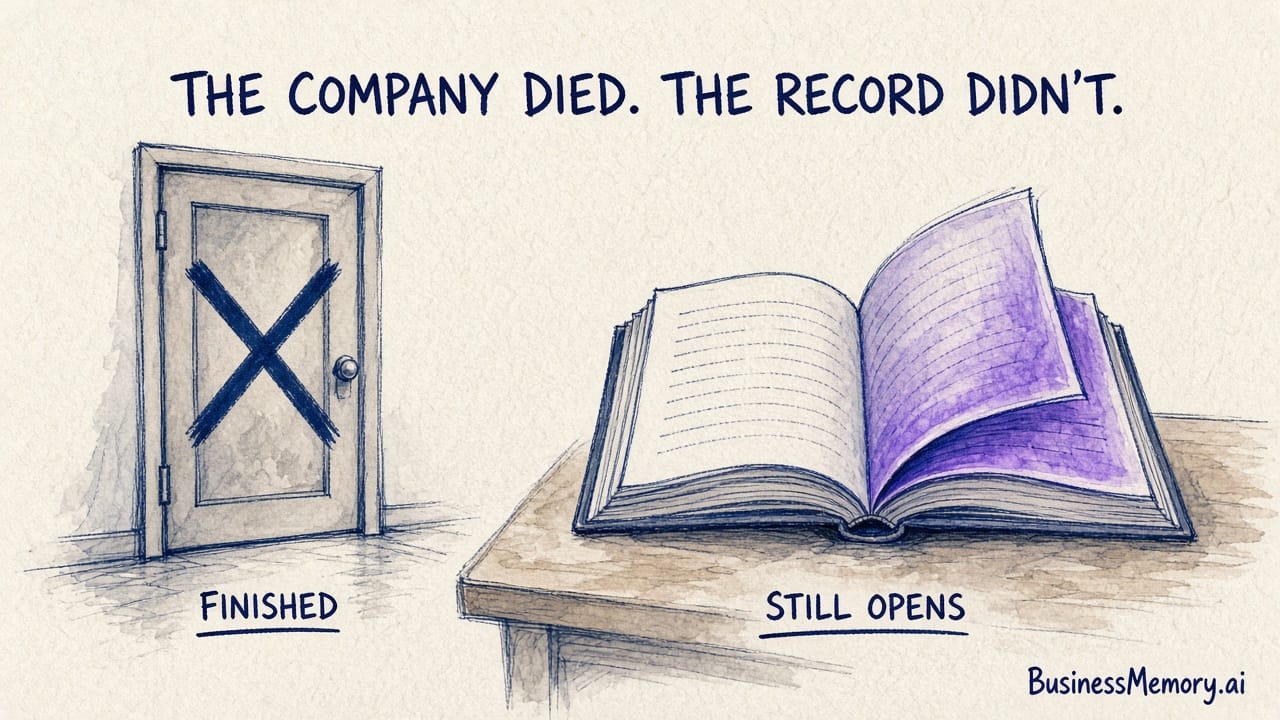
Why keep a record nobody has asked for yet?
Because the reason a thing gets written down is almost never the reason somebody reads it later.
The Hudson's Bay Company began in 1670 as a fur trading business. Its bosses in London ordered every trading post to keep a daily journal — the weather, the temperature, the wind, sunny or rainy, and anything else worth noting.
Those papers now fill more than 1,500 metres of shelving at the Hudson's Bay Company Archives in Winnipeg, Canada. UNESCO added the years 1670 to 1920 to its Memory of the World Register in 2007.
Nobody writing about the wind in 1780 was thinking about science.
Researchers read those same records for exactly that today. That is what a business memory is for: it keeps the reason, not only the result.
| A record kept for today | A record kept for later | |
|---|---|---|
| What it holds | What was decided | What was decided, and why |
| Who it serves | You, this week | Anyone asking in five years |
| What happens when you forget | You argue it all over again | Nothing. The note answers. |
| What a rival can copy | Nothing here is secret | They were not in your room |
| The Hudson's Bay version | Tell London how the post is doing | Show a scientist what the weather did in 1780 |
What did those clerks actually write down?
Small, ordinary things. Nothing anybody would call important.
The company's committee in London required its men to keep a daily record of what happened at the post. The archives describe what went in it: "the weather, the temperatures, the direction of the wind, whether it was sunny or rainy, solar eclipses, any activities of note."
That is a weather report from a man who was not a scientist, written for a boss who only wanted to know how the fur business was going.
The oldest thing in the whole collection is a minute book from 1671. A record of a meeting.
Why would anyone read a fur trader's notebook now?
Because before weather stations, the only weather record is the one somebody kept by hand.
Two researchers went through the logbooks kept on Hudson's Bay ships sailing between Britain and the bay. In the journal Polar Record, they describe using logbooks from 1760 to 1870 to recover weather for the North Atlantic before instruments were keeping score.
The clerk wrote it to do his job.
Somebody else read it two hundred years later for a job the clerk could not have imagined.
What happened to the records when the company died?
Nothing happened to them. That is the whole point.
Hudson's Bay asked a court for protection from its creditors on 7 March 2025. By 1 June every store in Canada had closed for good, and about 8,347 people lost their jobs. A business that opened in 1670 was finished.
The records were not touched. The company had handed them to the province of Manitoba in 1994, and a separate foundation pays to look after them, so the insolvency did not reach the archive.
The stores are gone.
The record still opens on a Monday morning.
What does this have to do with your business?
I see the same thing in small businesses today.
You keep what you must — invoices, receipts, the tax file. Those are for one reader, and you know who he is.
The rest lives in your head. Why you dropped that supplier. What you promised the customer to save the job. Why the price went up in March.
Then it is three years later, somebody asks why, and the whole thing gets argued out again from memory.
Now the honest part, and you should hear it from me. I cannot tell you which note will matter later. Nobody can. That is exactly the problem — the value shows up long after the day you would have decided it was worth writing.
Plenty of what my own businesses know is still only in my head. I am working on that.
So here is what I do now. When I make a real decision, I write down why, not only what — because the man who needs that reason is me, three years from here, with no memory of this week at all.
A business memory is a private record of everything your business knows — what was agreed, paid, promised and decided — kept on your own computer as plain text files any AI can read, so you can ask anything and get the answer with the exact reference behind it.
Records were never meant for storage. Give your business a memory.