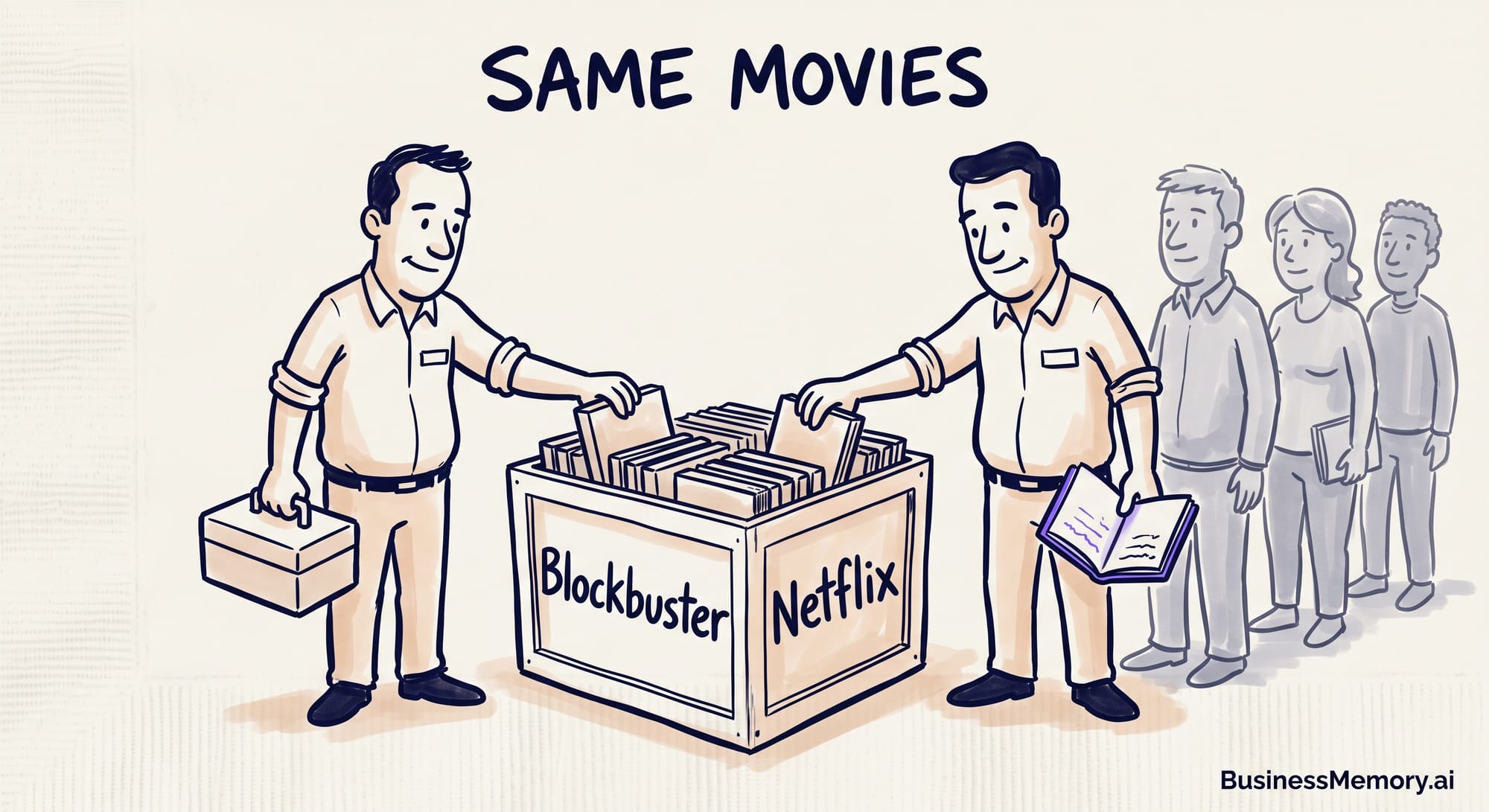
Netflix vs Blockbuster — same movies, one remembered its members
Both rented the same studios' movies. Both kept a database of their customers. One record was built to run stores. The other was built to know a person.

Every business can rent the same AI this year, so the record it reads is the only thing left that is yours — that is what a business memory is. Two video chains settled the argument thirty years before anyone typed a prompt, and their own filings show how.
Did Netflix beat Blockbuster because it had customer data and Blockbuster had none?
No. Both had it, and both said so in writing. Blockbuster's 2002 annual report describes "a fully integrated, comprehensive customer database," two years in the building, used to choose store locations, decide how many copies each store stocked, and cut marketing spend — and it had already licensed its U.S. customer database to MTV Networks for $18.0 million. Netflix's filings describe a different record: "more than 230 million movie ratings" collected from its users by 2002, over 525 million by 2004, feeding a service that built a personal store for every subscriber. Same studios. Same releases. One record was built to answer questions about stores. The other was built to answer questions about people. That gap is the difference between a database and a business memory — and it is the same gap that decides what AI can do for your business today.
| The question | Blockbuster's record | Netflix's record |
|---|---|---|
| Where should the next store go? | Yes — its filing names this use | No stores to place |
| How many copies of this release? | Yes — store by store | Yes — by what members had queued |
| What does this customer owe today? | Yes. That was the late fee | Nothing. No due dates, no late fees |
| What should THIS person watch next? | Not what it was built for | Yes — "more than 30 million personal recommendations daily" |
What is a business memory, and why does this story settle it?
Both companies had a database. Only one had a memory.
The difference is not size, and it is not software. A database answers questions about the business — where to put a store, how many copies to stock, what a customer owes. A memory answers questions about the work: what did we agree with this person, what did we promise them, what did they actually want.
Netflix built its version with engineers, over years, because in 1999 there was no other way to get one.
There is another way now. That is why this story matters to a business with eleven customers rather than eleven million — the record that used to take an engineering team is something you can keep, and ask, starting this week.
Now look at what each record was actually built to do.
What did Blockbuster actually do with its record?
It ran the stores with it.
Its own 2002 filing says every rental and every sale was scanned at checkout and sent, at the end of each day, into the customer transaction database. That database picked store locations. It fed the ad campaigns. It set how deep each store stocked a new release.
And then the company wrote a sentence I cannot stop reading. With the new database finished, Blockbuster said it hoped to "fully take advantage of the rich customer data that is generated from our business."
Hoped. That is 2002, from a company with 65 million customers and the data already in the building.
Meanwhile the other side was already spending theirs.
What was Netflix's record built to do?
Sell the whole library, not just the hits.
Netflix told investors that in the last quarter of 2002, more than 97% of its 14,500 titles were picked by somebody. Then it added the comparison, in the same paragraph: the average large video store carried fewer than 3,000 titles.
Read those two numbers next to each other, because that is the entire business.
A store can only sell what fits on a shelf a stranger will browse. A record of what each member had rated could go into the back of the library and hand a person something nobody would have handed them at a counter.
Same movies. Same studios. One of them could ask its own files a question about YOU.
So did the record kill Blockbuster?
Honestly, I can't tell you that, and neither can anybody else selling you a lesson about it.
Blockbuster had debt, leases and thousands of stores to feed. It filed for Chapter 11 on September 23, 2010, and there is no honest way to hang that on one database.
What I can show you is what the record it DID keep was worth. When Blockbuster ended late fees in January 2005, it told investors those fees would have brought in an estimated $400 million to $450 million in revenue and $250 million to $300 million in operating income that year.
That is what a record of the transaction pays. It is real money, and it only ever gets collected once, from a customer who is annoyed.
What does a video store have to do with AI in my business?
I see the same split every week now, and the tools are not the difference anymore.
Every owner can rent the same AI this year. Your competitor down the street has the identical model on the identical laptop. That part is level, the way the studios were level.
What is not level is what your business wrote down.
Most of us are keeping Blockbuster's record without meaning to. The accounting software knows exactly what every customer PAID. Nothing in the building knows what any of them WANTED, asked for twice, or was promised on a phone call in March.
Now the honest part, so you hear it from me: no tool fixes this by itself. If what happened never gets written down anywhere, an AI has nothing to read, and it will answer you in a confident voice about a business it has never met. The record has to be kept before it can be asked.
That is the whole reason to give your business one. A business memory is a private record of everything your business knows — what was agreed, paid, promised and decided — kept on your own computer as plain text files any AI can read, so you can ask anything and get the answer with the exact reference behind it.
The company with the shelf wrote down what you owed.
The company that is still here wrote down what you liked.
I'm committed to being the second one.
Records were never meant for storage. Give your business a memory.
Frequently asked questions
Did Blockbuster have customer data?
Yes, a great deal of it. Blockbuster's 2002 annual report describes a two-year effort that produced "a fully integrated, comprehensive customer database," fed nightly by the point-of-sale system in its stores, and used to select store locations, plan copy depth and target marketing. It had also licensed its U.S. customer database to MTV Networks for $18.0 million. The popular version of this story — that Blockbuster had no data — is not what its own filings say.
What was the real difference between Netflix's and Blockbuster's customer records?
What each one was built to answer. Blockbuster's record answered questions about stores: where to open one, how many copies to stock, where to spend the ad budget, and what a customer owed in late fees. Netflix's record answered a question about a person: what should this member watch next. By 2002 it held more than 230 million member ratings and drove "more than 30 million personal recommendations daily."
How much was Blockbuster's late-fee revenue?
Blockbuster ended late fees on January 1, 2005. In its annual report for 2004, it projected that those fees would otherwise have contributed an estimated $400 million to $450 million in revenue and roughly $250 million to $300 million in operating income for the full year 2005. Widely quoted figures for earlier years, such as "$800 million in 2000," do not appear in the filings and are not used here.
When did Blockbuster file for bankruptcy?
Blockbuster filed for Chapter 11 on September 23, 2010, the same day it announced a pre-arranged recapitalization plan. Many things went wrong at once — debt, store leases, a shrinking rental market — and no single database explains it.
What is a business memory?
A business memory is a private record of everything your business knows — what was agreed, paid, promised and decided — kept on your own computer as plain text files any AI can read, so you can ask anything and get the answer with the exact reference behind it.