Every Doctor Kept His Own Notes. Then Mayo Gave the Team One Chart.
Each Mayo doctor once kept his own notebook on you, so the team could never answer as one. In 1907 one shared chart fixed it. Your team needs the same.

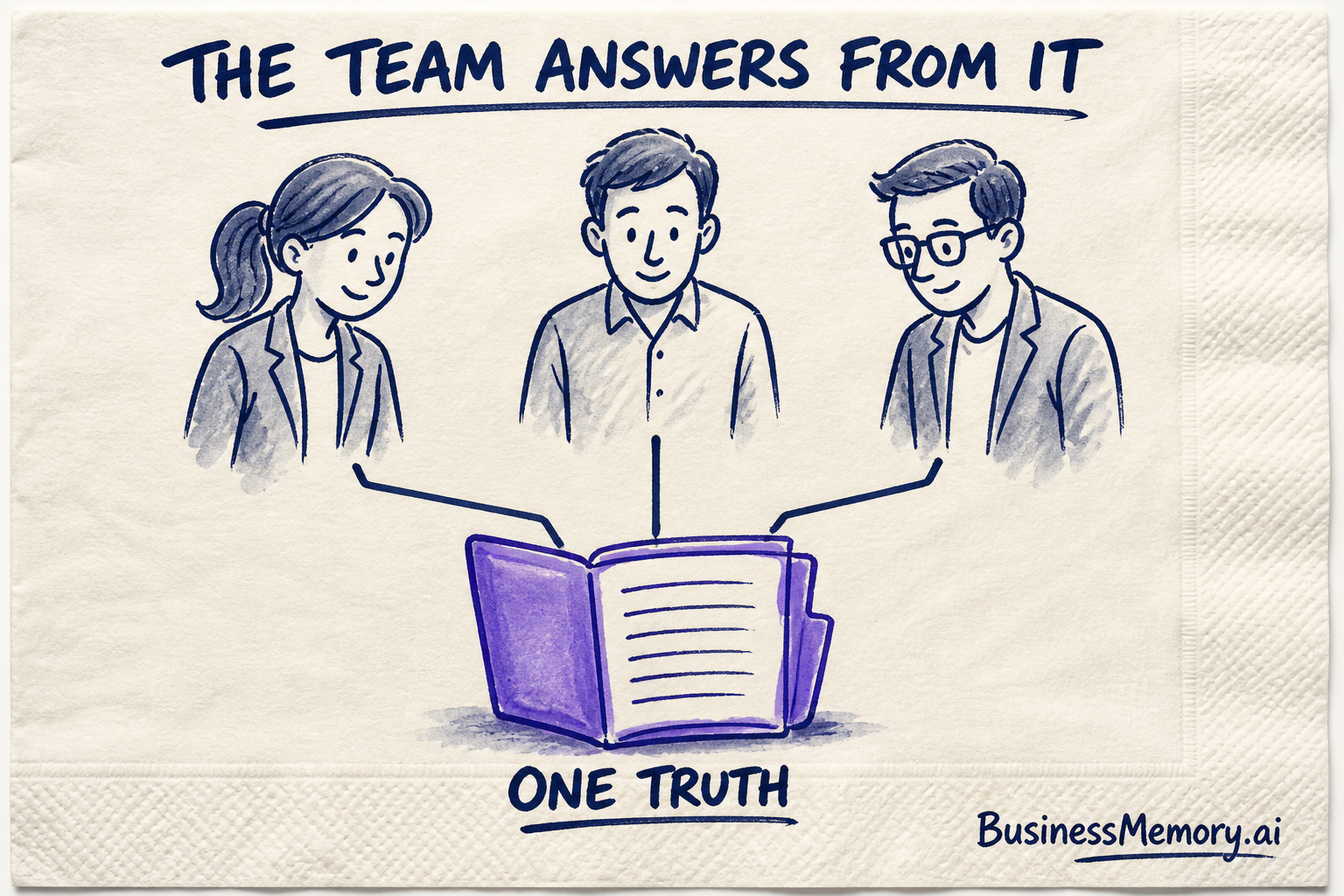
Before 1907, each Mayo doctor kept a patient's story in his own private notebook, so the team could never answer as one. Dr. Henry Plummer gave every patient one shared chart any doctor could read — and modern team medicine was born. In most businesses the deal still lives with whoever closed it. A shared business memory is that one chart for your whole team, and any AI can read it too.
How do you get your whole team working from the same information?
You keep one shared record that everyone reads and everyone adds to — instead of each person keeping their own notes in their own head. When the record belongs to the team and not to one person, anyone can pick up where anyone else left off.
Mayo Clinic proved it in 1907. Before then, each doctor kept his own notebook on a patient, so the story was scattered across a dozen desks and often lost.
Dr. Henry Plummer, with his secretary Mabel Root, gave every patient one shared file that followed them to every doctor. Mayo's own leaders say that one move — a team working from shared records — is what made Mayo great.
A business memory is that shared file for your company: one record your whole team reads and feeds, and any AI can read it too.
| Each person keeps their own notes | One shared record | |
|---|---|---|
| When the person who closed the deal is out | Nobody else knows the details | Anyone can pick it up |
| A new hire | Starts blind | Reads the record and catches up |
| Your AI | Sees only one person's scraps | Reads the whole team's record |
| When someone quits | Their knowledge walks out the door | It stays — it was shared |
| Mayo's version, 1907 | A dozen scattered notebooks | One chart the whole team answers from |
What is a business memory, and what does Mayo prove?
Mayo proves that a team is only as strong as the record it shares.
The doctors did not get smarter in 1907. They started reading from one chart instead of a dozen private notebooks. That is the whole change, and it built one of the greatest hospitals in the world.
A business memory is that same shared chart, shrunk to your business — one record everyone on the team reads and adds to, so the company knows something instead of just the people in it.
It is different from handing one person's AI a memory. This is the team sharing one.
And because it is plain files, the AI you already rent can read the whole thing, not just what one person happened to type into a chat.
What did Mayo Clinic actually change in 1907?
It stopped letting the record belong to one doctor.
Before Plummer, each office kept its own ledger, and one patient's history could be spread across a stack of them. If your doctor did not have his notebook in front of him, your story started over.
Plummer and Mabel Root gave every patient one number and one file, kept in one place, that any doctor treating you read first. The record was no longer one physician's private property — it belonged to the patient and was open to everyone caring for them.
From patient number one in 1907, that same system has carried more than 8 million people.
It looked like boring paperwork. It was the floor the whole place was built on.
Why did one shared chart matter so much?
Because it let the team act as one instead of as a dozen strangers.
A nurse, a lab worker, the next doctor — all of them could read the same record and add to it.
Nobody had to track down the one person who knew. Nobody started from zero.
The knowledge stopped walking out the door every time a person did.
That is the quiet power of a shared record: it turns a group of busy people into a team that remembers the same things.
Why does this matter to your business now?
Because AI made the tools equal, but it cannot fix a team that does not share what it knows.
I see the same thing happening with AI in small businesses today. Every owner can rent the same AI for a few dollars a month.
But in most small businesses, every person is still their own ledger.
The deal lives with whoever closed it. The price lives in one person's head. The promise lives in a text nobody else ever saw.
So when that person is out, or quits, the business forgets — and the AI you rent only ever sees one person's scraps, never the whole team's record.
A shared business memory is the Plummer move for your company: one record the whole team reads and feeds, and the AI reads it too.
Now the honest part, so you hear it from me. This only works if the team actually shares it, and the sharing has to be simple.
With a business memory it is: one shared record everyone you invite can open and see — plain and visible, not locked person by person.
For a small team, that is exactly what you want. Keep the private things in a record you do not share.
So I'm committed to keeping ours shared — every deal, price and promise in one record my whole team works from, not trapped in one person's head.
A business memory is a private record of everything your business knows — what was agreed, paid, promised and decided — kept on your own computer as plain text files any AI can read, so you can ask anything and get the answer with the exact reference behind it.
Records were never meant for storage. Give your business a memory.
Frequently asked questions
What did Dr. Henry Plummer change at Mayo Clinic in 1907?
He replaced the separate notebooks each doctor kept with one shared patient record. With Mabel Root, he gave every patient one number and one file, kept in a central place, that any doctor treating them read first.
The record belonged to the patient and the team, not to one physician — and Mayo's leaders credit that shared-record idea as a foundation of the clinic's success. The system has carried more than 8 million patients since 1907.
What does a 1907 patient chart have to do with my business?
In most small businesses, each person keeps the important details in their own head — the deal with whoever closed it, the price with whoever quoted it. When that person is out or leaves, the business forgets.
A shared business memory is Plummer's move for your company: one record the whole team reads and adds to, so the company remembers, not just the people in it.
How is this different from giving AI a memory of your business?
Giving your AI a memory is about the tool reading your record before it answers. This is about the whole team sharing one record in the first place.
They fit together: when the team keeps one shared record, both your people and your AI can read it — instead of each working from scraps.
Can a whole team really share one business memory safely?
Yes, and the sharing is simple to see: everyone you invite to the shared record can read all of it.
That is the right fit for a small team — plain and visible, not locked person by person. Anything private goes in a separate record you do not share.
What is a business memory?
A business memory is a private record of everything your business knows — what was agreed, paid, promised and decided — kept on your own computer as plain text files any AI can read, so you can ask anything and get the answer with the exact reference behind it.