The Price of Having No Business Memory
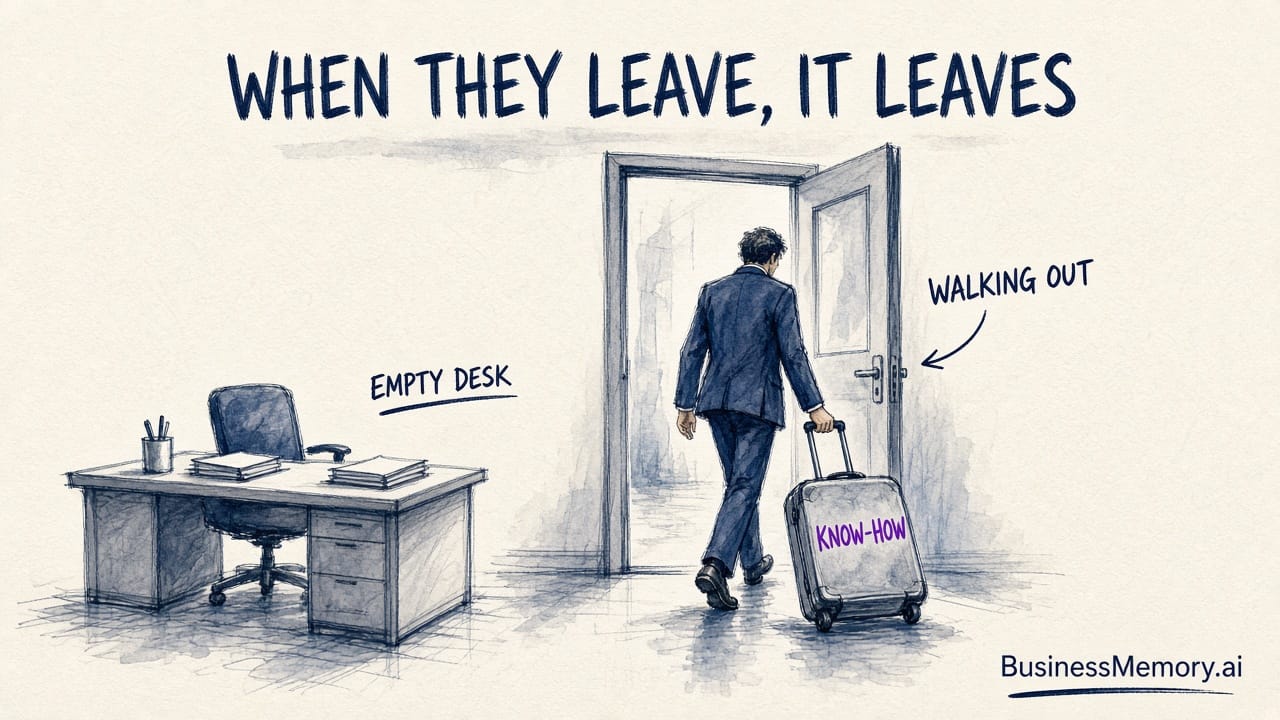
Without a business memory, a company pays to rebuild knowledge it already owns. One factory needed 12 weeks to relearn how its own machine worked.

Forgetting does not always look like a missing file. Sometimes it means paying specialists to discover how your own business works before a person or AI can improve it.
What is the price of having no business memory?
The price is not only the time people spend searching. It is paying to rebuild knowledge the business already owns. A Solvetronix case study describes a filling-line control system written in a special form of Pascal in 2001. The developer could not be reached. There was no documentation, no source code and no working software to edit it. Only a program on a 3.5-inch floppy disk remained. Specialists needed 12 weeks to recover about 40% of the source code, map 87 control signals, rebuild 12 stages in the machine's work and identify 34 safety rules. The machine still worked. The business had simply lost the knowledge a person or AI would need to understand and change it.
| The question | Without a business memory | With a business memory |
|---|---|---|
| How does this work? | Watch it and work backward | Read the current record |
| Why was it built this way? | Guess | Read the reason and the decision |
| What can safely change? | Test the live system | Start from known limits |
| What happens when the expert leaves? | Hire someone to rediscover it | Hand the next person the record |
What was left on the floppy disk?
The machine was running.
That made the problem easy to miss.
But three new products were planned, and the control system needed to change. The old developer was gone. The software used to work on it had expired. The source code was missing.
The only thing left was the program the machine could run.
People could not read it.
So the company had to work backward from the machine itself.
According to Solvetronix's published case study, specialists read the floppy with a special tool and recovered about 40% of the code.
Then they watched the machine.
They mapped 87 control signals.
They rebuilt 12 operating states.
They found 34 safety conditions, including some that were active but had never been written down.
Twelve weeks later, the business had its first complete record of how the control system worked.
It owned the machine the whole time.
What it did not own was an answer.
Why did the business have to reverse-engineer itself?
Reverse engineering means working backward from something that already exists to understand how it works.
That is useful when studying an old machine or another company's product.
It is painful when the thing you are studying is your own.
The filling line had stored one kind of memory: behavior. It knew which signal came next. It knew when to stop. It knew every safety condition.
But that memory was trapped inside a program nobody could read.
The business could use the system. It could not explain it, change it or hand it to the next person.
That is the difference between owning a machine and owning the knowledge inside it.
What does a business lose when it loses its memory?
First, it loses speed.
The next change begins with discovery instead of work.
Second, it loses judgment.
People can see what the system does, but not why earlier choices were made.
Third, it loses safety.
A hidden rule can still protect the business today, but nobody knows what will break if that rule is removed tomorrow.
Finally, it loses the value of past work.
The company already paid someone to learn the machine, build the logic and test the limits. When that knowledge disappears, the company pays for the lesson again.
Organizational memory includes both a company's records and the knowledge held by its people. But memory only helps when it can be found and used.
A floppy in a drawer is storage.
An answer the next person can use is memory.
What should a business memory keep?
Not every email. Not every draft. Not every thought.
It should keep the things the business would otherwise have to pay to discover again:
- The current way the work is done.
- The reason important choices were made.
- The versions that failed, and why.
- The limits, exceptions and safety rules.
- The source behind every answer.
That record must stay close to the work. It must be updated when the work changes. And the people and AI tools using it must be able to show where an answer came from.
Otherwise, the business is only building a newer drawer.
Can a business memory prevent every loss?
No.
A memory cannot keep what never reaches it. It cannot pull thirty years of judgment out of somebody's head after that person has already left. And an old record can be just as dangerous as no record if nobody marks what changed.
The work must leave a trail while it happens.
That is why the lesson from the floppy disk is bigger than documentation.
The operator did not need a nicer manual after the expert disappeared.
It needed the knowledge to survive before the disappearance.
The cost of having no business memory is paying to reverse-engineer a business you already built.
That is a terrible way to buy your own knowledge twice.
A business memory is a private record of everything your business knows — what was agreed, paid, promised and decided — kept on your own computer as plain text files any AI can read, so you can ask anything and get the answer with the exact reference behind it.
Records were never meant for storage. Give your business a memory.
#BeBusinessSmart
Frequently asked questions
What is the price of having no business memory?
The price is the cost of rebuilding knowledge the business already paid to create. It appears as repeated discovery, delayed changes, hidden risks and specialists hired to work out how the company's own systems operate.
What is a business memory?
A business memory is a private record of what a business knows — including what was agreed, paid, promised and decided — kept in readable files so people and AI can ask questions and check the source behind each answer.
What is reverse engineering?
Reverse engineering is working backward from an existing product, machine or process to understand how it works when its original design or source is not available.
Can documentation replace an experienced employee?
No. Some judgment stays with the person. But a current record can preserve the process, the reasons behind decisions, the exceptions and the failed approaches, so the next person does not begin from zero.
What should a business record first?
Start with knowledge that would be hardest or most expensive to rebuild: the current process, why it works that way, its limits, the person who can confirm it and the source behind the answer.
The price of having no business memory is not only searching for old information. It is paying to rebuild knowledge the business already bought.