
The Romans Wrote Down the Recipe. A Business Memory Writes Down the Work.
The Romans wrote down what went into their concrete. A half-built house in Pompeii showed how. A business memory keeps the how.

Subheadline: Roman concrete still stands after two thousand years, and the book with its ingredients survived too. Yet the step that made it last was found in a half-built house in Pompeii, not in the book. A business memory keeps that kind of record: the work itself, written down while it happens.
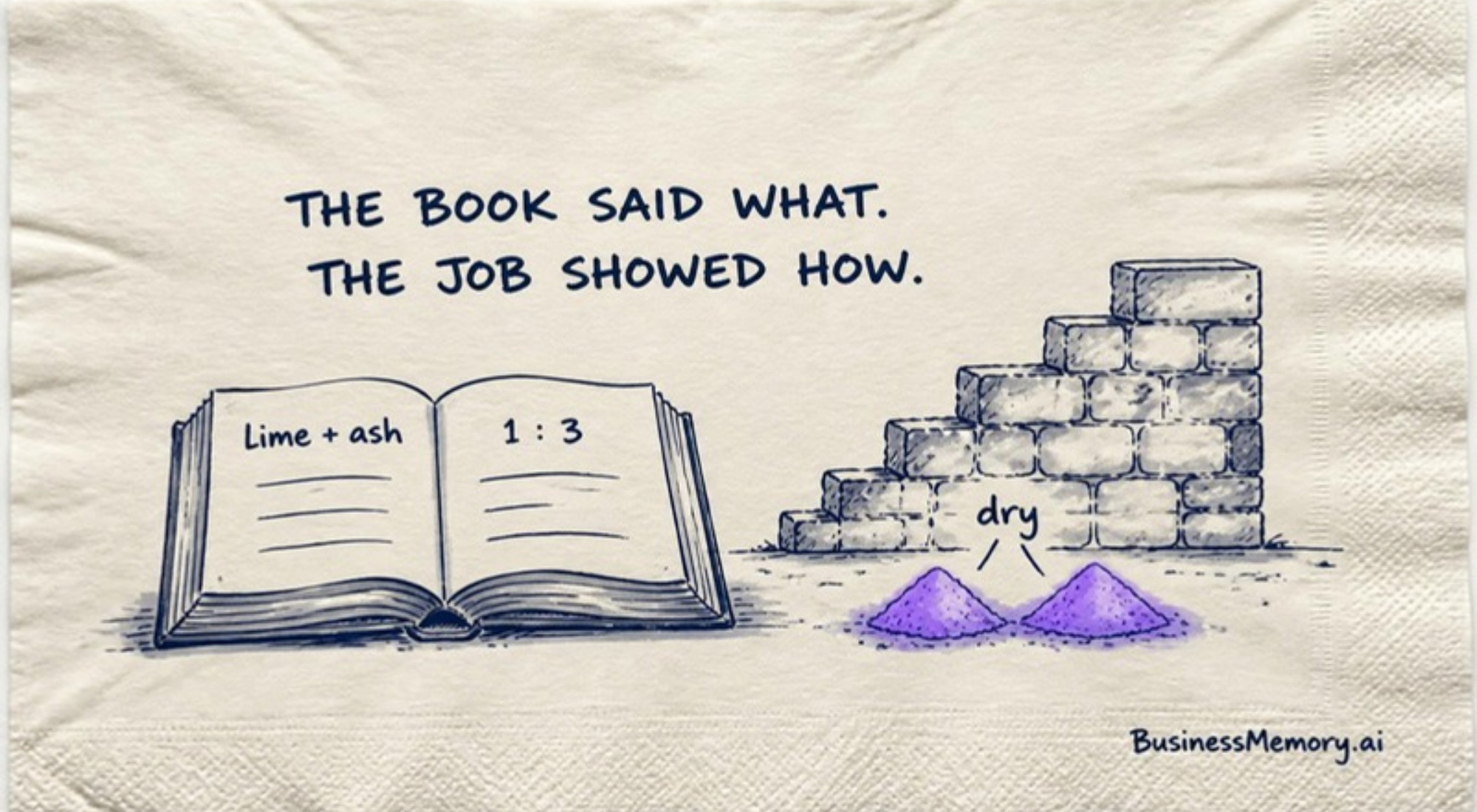
Why does a business need a business memory if the steps are already written down?
Because the write-up usually holds the what, and the work holds the how.
Roman concrete is the proof. Around 25 BC the Roman architect Vitruvius wrote down what went into it: lime and volcanic ash, so many parts of each. That book survived. So did the buildings.
Yet in 2023 an MIT-led team wrote that the exact order of the steps "remains ambiguous". And in December 2025 a half-built house in Pompeii showed the builders mixed the lime and the ash dry first, and added the water after.
A business memory keeps that second kind of record: the work itself, written down while it happens, so the how is still there when the person who knew it is gone.
What did the Romans write down about their concrete?
They wrote the shopping list.
Vitruvius gave the amounts. One part lime to three parts volcanic ash for a building. One to two for work under water. He also described the order, the way he understood it: water into the lime first, to make a paste, then the rest.
That is the first thing to look at. A tidy page, written by a smart man who respected the craft.
Now look at what it did not save.
For a long time, people who studied old Roman concrete saw little white lumps of lime inside it. They were brushed off as sloppy mixing, or poor material.
They were neither.
In January 2023, the MIT team showed those lumps help the concrete last. When a tiny crack opens and water gets in, the lumps dissolve, and the lime fills the crack again. The concrete heals itself.
And the team traced the lumps to a hot step: the lime going in as quicklime, not as a wet paste.
So the most important step of the whole recipe was the one the book did not make plain.
What did the half-built house in Pompeii show?
Here is the second thing to look at.
In AD 79, Vesuvius buried Pompeii. Inside one house, the workers were in the middle of a job. Walls half built. Repairs half done. And on the floor, piles of dry lime and volcanic ash, already mixed, waiting for water.
Nobody wrote those piles up. Nobody tidied them for a reader. They were just the job, stopped mid-step.
And they answered the question the book could not. Dry first. Water after. The heat of that step is what leaves the white lumps behind.
Even the lead researcher, Admir Masic of MIT, was careful about it: "Having a lot of respect for Vitruvius, it was difficult to suggest that his description may be inaccurate." He says the book may simply have been misread. Nobody is calling Vitruvius a liar.
But see what it took. The book survived. The buildings survived. The how still had to come out of a house the workers never finished.
The book told us what went in. The unfinished job told us how it was done.
Why does a business lose the how when a good person leaves?
I see the same thing in small businesses today.
When somebody good leaves, most owners are not worried about the list. The suppliers, the prices, the quote template — that part is written somewhere.
What goes with him is the order.
He calls the customer before he sends the price, not after. He checks one thing on the truck before it leaves. He knows which supplier you never call on a Friday.
He never wrote it down. To him it was not worth writing. It was just how you do the job.
And honestly, if you asked him to write it down on his last day, you would get Vitruvius: a tidy page, written from memory, missing the step that mattered.
What can a business memory keep, and what can it not?
Now the honest part, so you hear it from me.
A business memory cannot read a man's hands. If a step only ever lived in somebody's head, and nothing about it was ever written anywhere, no tool will find it after he is gone.
What it does keep is the work while the work is happening. The email he sent. The quote, and the change the customer asked for on Tuesday. The note typed at four in the afternoon. The answer he gave when a client called confused.
That is the Pompeii pile, not the book. Not a summary written later. The job, caught in the middle.
So I'm committed to keeping my business that way — the work written down the day it happens, while the person who knows the how is still in the building.
A business memory is a private record of everything your business knows — what was agreed, paid, promised and decided — kept on your own computer as plain text files any AI can read, so you can ask anything and get the answer with the exact reference behind it.
Rome wrote down the ingredients. Your business can keep the work.
Records were never meant for storage. Give your business a memory.
BeBusinessSmart
Questions people ask
Why does a business need a business memory if the steps are already written down?
Because a written procedure usually holds the what — the parts, the amounts, the list — and leaves out the how, the order and the small checks people do by habit. A business memory keeps the work itself as it happens: the emails, quotes, changes and notes. So when the person who knew the how leaves, the record of how the job was really done stays.
Was the recipe for Roman concrete lost?
Not the ingredients. The Roman architect Vitruvius wrote them down around 25 BC, and his book survived. What stayed unclear was the working method, the order the materials went in. Key parts of it were only worked out in the 2020s: in 2023 an MIT-led team showed the hot step with quicklime, and in 2025 a building site in Pompeii showed it in place.
What did the Pompeii building site show about Roman concrete?
A house in Pompeii was under repair when Vesuvius erupted in AD 79. The workers left piles of dry lime and volcanic ash, already mixed and waiting for water. Research published in December 2025 showed the Romans mixed these dry first and added water after — a different order from the one Vitruvius is usually read as giving.
Can a business memory capture what is only in an employee's head?
No. If a step was never written anywhere, nothing can recover it once the person is gone. What a business memory does is keep everything the work leaves behind, day by day — the messages, the quotes, the changes, the notes — so the next person, or the next AI, reads what was really done instead of guessing.