Search Gives You Somewhere to Look. Your Business Memory Gives You the Answer.
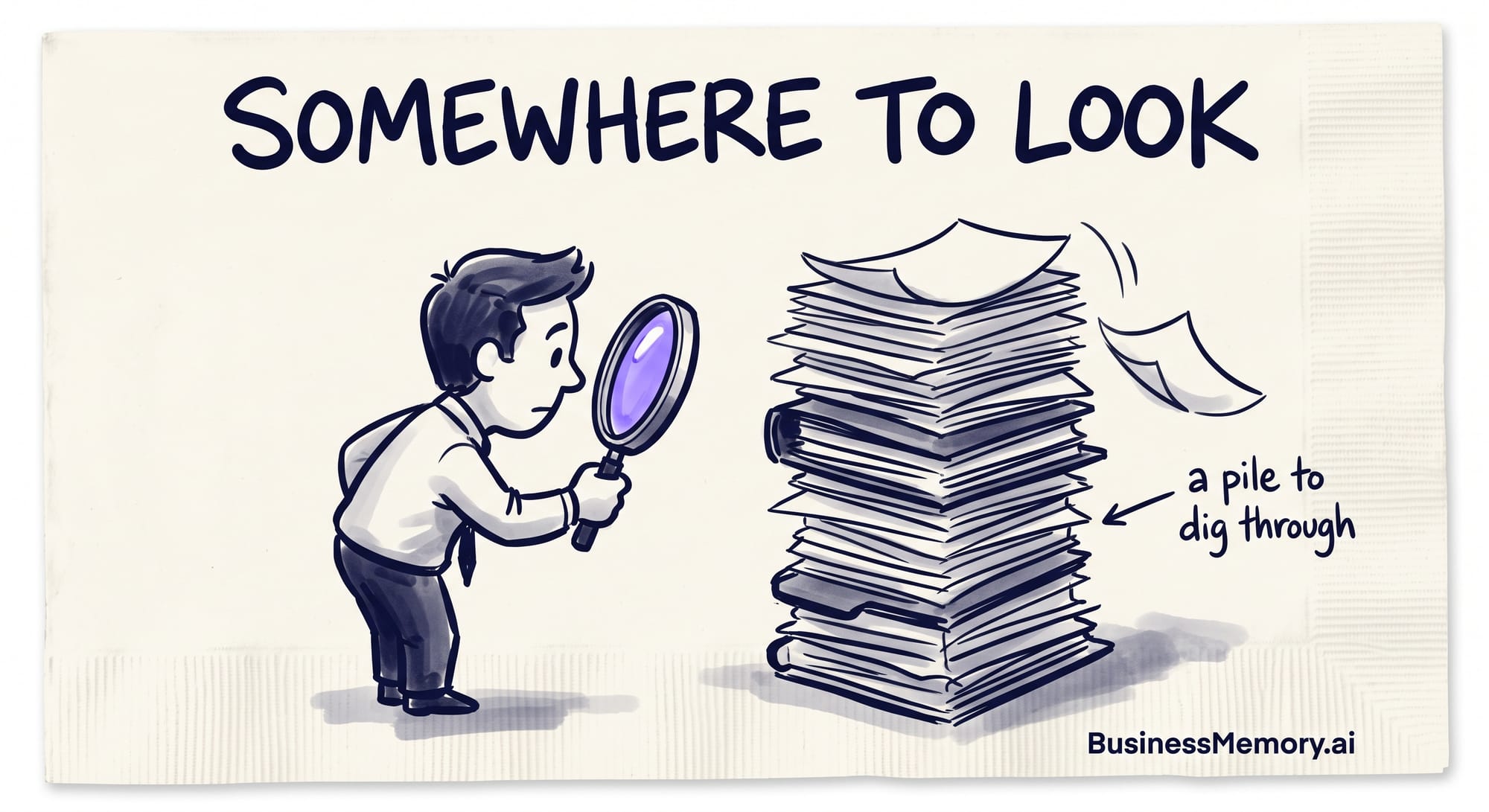
Same question, two screens. One gave me nine results. The other gave me the answer — and the file it came from. That line underneath is the whole argument.

Searching your own business is a skill you should not need anymore. Asking is better — but only when the answer arrives with the file it came from.
What is the difference between searching your files and asking your business memory?
Searching returns places to look. Asking returns the answer itself — and what comes attached to it is the whole difference. A search hands you a list of files and leaves every judgment to you. A business memory hands you one answer and names the file it came from, so you can check it in seconds. That receipt is not decoration. When the Tow Center at the Columbia Journalism Review tested eight AI search tools across 1,600 queries, they returned the wrong source more than 60% of the time — and rarely declined to answer at all. An answer with no verifiable source is a step down from ten links, because links make you check and a confident sentence does not. Asking beats searching only when the answer carries its receipt.
| Searching | Asking | |
|---|---|---|
| What comes back | A list of places the answer might be | The answer itself |
| Who does the checking | You, every time, before you can act | You, once, on the source it names |
| What it needs from your files | Only that they exist somewhere | That they are readable and kept up to date |
| What it costs when it is wrong | Time — you keep digging | A decision — you already acted on it |
| What makes it safe | You never stopped reading the source | The answer names the source, every time |
Why is searching your own business outdated?
Because searching was never a skill you wanted. It was a tax.
You typed a word you hoped somebody had used two years ago. You opened four files that were nearly right. You found the number, and then you had to remember which folder held the newer version.
The machine can do all of that now. Retrieval-augmented generation — the technique behind every "ask your documents" tool since the 2020 paper that named it — reads your material first and then answers from it, instead of answering from memory. And the newest tools go further: they read a folder of plain files you keep on your own computer at the start of every session.
So the digging is over. That part is real, and it is worth celebrating.
What is the catch nobody selling this will tell you?
When you searched, YOU were the fact-checker. Every list of links forced you to open the source and read it.
Asking removes that step. The answer arrives finished, in a calm sentence, and the calm is the danger.
That is what the Tow Center numbers actually mean. The tools were not just wrong — they were wrong confidently, and they almost never said "I am not sure."
So the question to ask any tool that answers for your business is not "is it fast?"
It is: can you show me where that came from?
How I saw the difference on my own screen
Same morning. Same question. Two screens.
I asked the first one where a supply job stood.
It gave me nine results. Two spreadsheets, an old email, a scan of a delivery note, and a folder from last year.
Somewhere in there was the answer. Finding it was my job.
I asked the second one — my own memory, the one built out of my own files.
It gave me one paragraph. The date, the open items, what was agreed.
And under it, one line: the name of the file it read.
I opened that file. It was right.
That was the moment the argument ended for me. Not the speed. The line underneath.
A search makes you check everything. A good answer shows its work, so you only check once.
Now the honest part, because you should hear it from me. An answer is only as good as what the memory is allowed to read. If your files are a mess, or half your business lives in somebody's head, asking will not save you — it will just be faster at telling you what little it knows. The memory has to be fed before it can answer.
But once it is, you stop hunting for your own business.
That is what a business memory is for. A business memory is a private record of everything your business knows — what was agreed, paid, promised and decided — kept on your own computer as plain text files any AI can read, so you can ask anything and get the answer with the exact reference behind it.
Search gives you somewhere to look.
Give your business a memory that gives you the answer.
#BeBusinessSmart
Frequently asked questions
Is searching your own files still necessary in 2026?
Not for most questions. Tools that read your documents and answer from them have replaced the hunt — you ask in plain words and get the answer instead of a list of places to look. Search still matters when you want to browse rather than ask, or when you are looking for a document rather than a fact.
What should an AI answer include if you are going to act on it?
The source. An answer that names the file, page or record it came from can be checked in seconds; an answer without one has to be trusted blind. Columbia Journalism Review's Tow Center found AI search tools returned the wrong source in more than 60% of 1,600 tests, and rarely refused to answer — which is why the receipt matters more than the wording.
What is the difference between enterprise search and a business memory?
Enterprise search indexes what your company already has and returns ranked results. A business memory keeps the record itself — what was agreed, paid, promised and decided — on your own computer, files new material as it arrives, answers in plain words, and names the source of every answer.
Does asking work if your files are disorganised?
Only up to a point. An answer can only be as complete as the material the memory is allowed to read. If the deal lives in one person's head or in an unfiled inbox, no tool can answer for it. The filing has to happen first — which is why a business memory files as it goes, instead of waiting for a clean-up day.
Takeaway — A business memory is a private record of everything your business knows — what was agreed, paid, promised and decided — kept on your own computer as plain text files any AI can read, so you can ask anything and get the answer with the exact reference behind it.