Why the Best AI Second Brain Apps Are NOT a Business Memory
Notion, Obsidian, Logseq, Mem, Reflect, Capacities and Tana are real tools. Not one of them is a business memory — and the lists never say so.

Notion, Obsidian, Logseq, Mem, Reflect, Capacities and Tana are real tools. Not one of them is a business memory — and the lists never say so.
Are the best AI second brain apps a business memory?
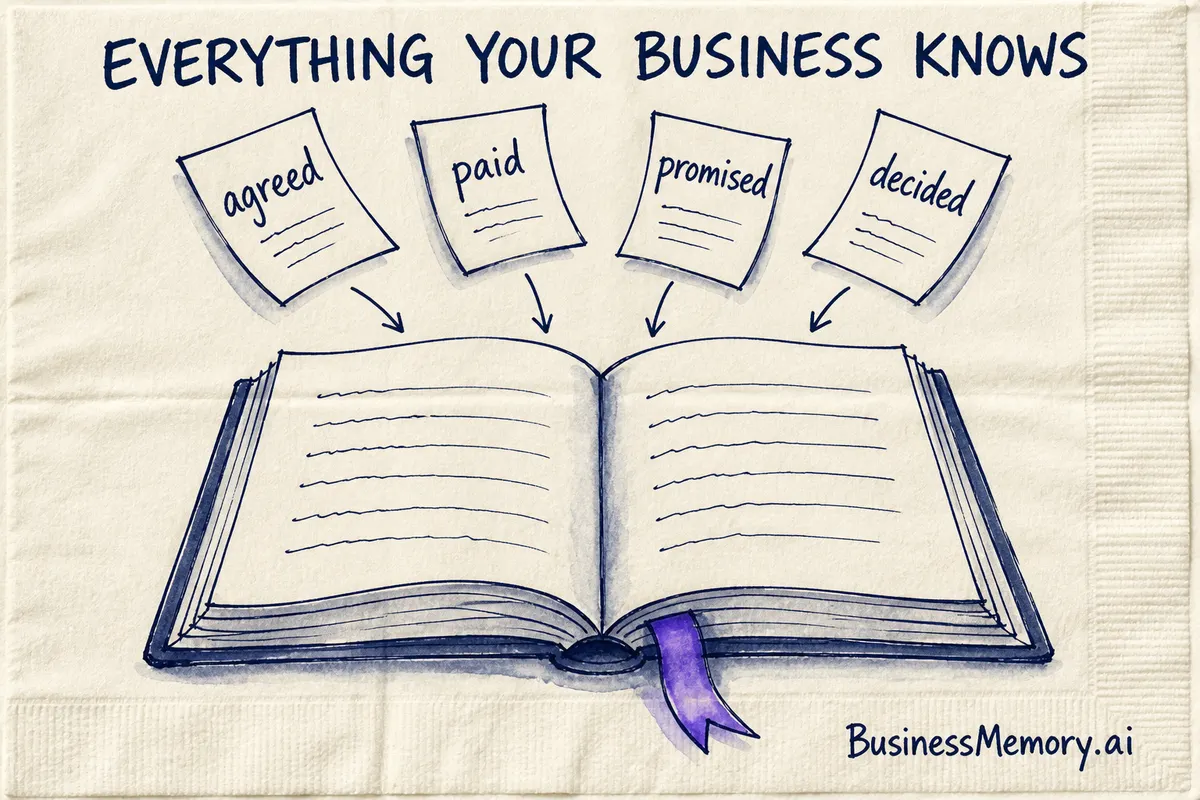
No. The best AI second brain apps in 2026 — Notion, Obsidian, Logseq, Mem, Reflect, Capacities and Tana — are real tools, and a July 2026 list treats the first five as personal note vaults you fill in and keep current yourself. A business memory is a different thing: a private record of everything your business knows — what was agreed, paid, promised and decided — kept on your own computer as plain text files any AI can read, so you can ask anything and get the answer with the exact reference behind it.
A second brain app holds one person's notes. A business memory records the business itself — the deal, the payment, the promise, the decision — and every answer points back at the document behind it. Each of these apps are amazing and do real work. But none of them is a business memory. The lists never say that.
What are the best AI second brain apps in 2026?
The 2026 lists agree on the field: Notion, Obsidian, Logseq, Mem, Reflect, Capacities, and Tana. Most are personal knowledge vaults you keep up yourself. Tana is the one that puts itself forward as a shared brain that builds itself.
Most owners who pick one are not careless. They picked a real tool.
| A second brain app | Business memory | |
|---|---|---|
| What it holds | Your notes and ideas | What was agreed, paid, promised, decided |
| Who fills it | You keep the vault current — Tana says it builds itself | It files itself |
| Where it lives | Usually the app's cloud; Obsidian and Logseq keep local files | Your own computer, as plain text any AI can read |
| How you check an answer | You trust your own notes | The exact reference behind every answer |
| Built for | One mind — Notion and Tana also sell team versions | The business and its owner |
| Sharing | The vendor's accounts and permissions | A shared vault the team works from — everyone in that vault sees the whole vault |
What is each second brain app actually built for?
Here is what each one is, in its own words.
Notion says "Bring everything into one system of record." That is the pitch: a database-first workspace where you build the system. It is a place to build a record. It is not a record of the business, kept on your computer.
Obsidian stores your notes "locally as plain text Markdown files" on your own device — files you can open, even offline. Sync and Publish are paid add-ons, and a team can share a vault through Sync. Local files, and a real strength. Still one person's notes.
Logseq is the other local-first outliner on that same 2026 list — another personal vault you keep up yourself.
Reflect says "Reflect builds you a second brain," with notes end-to-end encrypted so "no one else can read them (not even us)." It is built for one person, and it says so.
Mem calls itself "Your AI chief of staff." It holds your notes, meetings and ideas and organizes them for you. It is not a record of the business, kept on your computer.
Capacities builds "for individuals who think for a living. No collaboration chaos." Notes are "connected objects, not files buried in folders." It is hosted in Europe, and you can take your files out — "full export, no lock-in." Made for you, not your team.
Tana is the closest in ambition. It is an AI meeting platform whose "context graph is your organizational memory" — the brain builds itself from the work you already do rather than from notes you file by hand, and the graph can be exported. Its older outliner is a different product. But that organizational memory lives on Tana's platform. A business memory lives on your computer.
Tana and Notion already sell tools a team can use. A team second brain is still not a business memory.
What does a business memory do that these apps do not?
An AI reads the whole internet, not your company. Every AI you buy starts from zero, because there is nothing of yours for it to read.
A business memory is that record — on your computer. It records the business itself, not one person's notes. It files itself, so nobody has to become the librarian. It lives on your own machine as plain text any AI can read, not in someone's cloud. And every answer comes back with the exact reference behind it, so you are never guessing about your own business.
All these amazing apps are real. I will not pretend they are not.
But they are built for a different job — one mind's notes, kept up by that mind. A business memory is built for the business and kept up by a trained model to keep up.
What are a business memory limits?
Now the honest limit on our side.
As of now, a business memory does not give per-person permissions inside one vault. Everyone you invite to a vault sees the whole vault. For a small team that line is simple, and you can see it. It is not enterprise permissions. I would rather say so.
We built it for our own businesses first — our record lives in our own files, on our own machines. We are in a private beta now: a few seats at a time, by invitation.
A business memory is a private record of everything your business knows — what was agreed, paid, promised and decided — kept on your own computer as plain text files any AI can read, so you can ask anything and get the answer with the exact reference behind it.
A note app is not a memory.
#BeBusinessSmart
Frequently asked questions
What are the best AI second brain apps in 2026?
The 2026 lists name Notion, Obsidian, Logseq, Mem, Reflect, Capacities and Tana. A July 2026 list treats Notion, Obsidian, Logseq, Mem and Reflect as personal note vaults you keep up yourself, while Tana positions itself as a shared brain that builds itself from the work you already do.
Is a second brain app the same as a business memory?
No. A second brain app holds one person's notes and ideas, kept current by that person. A business memory records the business itself — what was agreed, paid, promised and decided — on your own computer as plain text any AI can read, and every answer points back at the exact reference behind it.
Which second brain apps keep your notes on your own computer?
Obsidian and Logseq are local-first — they store plain-text or Markdown files on your own device. Most of the others keep your notes in the app's cloud. A business memory also keeps its record on your own computer, as plain text any AI can read.
Can a second brain app work for a team?
Notion and Tana sell team versions, and Obsidian can share a vault through its paid Sync add-on. A team second brain is still not a business memory. With a business memory, sharing is per-vault: everyone you invite to a vault sees the whole vault.
Who can read a business memory?
Everyone you hand that vault to. Sharing is per-vault, not per-person — the whole team can work from the same company context in a shared vault, and private records belong in a vault you do not share.