Why Watching Toyota Was NOT Enough for GM
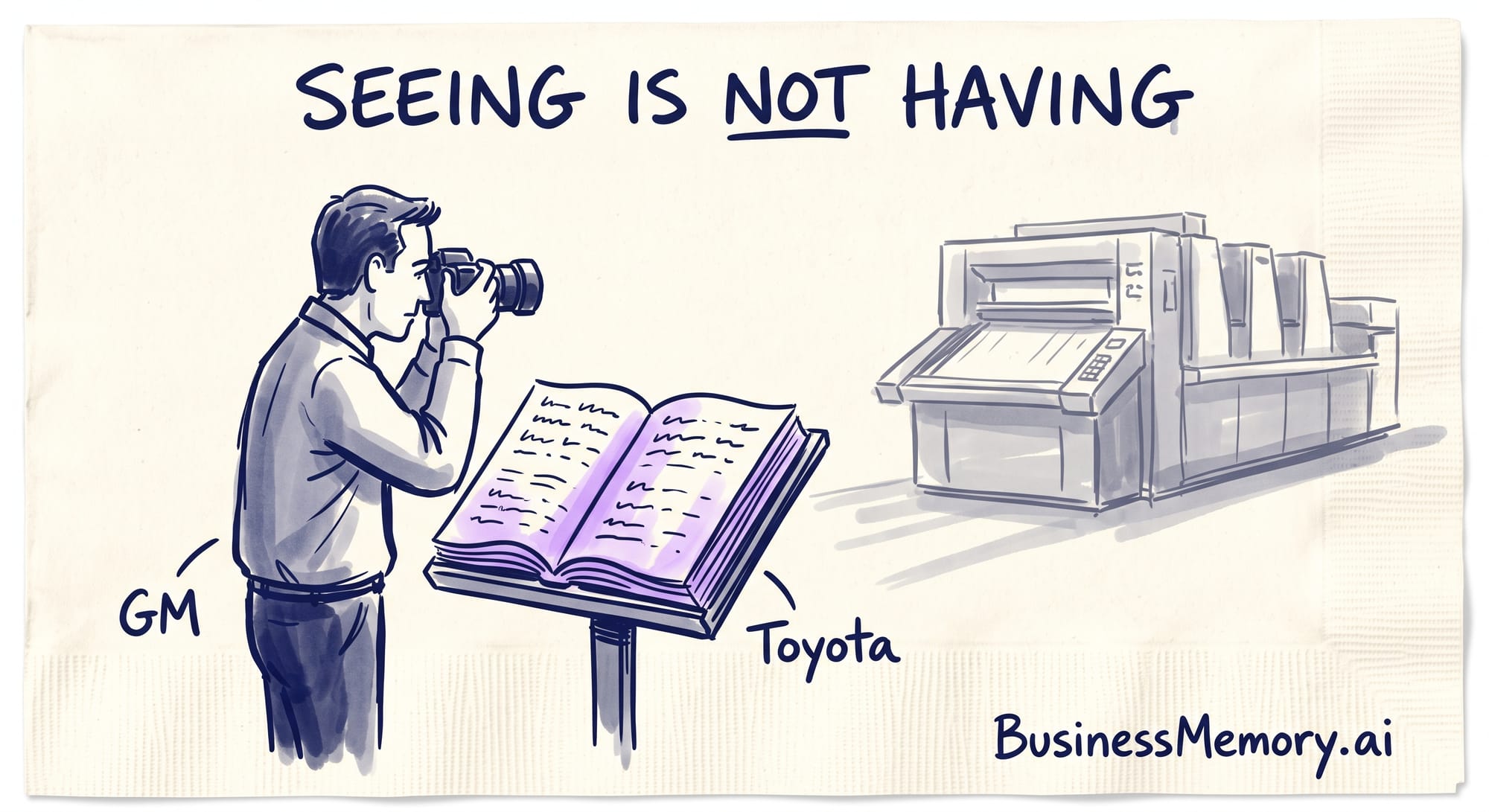
GM walked Toyota's NUMMI floor for years. Same workers. Same machines. The kept way of working still would not travel on a plant tour.

Everyone can rent the same AI tools tomorrow morning. At NUMMI, GM walked Toyota's floor for years — and still took far too long to carry the real asset home.
Why couldn't GM copy Toyota after watching it up close?
Because the real asset was not the machines on the floor.
It was a written way of working that GM could watch for years and still not carry home.
In 1984, General Motors and Toyota opened a joint plant in Fremont, California, called NUMMI.
John Shook, who helped Toyota train that plant, wrote that Fremont had been GM's worst.
Toyota reopened it, and over 85% of the people hired back were workers GM had laid off.
Quality went from GM's very worst to GM's very best in one year.
Same hands.
GM sent managers to walk that floor.
The tools were in plain sight.
Carrying the kept practice across the rest of GM still took close to 15 to 20 years.
A business memory is that same kind of asset for a small shop: a private record of how your business actually works, so a rival can watch your tools and still leave with nothing.
| What everyone can buy | What only you keep |
|---|---|
| The same machines | The written way each job is done |
| A plant tour | Every problem and fix, saved |
| The same AI chat apps | One shared record the whole team works from |
| Photos of the floor | Answers with the exact page behind them |
| Training for a week | The habit of writing it down the day it happens |
| A rival's tools tomorrow | Your deals, payments, promises, decisions |
What was wrong with GM's Fremont plant before Toyota?
Before NUMMI, the old GM Fremont plant was famous for the wrong reasons.
Shook wrote that many people considered it GM's worst plant.
Absenteeism routinely ran over 20%.
Quality was among the worst in the GM system.
This American Life reported the same picture: wildcat strikes, grievances stacked high, and cars so broken some had to be towed off the line.
Then GM closed Fremont, in 1982.
What did Toyota do with the same workers?
When NUMMI opened in December 1984, over 85% of the workforce were old hands from GM Fremont.
Toyota flew groups to Japan to learn how the work was done.
The written way of each job mattered.
If something went wrong, the worker was expected to call for help and fix it now — not push junk down the line for the yard to repair later.
Shook's report: with that system, quality went from GM's very worst to GM's very best in only one year.
Same workers.
Including people management had once called troublemakers.
The plant did not get a brand-new crew.
It got a kept way of working.
Why was watching still not enough for GM?
GM sent rising managers to NUMMI so they could carry the lessons home.
Toyota did not hide the floor.
Ernie Schaefer, a GM plant manager who visited, later said Toyota never stopped them from walking through and asking questions.
He also said something that should stop every owner cold.
They were asking the wrong questions.
They stared at the line.
They missed the system that supported the line — the written practice, the suppliers, the habits off the floor.
One senior order, told on This American Life, was almost a joke: take pictures of every square inch and make our plant look like that.
You can photograph a machine.
You cannot photograph a kept record of how people actually fix problems together.
Steve Bera, one of the early GM managers at NUMMI, said no one came back to the group and asked for the secret sauce.
Mark Hogan said there was no sense of urgency for years.
Shook later wrote that the first people who returned were quickly swallowed by the old GM system, and it took GM close to 15 to 20 years to make serious visible progress.
So.
GM was inside the building.
The tools were in plain sight.
The win still would not travel on a tour badge.
What does that have to do with your shop today?
I see the same thing happening with AI in small businesses today.
(Think ChatGPT.)
Most of us can rent the same tools by tomorrow morning.
The edge is not the app.
The edge is the written record of what your business agreed, paid, promised and decided.
Seeing is NOT having. Watching a rival's tools will NEVER hand you their kept record.
Plant tours are amazing.
Factory photos are amazing.
Now the honest part, so you hear it from me.
GM did learn a lot from NUMMI. Shook says so. Later plants got better.
The honest story is speed. Watching was easy. Spreading the kept practice across a huge company took many years.
And a business memory does not turn a bad week into a good one by magic.
It only answers from what you wrote down.
So I'm committed to keeping mine — every deal, every payment, every promise, written down the day it happens.
A business memory is a private record of everything your business knows — what was agreed, paid, promised and decided — kept on your own computer as plain text files any AI can read, so you can ask anything and get the answer with the exact reference behind it.
Your rivals can copy your tools by tomorrow morning.
They will NEVER copy your record.
Records were never meant for storage. Give your business a memory.
#BeBusinessSmart
Frequently asked questions
Why couldn't GM copy Toyota after watching it up close?
Because the real asset was not the machines on the floor. It was Toyota's kept way of working — jobs written down, problems fixed now, fixes saved.
GM watched for years, and still took close to 15 to 20 years to carry that practice across the company.
What was NUMMI?
NUMMI was a joint plant in Fremont, California, opened in 1984 by GM and Toyota. Toyota ran the system. Most of the workers came from the old GM Fremont plant.
Quality jumped with the same people under a different way of working.
Did GM learn nothing from NUMMI?
No. GM learned a lot, and later plants got better. The honest story is speed.
Watching was easy. Spreading the kept practice across a huge company took many years.
What does NUMMI have to do with a business memory?
Same tools are for sale to everyone. The edge is a private record of how your business actually works.
A business memory keeps what was agreed, paid, promised and decided as plain files you own, so AI can answer with the source behind it.
What is a business memory?
A business memory is a private record of everything your business knows — what was agreed, paid, promised and decided — kept on your own computer as plain text files any AI can read, so you can ask anything and get the answer with the exact reference behind it.