What Forgetting Costs a Business: $1.1 Billion for Messages They Could Not Show
One September day in 2022, sixteen firms paid more than $1.1 billion for conversations their businesses could not produce. Forgetting is not a feeling. It is an invoice.

The famous numbers about lost business knowledge cannot be counted, so this page will not use them. The counted bills are worse — and they land on businesses that let answers live in threads.
What does forgetting actually cost a business?
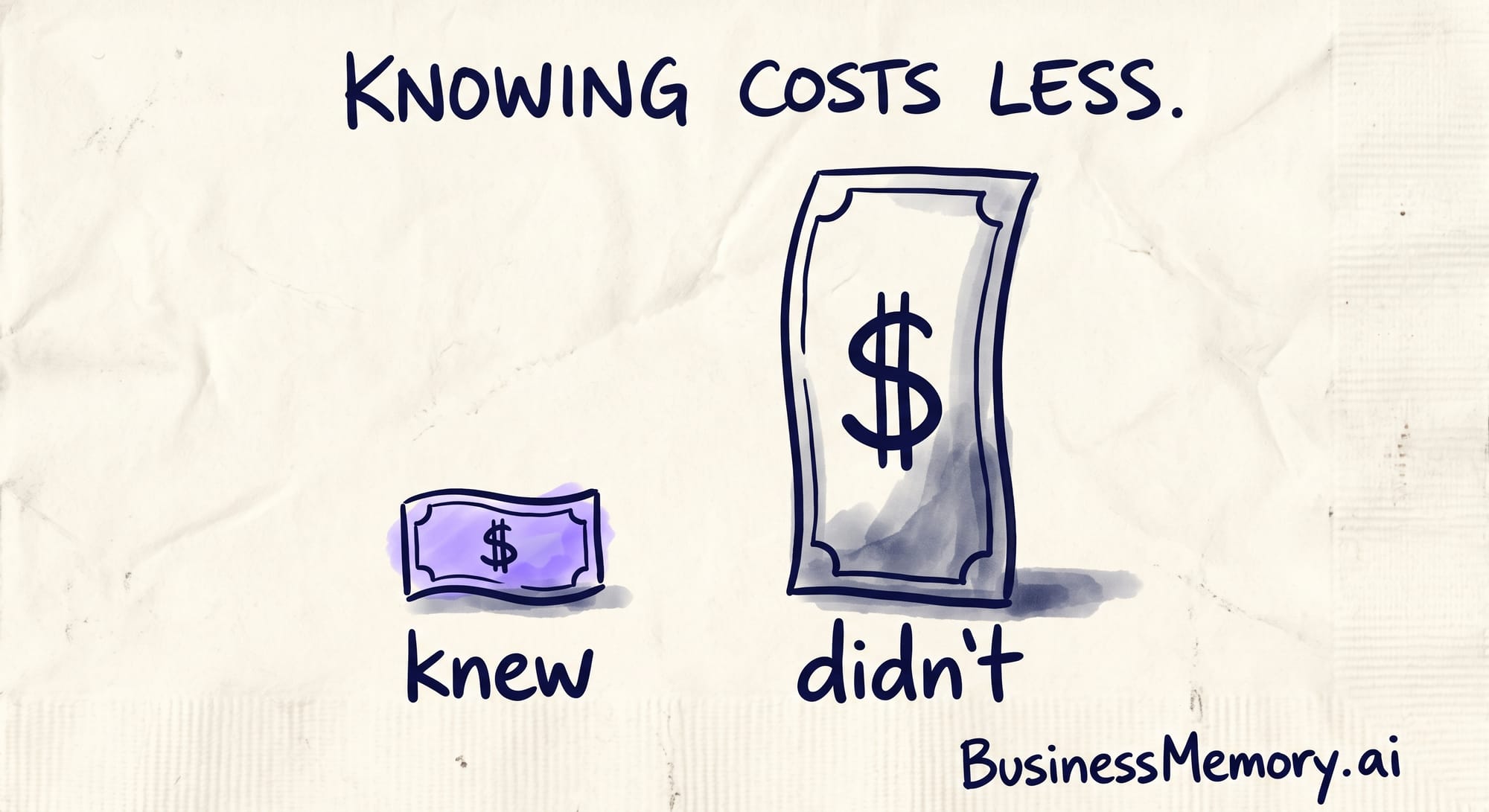
On September 27, 2022, the SEC charged sixteen Wall Street firms more than $1.1 billion in penalties — in one day — because their people did business in text threads on personal phones, and the firms could not produce the records. That is what forgetting costs when somebody with authority asks for proof. The famous industry numbers — $1.3 trillion a year, $31.5 billion a year — cannot be counted by anyone who quotes them, so this page does not use them. The counted bills are enough: $392.75 million more in August 2024, $63.1 million more in January 2025. And a small business pays the same bill in a smaller envelope: a deduction you cannot prove at audit is disallowed, with interest and a penalty on top. Forgetting is not a feeling. It is an invoice.
Here are the documented bills, counted:
| When | Who paid | The bill | What was missing |
|---|---|---|---|
| September 27, 2022 | 16 Wall Street firms | More than $1.1 billion | Business done in personal text threads; the firms admitted most of it was never preserved |
| August 14, 2024 | 26 firms | $392.75 million | The same failure, next wave |
| January 13, 2025 | 12 firms | $63.1 million | The same failure, again |
| Any audit, any year | A small business | The disallowed deduction, plus interest and a penalty | The one paper that could not be found |
What exactly did those firms forget?
Here is the part worth sitting with: nothing was hacked, and nothing was lost in a fire.
The messages existed. On somebody's phone.
The deals were discussed, the prices were agreed, the promises were made — and the business itself had no record of any of it. When the regulator asked, the firms admitted they could not produce most of those conversations.
A message on somebody's phone is not a business record. It is a rumor your business cannot prove.
And inside the January 2025 wave sits the most honest number in this whole story. Eleven firms paid between $4 million and $12 million each. One firm had tracked its own failure and reported it — it paid $600,000. Knowing what happened inside your own business was worth millions of dollars. Counted, not estimated.
Are the famous knowledge-loss statistics real?
Honestly, nobody can show you the count.
The pages selling knowledge software quote them everywhere: lost knowledge costs $1.3 trillion a year, poor sharing costs $31.5 billion. Trace any of them and you land on a survey summary quoting another summary.
So here is the rule this blog runs on: if a number cannot be counted, it does not get used. The real, countable bills above make the point without a single guess.
How does a small business pay for forgetting?
No regulator sends you a $125 million invoice. Your version is quieter.
An auditor asks you to prove one expense, and the paper is nowhere. The deduction is disallowed, the tax comes back with interest, and a penalty can land on top.
A customer swears you quoted one price. The quote lived in a phone call.
A warranty expires while nobody remembers the machine is still covered.
And between all of it, the days you spend hunting for what your own business already knew.
Most of us are running the same setup those firms were fined for — the agreement in a text thread, the price in one person's head, the paper in a box somewhere. The scale is smaller. The mechanism is identical.
Now the honest line, so you hear it from me: no tool would have saved those firms, and none will save you, if business keeps happening where nothing keeps the record. The record has to live where the work happens. A memory can only keep what reaches it.
That is the whole reason to give your business one. A business memory is a private record of everything your business knows — what was agreed, paid, promised and decided — kept on your own computer as plain text files any AI can read, so you can ask anything and get the answer with the exact reference behind it.
The cheapest line in this whole story is the $600,000 — the price paid by the one firm that knew what had happened inside its own walls.
I'm committed to being the business that knows.
Records were never meant for storage. Give your business a memory.
#BeBusinessSmart
Frequently asked questions
What does forgetting actually cost a business?
The counted record: the SEC has charged firms more than $1.1 billion in one day (September 27, 2022), $392.75 million in August 2024, and $63.1 million in January 2025 — all for business conversations the firms could not produce. A small business pays the same way at audit: a deduction with no record is disallowed, with interest and a penalty on top.
What are the biggest documented fines for not keeping business records?
The September 27, 2022 SEC action: sixteen Wall Street firms admitted their people did business in personal text threads that were never preserved, and paid more than $1.1 billion combined — eight firms paid $125 million each. Further waves followed in 2024 ($392.75 million) and 2025 ($63.1 million).
Are the famous knowledge-loss statistics like "$1.3 trillion a year" real?
They circulate widely, but nobody who quotes them can show the count — they trace back to survey summaries quoting other summaries. The documented recordkeeping fines are countable; the trillion-dollar estimates are not, which is why this page uses only the counted bills.
Is a message on an employee's phone a business record?
Not unless the business keeps it. That was the exact failure the SEC fined: deals discussed and promises made in personal text threads that the firms admitted they never preserved. A conversation the business cannot produce is a record the business does not have.
What is a business memory?
A business memory is a private record of everything your business knows — what was agreed, paid, promised and decided — kept on your own computer as plain text files any AI can read, so you can ask anything and get the answer with the exact reference behind it.