The Best Thing Our Business Memory Does Is STOP
Most AI is trained to always answer. Ours is built to stop when it is not sure — and that one pause is what makes it safe to hand your business to.

When an AI is not sure where your information belongs, the safe move is to ask — not guess. Here is what ours does instead, and why that one pause is what makes it worth trusting.
Last month I dropped a quick note into my business memory about what I pay one of my people.
It is the kind of note that must never land where the whole team can read it.
My memory read it — and then it did something most software never does.
It stopped.
It could not tell, on its own, whether that note was a company expense or a private record. Two different places. One of them shared.
So it did not choose.
It left one line at the top of my morning page: "This looks private — company expense, or a personal record? Tell me in one sentence."
I answered in six words. It filed the note where it belonged, and it never asked about that again.
That pause is the whole product.
The best thing our business memory does is stop.
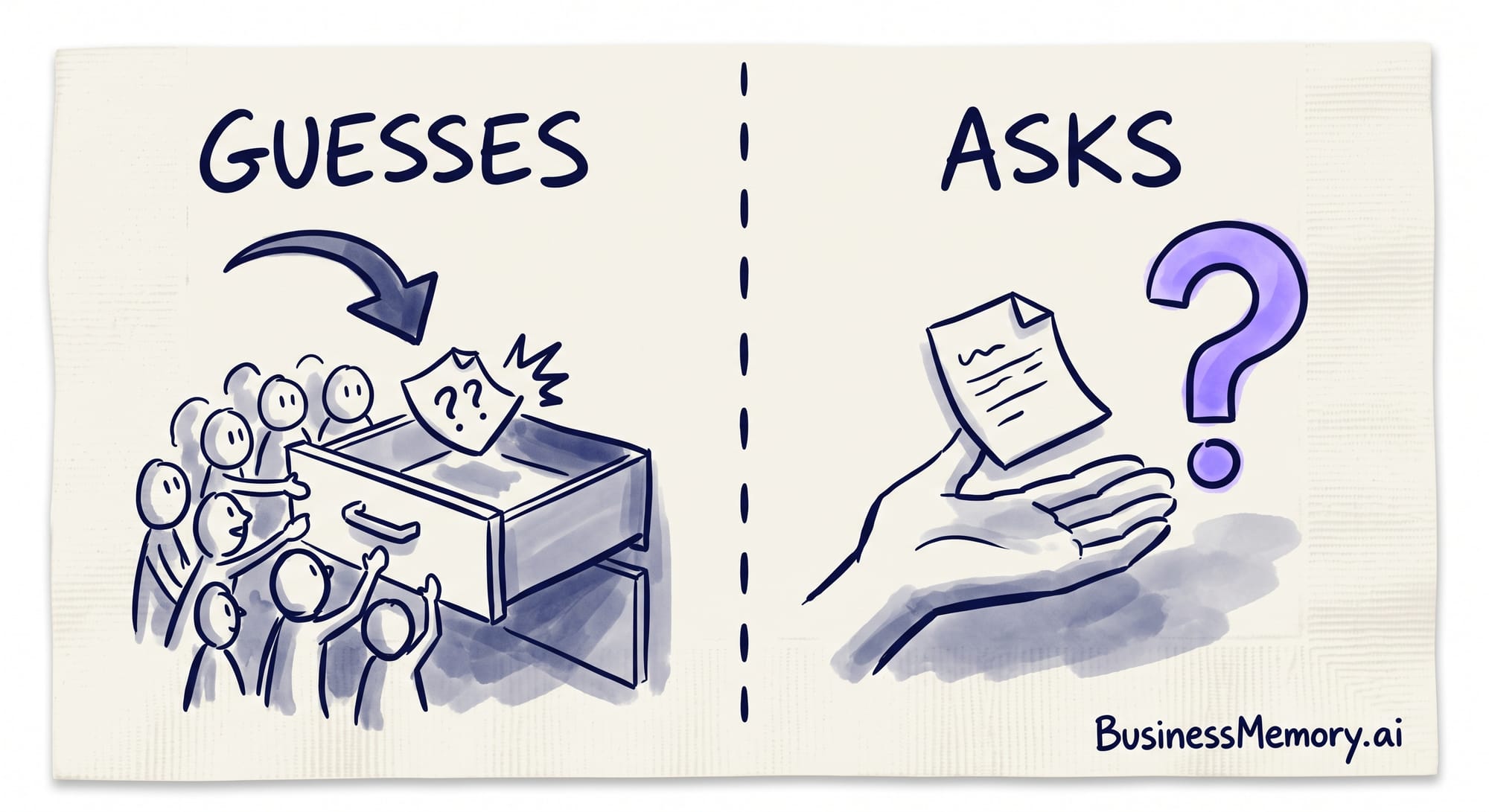
Here is the rule underneath it. When the memory is not sure where something goes, it does not guess. It keeps the item out of your shared record, flags it, and asks you — one question, one sentence back. We built it to never guess, because a guess is exactly how a private note ends up somewhere a guest can read it.
Most AI is built the other way around.
It is trained to always have an answer. Ask it anything and it will fill the silence — confident, fast, and sometimes completely wrong. The whole field knows this: a model would rather guess than say "I am not sure."
On a chat about the weather, a wrong guess costs you nothing.
On your business's memory, a wrong guess is a private note in a drawer the whole team can open.
So we made the opposite promise. Ours would rather ask a small question than make a big mistake.
And here is what surprised me, living with it every day: the asking is not annoying. It is the thing that lets me trust it.
Because now I know the rule. If it was not sure, it did not pretend. Nothing got filed on a hope.
A tool that guesses makes you check its work forever. A tool that asks when it is unsure earns the right to run without you standing over it.
Automation you can trust is not automation that never stops. It is automation that knows WHEN to stop.
Now the honest part — because you should hear it from me, not find it out later.
This is how we designed it, and we have tested that the rule holds. What I cannot show you yet is a stranger's before-and-after. It is early, and I will not dress up a controlled test as a customer result.
And the boundary is per vault, not per person. Everyone you hand a vault to can see everything in that vault. The memory keeps an unsure note out of the shared vault and asks you where it goes — but it does not yet do employee-by-employee permissions inside one vault. Records meant for different people belong in different vaults. For a small team, that line is simple, and you can see it. For a big one, it is not enough yet — and I would rather say so than sell you a promise I cannot keep.
Here is one thing you can check this week, on any AI tool you already use.
Hand it something genuinely unclear — a note that could belong in two places, a name it has never met.
Watch what it does. Does it stop and ask you? Or does it quietly pick one and move on?
The one that asks is the one you can hand your business to.
That is what a business memory is for in the first place. A business memory is a private record of everything your business knows — what was agreed, paid, promised and decided — kept on your own computer as plain text files any AI can read, so you can ask anything and get the answer with the exact reference behind it.
The kind that knows when to ask.
Give your business a memory it can trust.
#BeBusinessSmart
Frequently asked questions
What should an AI do when it is not sure where your information belongs?
It should stop and ask, not guess. A business memory that is unsure keeps the item out of your shared record, flags it, and asks the owner a single question — because a confident guess is how a private note ends up somewhere it should never be.
What is a review flag in a business memory?
It is the memory keeping its promise never to guess. When something is unclear — a name it has not met, a note that could belong in two places — it sets the item aside, lists it on your home page, and waits for one sentence from you. Your answer files it and teaches the memory, so the same question never comes back.
Is a business memory private by default?
Yes. When it cannot confidently place something, it keeps it out of the shared record rather than filing it where your team could see it, and asks you first. It errs toward private, not public.
Does a business memory give per-person permissions?
Not inside a single vault — everyone you hand a vault to can see everything in it. Sharing is controlled by vaults you can see: shared company work in one, private records in another. For a small team that boundary is simple and visible; it is not enterprise per-employee permissions.