The One Question to Ask Every AI Memory Tool: Where Does My Data Live?
The one question that splits every AI memory tool into two kinds — and why the FTC had to warn the first kind.

Every AI memory tool promises to protect your business data.
One question tells you whether that protection is a promise — or a fact.
What is the ONE question to ask an AI memory tool?
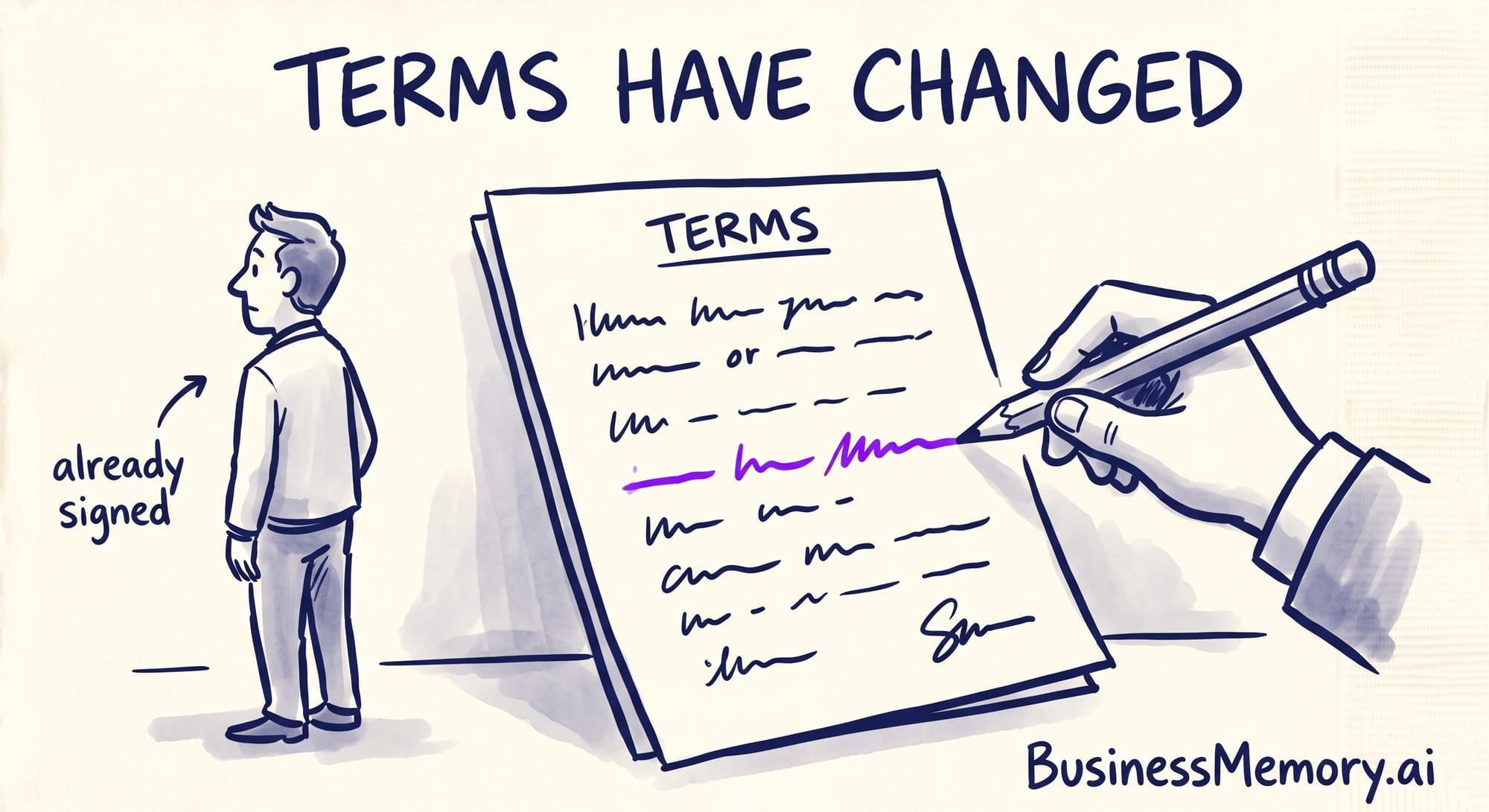
Before you trust any AI memory tool with your business, ask one question: where does my data live? The answer splits every tool into two kinds. One kind keeps your data on the vendor's servers and promises to treat it well. That protection is a policy — and a policy can change with the next update to the terms of service. In February 2024, the U.S. Federal Trade Commission warned that companies quietly rewriting their privacy terms to use customer data, including for AI training, may be breaking the law. It had to warn them because it keeps happening. The other kind keeps your data on your own computer. That protection is architecture — nothing needs to be promised, because nothing of yours sits on anyone else's servers. A policy is a promise. Architecture is a fact.
What is the difference between a policy and an architecture?
| Your data on their servers (policy) | Your data on your computer (architecture) | |
|---|---|---|
| What protects you | A promise written in the terms of service | The physical location of your files |
| Who can change it | The vendor, with the next update | Nobody — there is nothing to change |
| What you must do | Read every terms update, forever | Nothing — the files are in your folder |
| If the company is sold or shuts down | The promise goes with it | Your files stay exactly where they are |
| Sharing with your team | A permissions page you configure and trust | Decided by which vault a file lives in — a boundary you can see |
| How you verify | You cannot. You trust. | Open the folder and look |
Has a company ever quietly changed its privacy promise?
Yes — often enough that the regulator wrote it up.
The FTC's warning names two of its own cases. In 2004, the company behind "Hooked on Phonics" changed its privacy policy so it could share customer data with third parties — without telling the customers who had already handed their data over. In 2023, a genetic testing company retroactively expanded who it could share personal data with.
The FTC's words about AI companies today: they "have powerful business incentives to turn the abundant flow of user data into more fuel for their AI products."
None of this means cloud companies are villains. It means the incentive never sleeps, and a promise is the only thing standing in its way.
Software engineers even gave the alternative a name in 2019: local-first software — "you own your data, in spite of the cloud." One of its founding ideals: your data outlives any vendor.
How do you control sharing when everything is on your own computer?
By where the files live. That is the part most owners have never seen work, and it is simpler than any permissions page.
My partner and I run our AI company out of one shared vault — one set of files we both feed and both work from, the same company context for both of us. My private business records live in a different vault that never leaves my machine.
Who sees what is not a setting buried in an admin panel. It is a folder. You can look at the boundary with your own eyes.
One honest limit: this control is per-vault, not per-file. Everyone with a vault sees that whole vault. For a small team, that simplicity is the point.
Why does this matter more for a business than for a person?
Most people never read the terms update, and for a grocery list it never matters.
But whatever tool remembers your business, holds your business. The contracts. The payments. The promises your customers are counting on.
For that data, "where does it live?" is not a technical preference. It is the whole question — and it is the first thing we settled when we built our own: A business memory is a private record of everything your business knows — what was agreed, paid, promised and decided — kept on your own computer as plain text files any AI can read, so you can ask anything and get the answer with the exact reference behind it.
Ask the question before you sign up. If the answer is a link to a policy, you already have your answer.
Give your business a memory it can trust.
#BeBusinessSmart
Frequently asked questions
What is the most important question to ask an AI memory tool?
Ask where your data lives. If it lives on the vendor's servers, your protection is a policy that can change with the next terms-of-service update. If it lives on your own computer, your protection is architecture — there is nothing of yours on anyone else's servers to share, sell or lose.
Can an AI company change its privacy policy after I sign up?
It happens often enough that in February 2024 the U.S. Federal Trade Commission warned companies that quietly rewriting privacy terms to use customer data — including for AI training — may be unfair or deceptive. The FTC has brought cases against companies that did exactly that.
What is the safest place for a business's AI data to live?
On the business's own computer, in its own files. Data that never leaves your machine is protected by where it physically is, not by a vendor's promise. Engineers call this approach local-first software: you own your data, and it outlives any vendor.
How does a team share data that lives on one computer?
Through shared vaults — separate sets of files with visible boundaries. A team feeds one shared vault and works from the same company context, while private records live in a vault that never syncs anywhere. The control is per-vault: simple, and you can see it.