A Business Memory Has to Know Which Mary
Somebody types "Send Mary the file." Everyone in the office knows which Mary. A computer either knows which person — or it guesses. Here is how we proved ours does not guess.

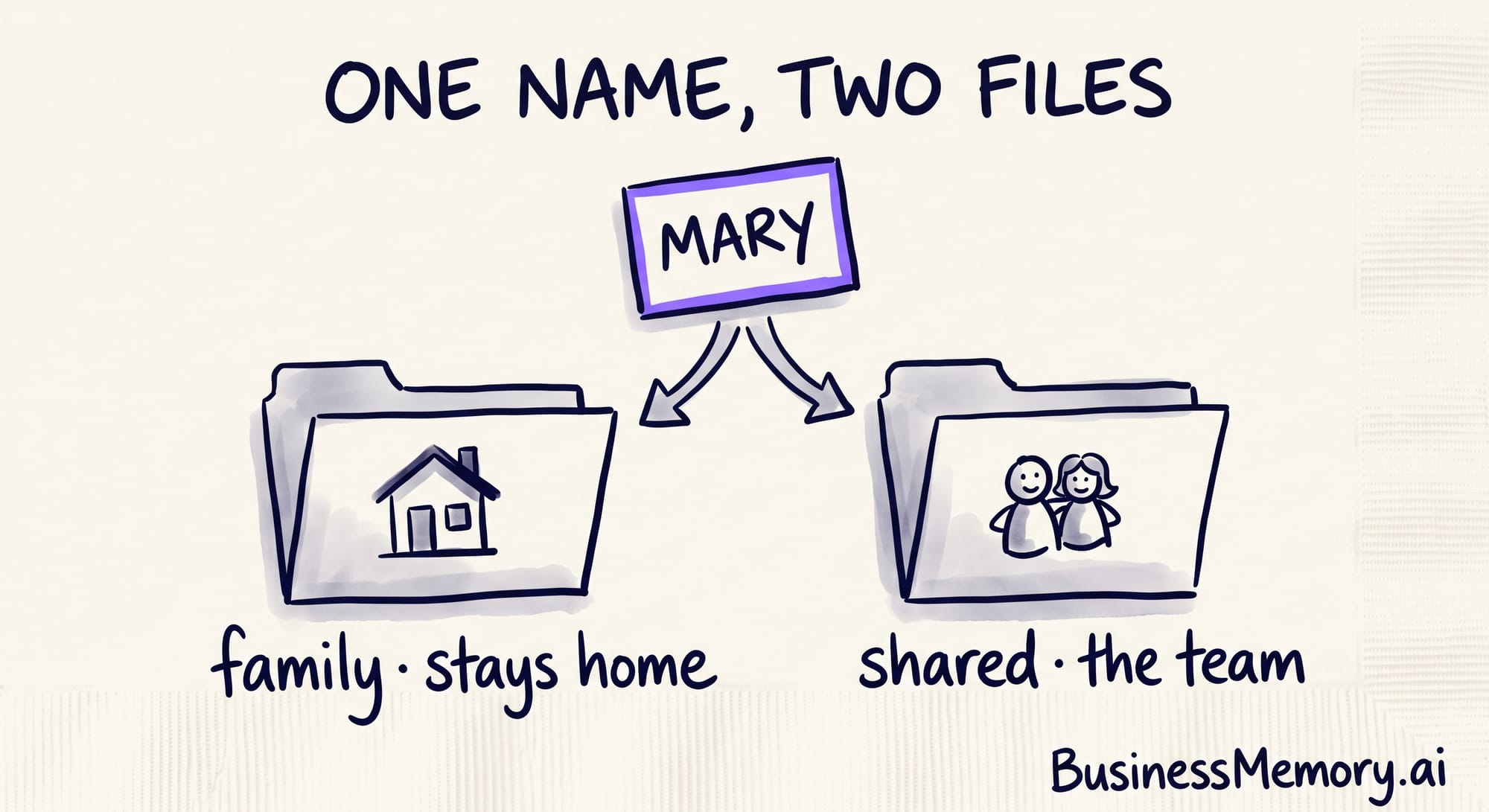
"Send Mary the file." Which Mary? One person wears three hats. Two people share one name. And one note sent to the wrong Mary can end up where a client can read it.
Why does a business memory have to know which person?
Because a name is not a person. In a small business, the same person can wear three hats. And two people can share one name. If your AI does not know WHICH person a note belongs to, one day it will drop a family note where a client can read it.
So on August 11, 2026, I set a trap for our own business memory: a made-up business where two different women were both named Marta. The memory kept the two Martas apart. It sent the family nickname to the sister. It kept the client's Marta with the client. And it made nothing up. That part of the test scored 5 out of 5. The whole test scored 48 out of 50. This problem is older than AI — it even got a name back in 1946. You do not fix it by remembering names. You fix it by knowing people.
| An address book | A business memory | |
|---|---|---|
| A name | Just a name | A person — with every hat they wear |
| Two people, one name | Easy to mix up | Two people, two files |
| The family note | Mixed in with everything else | In a vault that never leaves the house |
| Your team | Everyone keeps their own list | One shared vault the whole team works from — and everyone in it sees all of it |
What happens when two people share one name?
Here is one week in any family business.
"Mary, are you bringing Mom to dinner on Sunday?"
"Mary, are the bakery's books done?"
Same Mary. The owner's sister keeps the books.
"Mary, did the client approve the order?"
That one is a different Mary. She runs the office at your best client.
Then somebody types: "Send Mary the file."
Of course, everyone in that office knows which Mary. Nobody even stops to think about it.
A computer does not get to "just know." It either knows which person — or it guesses.
And here is why a guess is expensive. The sister's note must NEVER leave the house. The client's note is made to be shared. Same name. Opposite rules.
A memory that mixes up two names is not a memory. It is a guess in a nice suit.
How do you prove a memory knows which person?
You try to break it.
So before we offered our business memory to anyone, that is exactly what I did.
We built a fake business on purpose — a trap, designed to fool it.
The owner had a sister named Marta. The family called her "Martita."
One of her clients had an office manager. Her name was ALSO Marta.
Same name. Different women. Opposite rules.
Then, on August 11, the test ran. And the memory held. The two Martas never mixed. "Martita" went to the sister. The client's Marta stayed with the client. It made nothing up.
That part scored 5 out of 5. The whole test scored 48 out of 50.
Now the honest part, because you should hear it from me and not find it out later. The customer in that test was not a real person. It was played by an AI, reading a script we wrote. So this is our own test. It is not a customer story. And I won't dress it up as one.
One more honest line. As of now, sharing works by vaults — think of them as drawers. Family papers live in a drawer that never leaves the house. Client papers live in a drawer the team shares. Everyone you invite to a drawer sees everything in it. That is the line. Simple, and you can see it.
Is this a new problem?
No — it is actually a very old one.
Hospitals and governments have fought it since 1946. They even gave it a name: record linkage. Which John Smith is this one?
The biggest AI companies fight it today. Anthropic's engineers show a saved note that reads "the company's revenue grew by 3%" — but it does not say which company. Or which quarter.
They are trying to fix it for the whole internet.
You only need it fixed at one desk — yours.
That is what a business memory is for. A business memory is a private record of everything your business knows — what was agreed, paid, promised and decided — kept on your own computer as plain text files any AI can read, so you can ask anything and get the answer with the exact reference behind it.
Not a name. The person.
Give your business a memory that knows which Mary.
#BeBusinessSmart
Frequently asked questions
Why does an AI business memory need to know which person a name belongs to?
Because in a small business, one person wears many hats and two people can share one name. An AI that only remembers names will one day put a family note where a client can read it. A business memory ties every note to one specific person — so that never happens.
What happens when two people in a business share the same name?
A person uses common sense. A computer either knows which person the note belongs to, or it guesses. In our August 11, 2026 test, two women named Marta stayed on two separate files, and the family nickname "Martita" went to the right one.
How was the two-Martas test run?
We built a fake business on purpose, to trap our own product before selling it. The owner had a sister named Marta, and one client had an office manager also named Marta. The customer was played by an AI reading a script, not a real owner. The memory kept both women separate, made nothing up, and scored 48 out of 50.
Can an AI keep family records separate from business records?
Yes — with vaults. Family records live in a vault that is never shared. Client records live in a vault the team works from. As of now you cannot pick person by person inside one vault — everyone you invite to a vault sees everything in it.
What is record linkage?
The old science of telling whether two records belong to the same person. It got its name in 1946, from Halbert L. Dunn. It is the same problem an AI business memory must solve when two people share a name — or one person wears many hats.