Who can tell when the machine is wrong? Your longest-serving person, with a business memory in hand
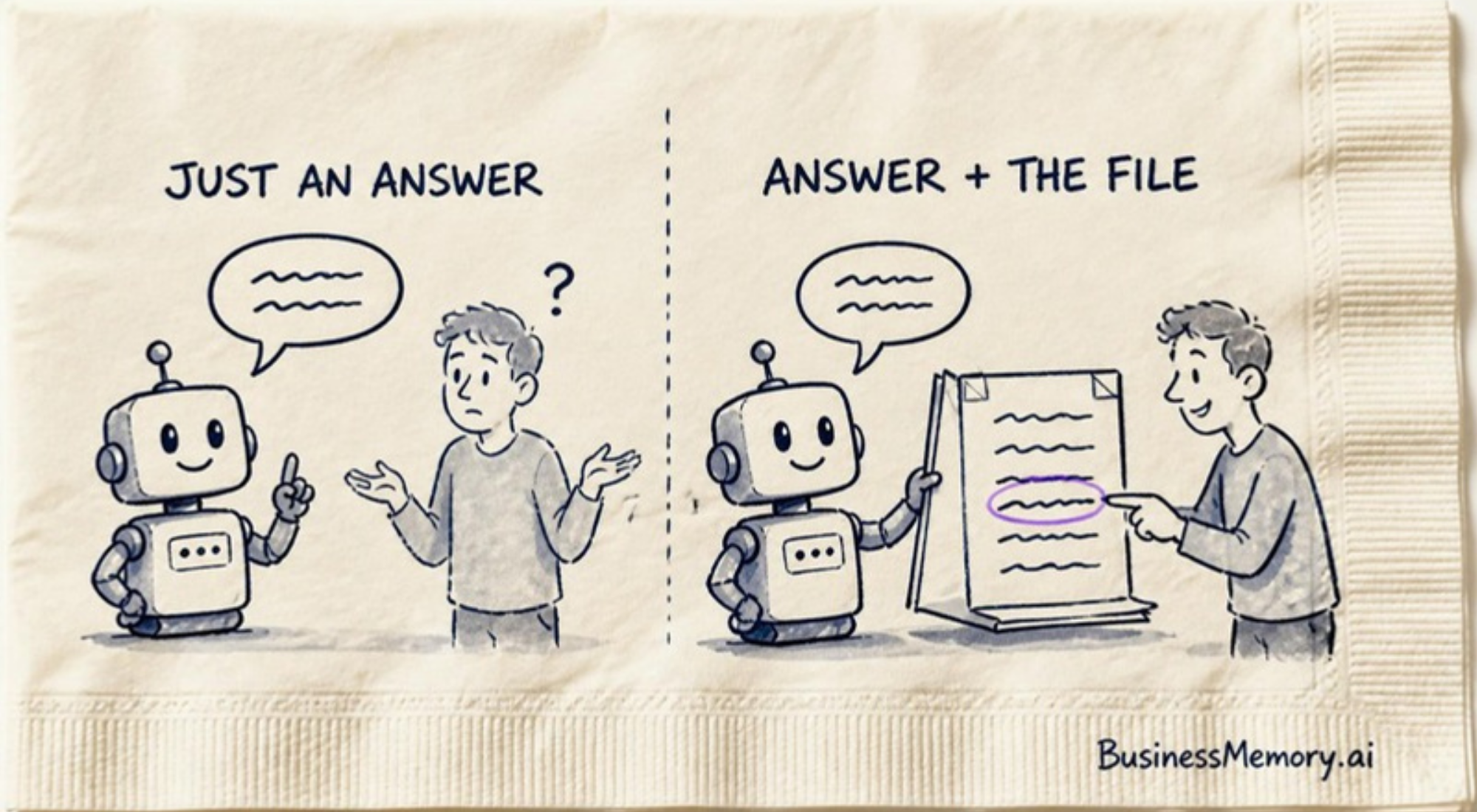
The AI sounds the same when it is right and when it is wrong. A business memory shows you the file behind every answer. Your best person can tell if that file is wrong.

The AI sounds the same when it is right and when it is wrong. A business memory shows you the file behind every answer. Your best person can tell if that file is wrong.
Who can tell when an AI answer about your business is wrong?
The person who has been there the longest. Not the machine. And not the newest hire.
An AI answer sounds the same when it is wrong. A 2025 paper, "Why Language Models Hallucinate," says these tools "sometimes guess when uncertain, producing plausible yet incorrect statements instead of admitting uncertainty."
So checking an answer takes two things.
A business memory gives you the first one: every answer comes with the exact file behind it.
The second one is a person. Someone who has watched the job for years opens that file and knows, fast, when something is off.
Memory is the record. The one who can tell is still a person.
| A business memory | The person who has been there longest | |
|---|---|---|
| What it gives you | The answer, with the exact file behind it | The feeling that a number is off |
| What it holds | What was agreed, paid, promised and decided, written down | What happened that nobody wrote down |
| How fast | Seconds | A minute, once the file is open |
| What it cannot do | Know that a written price got old | Remember every file for every customer |
| Teamwork | One shared vault the whole team reads | One head, and it goes home at night |
What do I keep seeing in small businesses?
I keep seeing the same scene.
A shop gets a new AI tool. The tool talks like it has been there ten years.
And the person who has actually been there longest is not the one holding it.
A lot of shops give the new tool to the youngest hire. I am naming what I see. I am not guessing why they do it.
Of course, the young hire is fast. That is real, and it is worth money. A 2023 study by Erik Brynjolfsson, Danielle Li and Lindsey Raymond found an AI helper raised issues resolved per hour by 34% for novice and low-skilled workers — with minimal impact on the most experienced ones.
So speed is not the question.
The question is who catches the answer that is wrong.
Why does the machine sound so sure when it is wrong?
The same 2025 paper gives the reason: the way these tools are trained and tested "reward[s] guessing over acknowledging uncertainty." So they guess.
The machine does not slow down. It does not lower its voice. A wrong price comes out in the same clean sentence as a right one.
(Think Air Canada: in 2024 a Canadian tribunal made the airline pay for a refund rule its own chatbot got wrong.)
I see the same thing in small businesses today. The machine answers. Somebody has to know.
Does a business memory replace the person who knows?
No.
The record can show you the source. A person still has to know the source is wrong.
Here is the scene. The AI says a customer pays in 30 days. The business memory shows the file, and the file says 30 days. Then the one who has been there ten years reads it and says, "That changed last spring. Nobody wrote it down."
The record did its job: it showed exactly where the answer came from. The person did theirs: knew the paper was old.
Now the honest part. As of now, a business memory answers only from what was written down. If a change lives only in somebody's head, the record repeats the old version — with the file to prove it.
That is why the file matters. It tells your best person exactly where to look. And once the fix is written down, the whole team reads the same fix tomorrow.
So I'm committed to keeping mine — every deal, every payment, every promise, written down the day it happens — so the one who can tell always has something to check.
A business memory is a private record of everything your business knows — what was agreed, paid, promised and decided — kept on your own computer as plain text files any AI can read, so you can ask anything and get the answer with the exact reference behind it.
Who in your business would catch it if the machine were wrong — and does that person have the file in hand?
Records were never meant for storage. Give your business a memory.
BeBusinessSmart
Frequently asked questions
Who can tell when an AI answer about your business is wrong?
The person who has been there the longest. The AI sounds the same when it is right and when it is wrong. A business memory shows the exact file behind each answer, and someone who knows the work can tell, fast, when that file is old or off.
Does AI help new employees more than experienced ones?
In speed, often yes. A 2023 study by Erik Brynjolfsson, Danielle Li and Lindsey Raymond found an AI helper raised issues resolved per hour by 34% for novice and low-skilled workers, with minimal impact on the most experienced. Speed is not the same as catching a wrong answer.
Can a business memory be wrong?
Yes, if what was written down is old. A business memory answers only from its record, and it shows you the file behind every answer. That is what lets a person check it, and fix the record once for the whole team.
Does a business memory replace experienced people?
No. The record can show you the source. A person still has to know when the source is wrong. A business memory hands your best person the file in seconds instead of making them dig for it.
Takeaway
A business memory is a private record of everything your business knows — what was agreed, paid, promised and decided — kept on your own computer as plain text files any AI can read, so you can ask anything and get the answer with the exact reference behind it.