
Why a Business Memory Must Show You It Ran
A silent tool can fail and still look fine. A business memory shows a morning page that proves it ran.

Subheadline: A silent tool can fail and still look fine. A business memory shows a morning page that proves it ran.
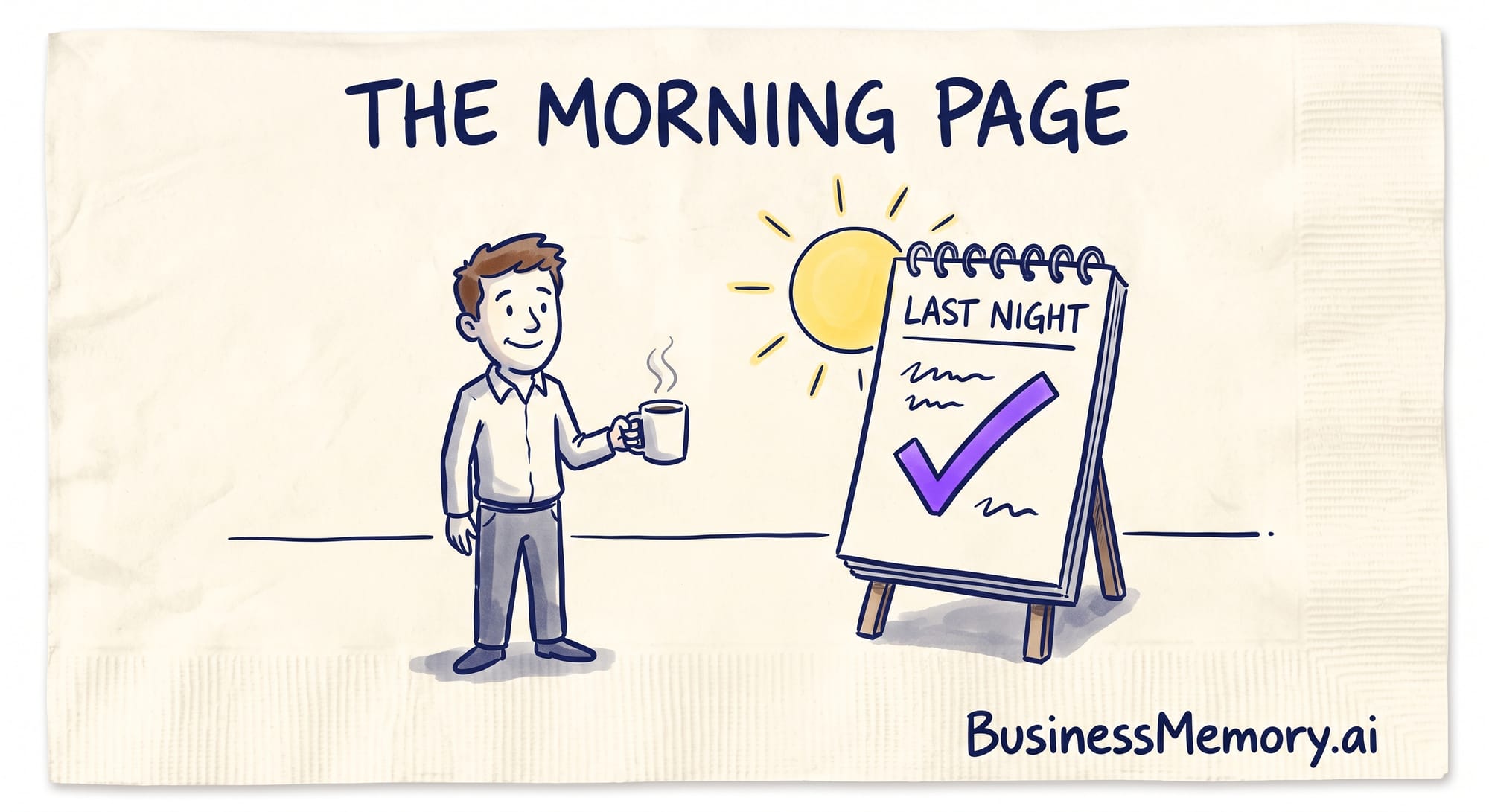
Why must a business memory show you it ran?
A business memory must show you it ran. Silence can mean success or failure. A silent tool leaves no signal. A business memory is a private record of everything your business knows — what was agreed, paid, promised and decided — kept on your own computer as plain text files any AI can read, so you can ask anything and get the answer with the exact reference behind it. Silence should never look like success.
Computers already have a name for this. A heartbeat is a periodic signal that says normal operation is still going. If the signal stops, the sender is assumed failed. That is a cousin. It is not the morning page. The morning page is the owner's version of the same idea: a visible success ping, every morning.
How does a silent tool compare to a memory that shows it ran?
| Silent tool | Memory that shows it ran | |
|---|---|---|
| What you see | Nothing. Quiet looks like success. | A morning page |
| What silence means | Success and failure look the same | You can see whether it ran |
| The signal | None, unless someone is listening for a missing ping | A page that proves it ran |
| Teamwork | No shared signal | The whole team works from the same company context in a shared vault. Everyone in that vault sees the whole vault — including the morning page. |
| How you verify | You find out later — or you never do. | Read the page. It should show the run, not just that a page exists. |
What do silent tools do well?
They stay out of the way.
Most owners who trust a quiet tool are not careless. Quiet looked like success.
Scheduled jobs can fail and print nothing. Silence is a signal only if something is listening for a missing success ping.
For an unattended agent, silence is both success and failure. The honest move is to make success loud.
A watchdog timer and a dead man's switch are cousins of the same idea: a missing signal is the alarm. They are not a morning page. I will not stretch them into one.
Ops writing already said the plain version: silence isn't safety. It's a liability. "No news is good news" fails when a signal was expected.
The honest limit on our side is the same one we tell you every time. Sharing is per-vault, not per-person. Everyone you invite to a vault sees the whole vault, including that morning page. For a small team that line is simple, and you can see it. It is not enterprise permissions. I would rather say so.
I also will not write that a silent memory has always failed. I do not have that proof. I have this: a memory that fails silently is worse than no memory at all, because silence looks like success.
Every morning it shows me a page that proves nothing was lost while I slept.
A business memory is a private record of everything your business knows — what was agreed, paid, promised and decided — kept on your own computer as plain text files any AI can read, so you can ask anything and get the answer with the exact reference behind it.
I'm committed to a memory that shows me it ran.
#BeBusinessSmart
Frequently asked questions
Why must a business memory show you it ran?
Because silence can mean success or failure. One trust check is a morning page that proves it ran. A silent tool leaves no signal, so a failed night can look like a good one.
What is a morning page?
It is a trust feature: the page a business memory can show every morning to prove it ran and that nothing was lost while you slept. The cornerstone calls it a morning page. That trust test is not the definition of business memory.
Is a silent tool the same as a business memory?
No. A silent tool can fail and print nothing. A business memory you can trust shows a morning page as a trust check — not as the definition itself. Silence should never look like success.
Who can see the morning page?
Everyone you hand that vault to. Sharing is per-vault, not per-person. The whole team works from the same company context in a shared vault. Everyone in that vault sees the whole vault.