Why Your Company Wiki Forgets — and What Remembers Instead
I wrote the page myself. A year later my own guy quoted a job from it and the price was dead. Why wikis forget, and what a business keeps instead.

A wiki is only true while somebody keeps it true. Here is what a business keeps instead — and why you can ask it a question and see the file the answer came from.
Why does a company wiki forget, and what is organizational memory?
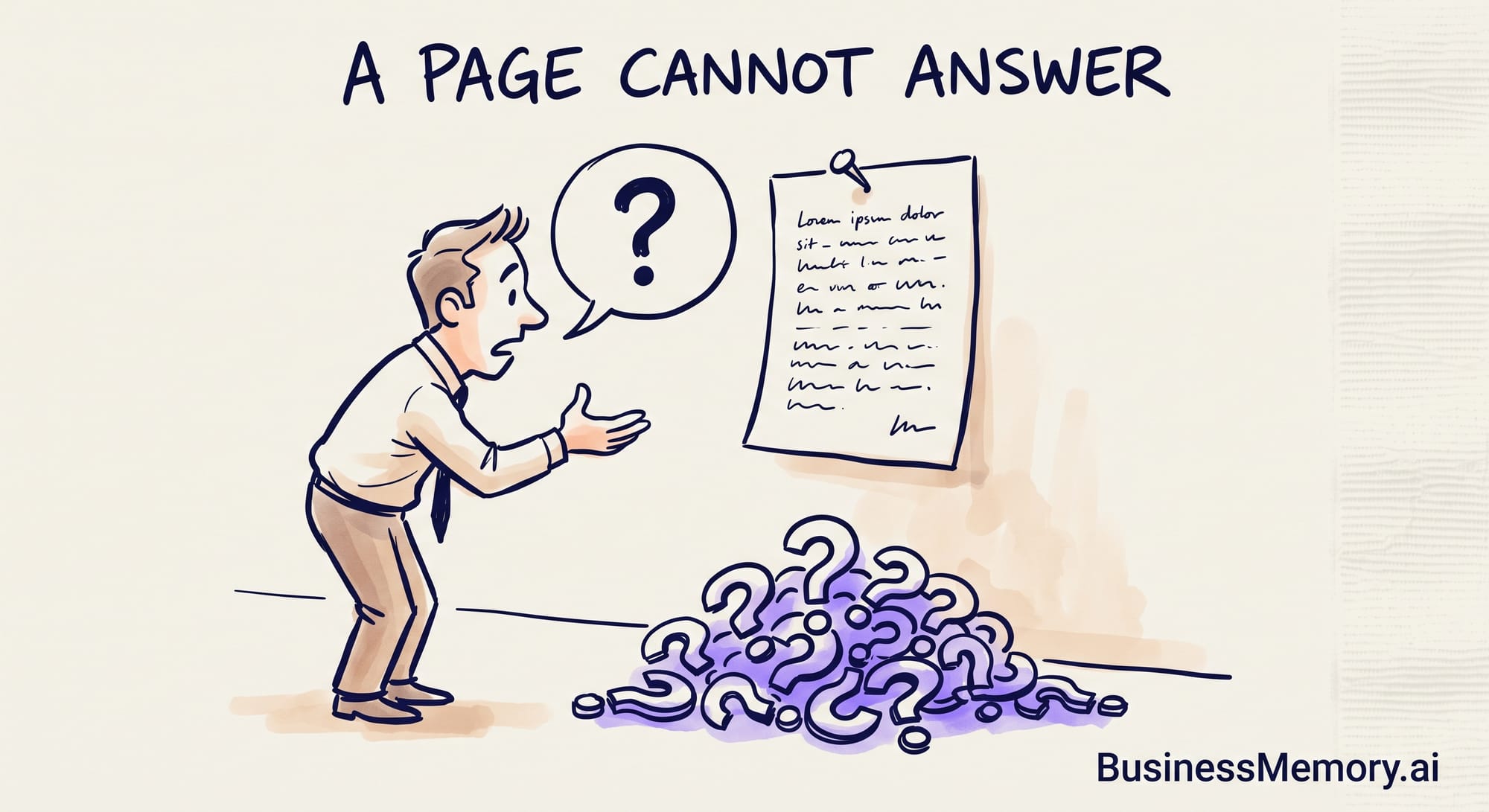
A company wiki forgets because keeping it true is a separate job from the work, and a separate job does not survive a busy month. The wiki was built for people to read. Ward Cunningham launched the first one, WikiWikiWeb, on March 25, 1995, so a group could write pages together and freely edit each other. Thirty years later, most company wikis hold last year's prices, a supplier who left, and a step nobody follows. What replaces it is not a tidier wiki. It is organizational memory — also called corporate memory — kept as a record while the work happens, in plain files on your own computer that an AI can read, so you ask a question and get the answer with the file it came from.
How does a company wiki compare with a business memory?
| A company wiki | A business memory | |
|---|---|---|
| Who keeps it true | A person, in time they do not have | The work itself — it is written down as things happen |
| What it is for | Reading | Asking |
| Where it lives | Somebody else's cloud, behind a login | Plain files on your own computer |
| How you know it is right | You find out from a customer | The answer names the file, and you open it |
| Teamwork | Everyone is asked to go and update it | The whole team feeds one shared vault and works from the same company context — and everyone in that vault sees all of it |
| When somebody leaves | What they knew leaves with them | What the work wrote down stays |
What does a company wiki actually do well?
Plenty. Let me say that plainly, because the people who built yours were not lazy.
A wiki puts the handbook, the policy and the "how we do this" in one place everybody can reach. It lets two people fix a page without asking permission. That was the whole idea in 1995, and it was a good one.
So the problem is not the wiki. The problem is what it needs from you.
It needs a human being to notice that something changed, remember the page exists, go and open it, and write the change down. Every time. Forever.
Honestly, who has that person?
Why does nobody keep the wiki current?
Because the moment the thing changes is never the moment anybody has a free hand.
The price goes up while you are on the phone. The supplier changes while you are driving. The step everybody now skips was never a decision — it just quietly became the way things are done.
None of those moments come with twenty minutes to go and edit a page.
So the wiki keeps saying what was true the day somebody last had a quiet afternoon. And when it is wrong once, people stop trusting all of it. That is how corporate amnesia starts — not with a disaster, but with a page nobody checks anymore.
The page I wrote, and the day I stopped trusting it
I wrote ours myself. One page: how we quote a job. Materials, the markup, the lead time, who to call.
I was proud of it. It was clear. It was right.
Then, about a year later, one of my guys used it. He did exactly what the page told him to do. He quoted the job from it.
And the price on that page was DEAD. The supplier had changed months before. The number he gave the customer was one I could not honor.
He did nothing wrong. He read the page.
I paid the difference, and I apologized to a customer for a mistake I had written down myself, in my own handwriting, a year earlier.
A page tells you what was true the day it was written. A record tells you what is true now.
So I stopped keeping a page.
Now the work writes the record as it goes. The quote, the invoice, the supplier's email, what we agreed on the phone — it lands in plain files on my own computer as it happens. Nobody schedules an afternoon to update anything.
And I do not read it. I ask it.
"What did we last pay this supplier, and when?" The answer comes back in plain words, and underneath it, the name of the file it came from. I open that file. Of course I do — that is the whole point.
Now the honest part
A record can only answer for what it was given. If half your business still lives in one person's head, no tool fixes that, and I will not pretend otherwise. It has to be fed before it can answer.
And sharing works by vaults — think of them as drawers. Family papers sit in a drawer that never leaves the house. Client papers sit in a drawer the team shares. Everyone you invite to a drawer sees everything in it. That is the line, and you can see it.
That is what a business memory is for. A business memory is a private record of everything your business knows — what was agreed, paid, promised and decided — kept on your own computer as plain text files any AI can read, so you can ask anything and get the answer with the exact reference behind it.
Records were never meant for storage.
#BeBusinessSmart
Frequently asked questions
Why do company wikis go out of date?
Because updating one is a separate job from doing the work, and it lands on a person who is already busy. The moment a price, a supplier or a step changes is never the moment anybody has twenty free minutes. So the page keeps saying what was true the last quiet afternoon, and once it is wrong once, people stop trusting the rest of it.
What is organizational memory?
Organizational memory — also called corporate memory or institutional memory — is the accumulated body of data, information and knowledge a business builds up over its life: what was agreed, paid, promised and decided. It lives partly in records and partly in people's heads. When it lives mostly in heads, it walks out of the door with them.
What is the difference between a company wiki and corporate memory?
A wiki is one place where corporate memory can be written down by hand. Corporate memory is the thing itself — everything the business knows. The wiki only holds the part somebody remembered to type, on a day they had time. A business memory keeps the record as the work happens instead, so nothing waits on a free afternoon.
What replaces a company wiki?
Not a better wiki. A record kept as work happens, in plain files on your own computer that an AI can read, so you ask a question instead of hunting for a page. The test of a good one is simple: the answer names the file it came from, and you can open that file yourself.
Can a small business keep organizational memory without an IT department?
Yes. The record is plain text files on a computer you already own — no server, no seat licences, no admin. The work of keeping it current is done as the work happens rather than scheduled as its own project, which is the part that always failed in a small business.
Takeaway
A business memory is a private record of everything your business knows — what was agreed, paid, promised and decided — kept on your own computer as plain text files any AI can read, so you can ask anything and get the answer with the exact reference behind it.