
What does Zara teach about business memory?
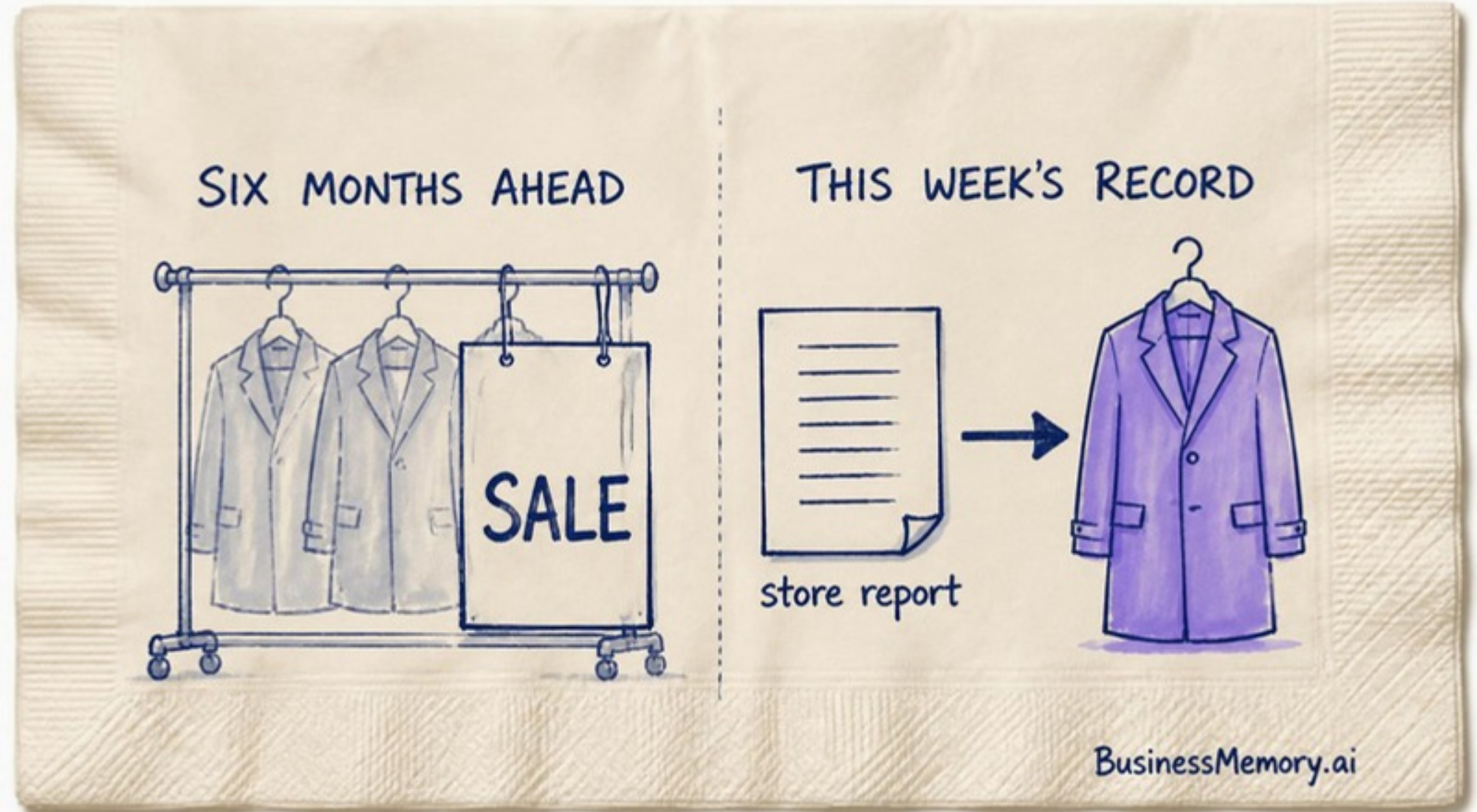
Zara and its rivals both counted what sold. Zara decided from this week's record; its rivals from a guess made six months earlier.

Zara and its rivals both sold clothes, and both counted what sold. Zara decided from what its stores said this week. Its rivals decided from a guess made half a year earlier. A business memory lets you ask this week's record, with the file behind every answer.
What does Zara teach about business memory?
That the age of your record matters as much as the record itself.
Most fashion companies took five to six months to get a design from the drawing table to the store. By the time a coat hung on the rack, the thinking behind it was half a year old.
Zara's stores sent their sales, broken down by color and size, twice a week. Its designers checked how each piece was doing every day. Inditex, the company behind Zara, still says its designers work from "daily feedback from our stores and sales teams."
So Zara could put a new design in its stores in about five weeks, and change one already selling in about two.
The rivals were not slower at sewing. They were slower at knowing.
A business memory does that job for a small business: it keeps this week's record where you, your team and your AI can ask it.
| One coat | Decided six months ahead | Decided from this week's record |
|---|---|---|
| When it is decided | About half a year before it sells | While the season is still running |
| What the decision reads | Last season, and a guess | What the stores said this week |
| When a mistake shows up | When the coat will not sell | In the next store report |
| What happens to the mistake | It waits on the rack for the clearance sale | Nobody makes more of it |
| What a customer's complaint can change | Next year's coat | This month's coat |
How old was the record behind a six-month coat?
Old. And nobody felt it.
The usual way worked like this. Star designers drew the season. Factories, often far away, sewed it months earlier. Then the clothes were advertised and shipped to the stores.
Of course, every store had a cash register. The sales were counted.
But by then the coat was already drawn, sewn and shipped. This week's sales could only teach next year's coat.
Here is the part most people miss. The rivals had records. Lots of them. They were just old by the time they reached the person deciding.
What did Zara's stores send to the designers?
Numbers, and words.
Twice a week, the stores sent their daily sales, item by item, by color and size. Store managers placed their own orders twice a week, too. And the designers listened to what those managers told them, in the reports and outside them.
A Harvard Business School course write-up on Zara gives the kind of words that traveled: "customers don't like the zipper," or "she wishes it was longer."
Think about that zipper.
At a six-month company, the complaint dies at the counter. Or it waits for next season. At Zara, it could reach the people drawing the clothes within days.
That is why so much was made during the season. In 2005, only 39 percent of Inditex's sales came from the collections planned ahead. The other 61 percent was made in season: new colors, cuts and fabrics on what was already selling, plus brand-new pieces.
And when a piece did not sell, Inditex stopped making it.
Did Zara win on fresh records alone?
No. And you should hear the honest part from me.
Zara also sewed close to home. By 2004, 52 percent of Inditex's production was in Spain, Portugal and Morocco. The company put it plainly: "To reduce lead time, we need to produce closer, not cheaper." Nearby factories made the fast loop possible.
And sales numbers were never a secret. Richard Hyman of Verdict Research, a firm that studies shops, said it in so many words: "having up-to-the-minute sales data is not unusual these days. What makes Zara different is that they can do something about it."
So the lesson is narrower than "keep records." Everybody kept records. Zara kept them close to the decision, and young.
What does a fresh business memory mean for a small business with AI?
I see the same thing happening with AI in small businesses today. (Think Waze: nobody drives from last year's traffic report.)
Every owner can rent the same AI this week. Same tool, same price. So the tool is not the edge. The edge is how old the record is that you hand it.
A customer tells your front desk on Tuesday that the last delivery came late. Nobody writes it down. On Friday, you quote that same customer as if nothing happened.
The AI could not help you. It never heard Tuesday.
Most of us decide from a record that is months old, or from memory, which is older than we think.
A record only helps while it is young enough to change the decision.
So I'm committed to writing things down the day they happen — the call, the complaint, the yes — so the record I ask is days old, not months.
A business memory is a private record of everything your business knows — what was agreed, paid, promised and decided — kept on your own computer as plain text files any AI can read, so you can ask anything and get the answer with the exact reference behind it.
Every store counted its sales. Zara read them while they could STILL change the coat.
Records were never meant for storage. Give your business a memory.
BeBusinessSmart
Questions people ask
What does Zara teach about business memory?
That a record helps most while it is young. Most fashion companies took five to six months to get a design from the drawing table to the store, while Zara's designers worked from store reports that were days old. A business memory keeps this week's record where you, your team and any AI can ask it, with the file behind every answer.
How fast could Zara get a new design into its stores?
About five weeks for a new design, and about two weeks for repeat orders or small changes, according to a 2007 study in Essays in Economic & Business History. The same study puts the usual time in the fashion industry, from design to store, at five to six months.
How did Zara's stores tell the designers what customers wanted?
Twice a week, the stores sent their daily sales by color and size, and store managers placed their own orders. Designers checked how each piece was doing every day and listened to what store managers told them. Inditex still says its designers work from daily feedback from its stores and sales teams.
Did Zara win only because of its records?
No. Zara also made much of its clothing close to home, in Spain, Portugal and Morocco, so a new design could reach the stores fast. Sales numbers alone were not unusual either. What Zara had was a fresh record that reached the people deciding while the season was still running.