7-Eleven Japan Let Part-Time Clerks Decide What to Order. Here Is the Business Memory Lesson.
At 7-Eleven Japan, even part-time clerks ordered from a guess about tomorrow, and the sales showed if it was right. Here is the business memory lesson for your team.

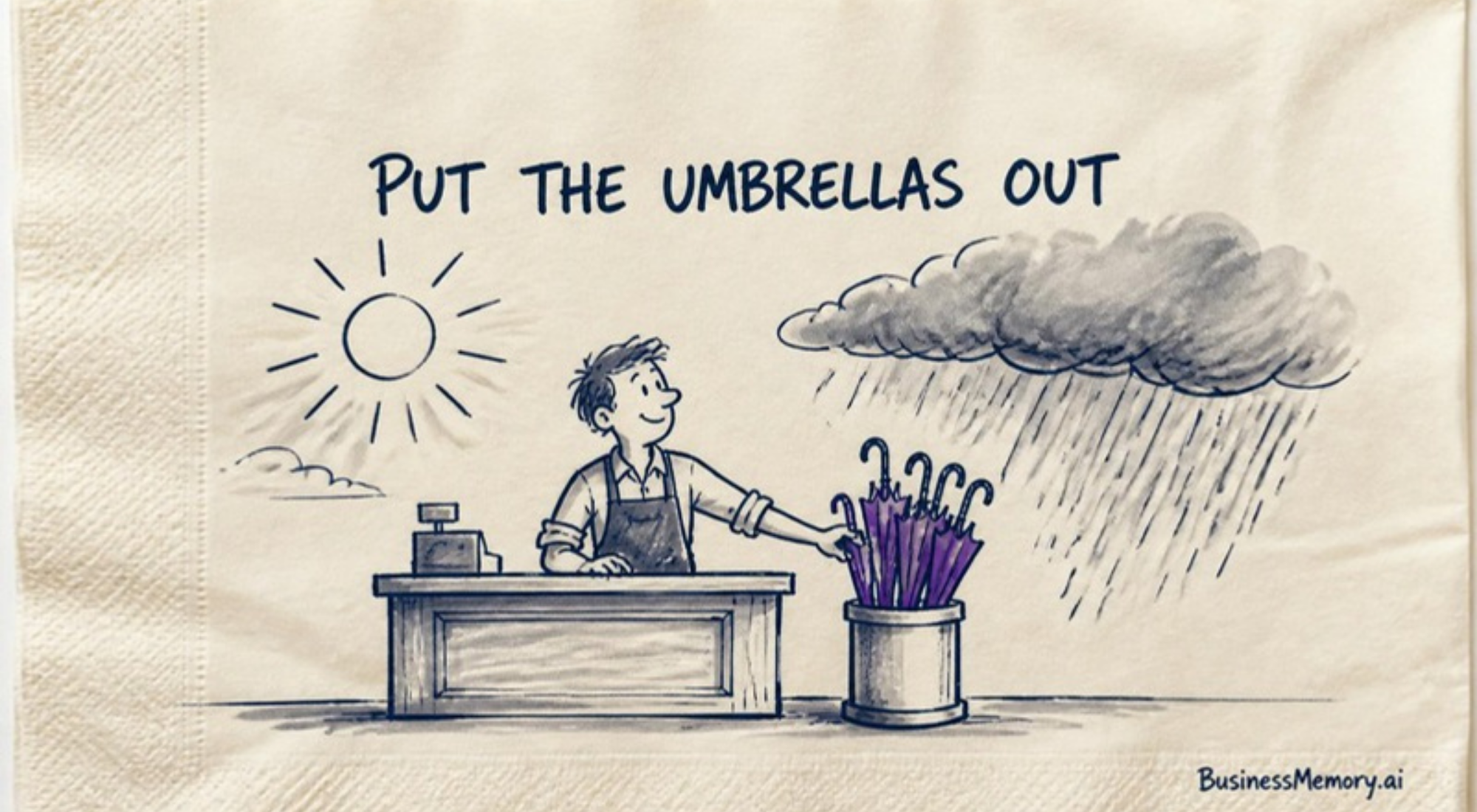
A sunny morning, with a storm coming in the afternoon. At 7-Eleven Japan, the clerk at the counter knew what to do: put the umbrellas out. The next day, the sales showed if that guess was right. A business memory does the same job for your team: everyone writes down what they see, and you check it later.
What can a business memory learn from 7-Eleven Japan?
Let the people closest to your customers write down what they see. Then check it against what really happened.
7-Eleven Japan did a version of this every day. Every employee, part-timers included, placed orders, and a store had about 20 part-timers.
Here is the simplest example. The morning is sunny, but a storm is coming in the afternoon. People leave home without an umbrella. So the clerk puts the umbrellas out.
That is a guess about tomorrow. Then the sales show if the guess was right. Right guesses get repeated. Wrong guesses get fixed.
A business memory does that same job for your company. Everyone on your team writes down what they learn, so the whole business, and any AI you use, can read it back and check it.
Why did 7-Eleven Japan let part-time clerks place orders?
Because the clerk is the one standing at the counter.
The chain's Porter Prize record says the staff who placed orders, "part-time staff included," were pushed to talk with customers and find out what was going on in the neighborhood.
Think about who hears things first. A customer mentions a big event at the school on Saturday. The clerk hears it before lunch. The head office never hears it at all.
Toshifumi Suzuki, the man credited with building 7-Eleven Japan, said it plainly: "We don't place an order because a product has sold well; we place the order because we believe the product will sell well."
So every order was a guess. And the person closest to the customer made it.
A Harvard Business School case on the chain gives more of the guesses they made. A cool day in the middle of summer? Bring out hot steamed buns and hot coffee. The days just before payday? Money is tight, so some stores lowered the price of their boxed lunches.
Guess. Order. Check. Every single day.
By the time the chain won Japan's Porter Prize in 2003, a 7-Eleven Japan store sold ¥650,000 a day on average. That was ¥150,000 more than the average of Japan's top five chains.
What did the cash register miss?
The reason.
7-Eleven Japan put in registers that counted every sale in 1982. Plenty of other businesses bought the same kind of machine in the 1970s and 1980s.
The register could show that umbrellas sold. It could not show that a storm was coming. The clerk knew that part.
So the machine gave the number, and the clerk gave the reason. 7-Eleven Japan used both.
A business memory is not only the owner's notebook. It is a habit everyone on the team can add to.
Why does this matter for business memory and AI today?
Because AI made the tools equal again.
I see the same thing happening with AI in small businesses today. Every owner can rent the same AI for a few dollars a month, the same way every store could buy the same register. (7-Eleven Japan's own part-time job page still asks new staff to "predict demand based on weather and seasonal events, and order products accordingly.")
But in most small businesses, only the owner writes things down, if anyone does.
The person at your front desk hears that a customer's daughter is getting married in May. The helper on the job sees that the old water heater will not last the winter.
Nobody writes it down. So nobody can check it later. And the AI you rent can only read what somebody wrote.
A shared business memory changes that. Everyone you invite reads the same record and adds to it, the way one chart let a whole team of doctors work as one. The note from the front desk sits next to the invoice and the promise. Next month you can ask: "What did we expect, and what really happened?"
Now the honest part. A business memory will not make the guess for you. 7-Eleven Japan spent years teaching its people how to guess well, and the Harvard case says plainly that it was not easy. The record only pays if people write in it, and then check what they wrote.
So I'm committed to letting the people closest to our customers write down what they see, not only me.
A business memory is a private record of everything your business knows — what was agreed, paid, promised and decided — kept on your own computer as plain text files any AI can read, so you can ask anything and get the answer with the exact reference behind it.
The owner does not need to know everything. The team needs to write it down.
Records were never meant for storage. Give your business a memory.
BeBusinessSmart
Questions people ask
What can 7-Eleven Japan teach a small business about business memory?
Let the people closest to your customers add what they learn. At 7-Eleven Japan, every employee, part-timers included, placed orders from a guess about tomorrow, and the sales showed if the guess was right. A business memory works the same way: your team writes down what it sees, so the whole business, and your AI, can read it back.
Did 7-Eleven Japan really let part-timers place orders?
Yes. Its Porter Prize record says all employees, including part-timers, about 20 per store, placed orders. Its part-time job page today still asks new staff to predict demand from the weather and seasonal events and order to it.
What kind of guesses did 7-Eleven Japan's clerks make?
Simple guesses about tomorrow. A sunny morning with a storm coming later meant putting the umbrellas out. A cool summer day meant hot steamed buns and hot coffee. The days before payday meant cheaper boxed lunches at some stores. Then the sales showed if each guess was right.
Do I need 7-Eleven's computers to do this?
No. 7-Eleven Japan built its own systems. Today a business memory is plain text files on your own computer. Your team can add to it, and the AI you already use can read it and answer with the file behind it.