AI Is Using You as Its Memory
Every new chat, you explain your business again from zero. You're not using AI — AI is using you as its memory. Write the business down once instead.

Every new chat, you explain your business again from zero. A friend finally named what was really going on — and it changed how we work with AI.
Why do you have to re-explain your business to AI every time?
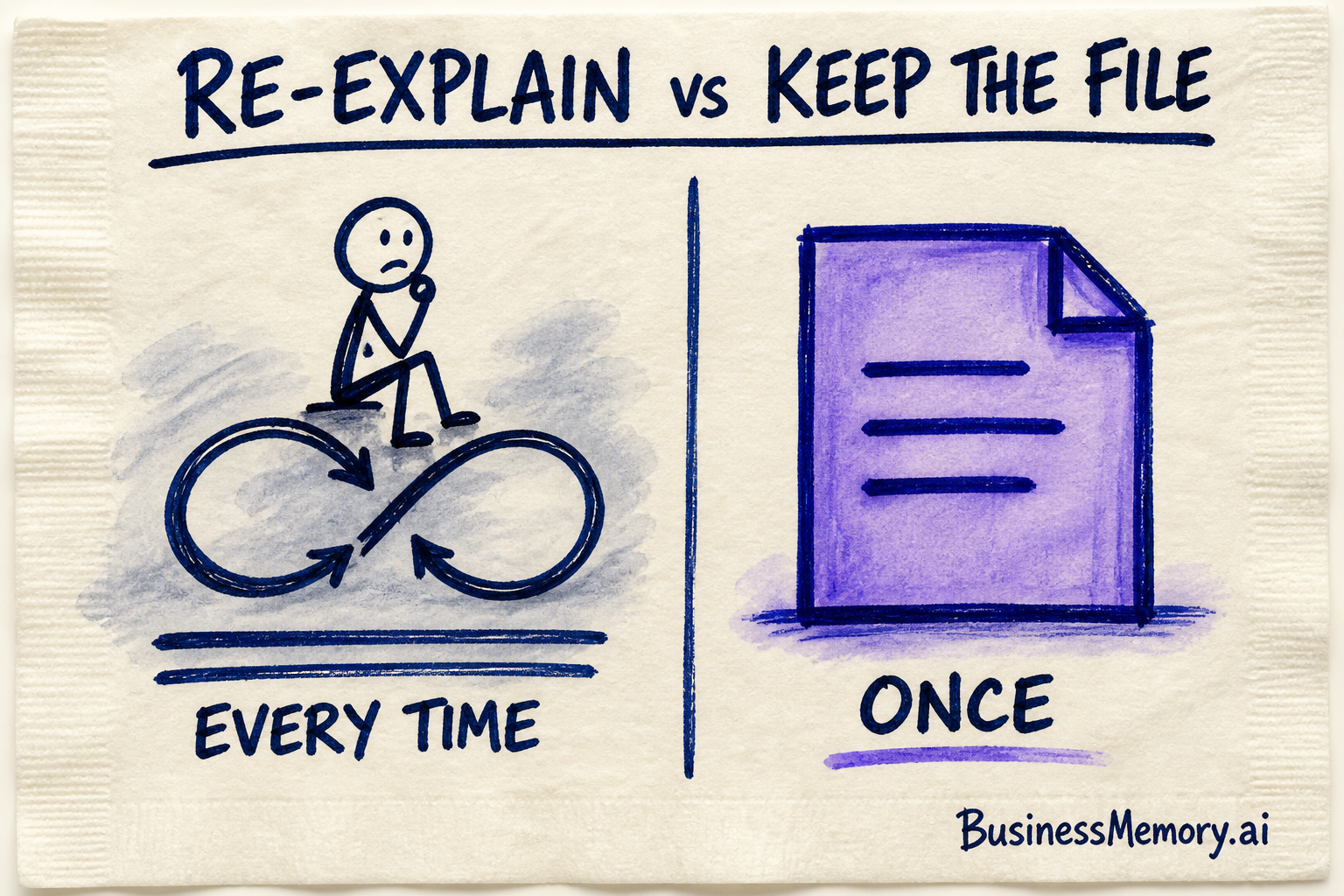
Because most AI tools do not keep a deep record of your business. You are the record. Every new chat starts near zero, so you type who you are, how you work, and what was decided — again — and the answer is only as good as the context you had time to paste in. This is not a small annoyance. MIT's Project NANDA found that 95% of enterprise AI pilots deliver no measurable return, and the report names the reason: most GenAI systems "do not retain feedback, adapt to context, or improve over time." The fix is not a smarter model. It is a business memory— your business written down once, in plain files on your own computer, that the AI reads before it answers.
| You as the memory | A business memory | |
|---|---|---|
| Where the context lives | In your head — and in what you retype | In plain files on your own computer |
| What a new chat starts with | Zero | The whole record |
| Who does the repeating | You, every single chat | Nobody — the AI reads first |
| How good the answer can be | As good as your last prompt | As good as the record you built once |
What does "AI is using you as its memory" mean?
It means the roles got reversed, and nobody noticed.
You think you are using a tool. But if the tool keeps no record of your business, then every session it borrows YOUR memory — your typing, your patience, your afternoon — to do its job.
Of course, chat tools do remember a little these days: account facts, and project workspaces. I have tried all three levels of AI memory, and the shallow ones help. But the detail that actually runs a business — what was agreed, paid, promised and decided — still arrives the same way: you, typing it in again.
How I found out — a few weeks in
We've always relied on our own memory, emails, and scattered Google Docs.
Then, we started using AI.
We soon learned that if we provided detailed context, the AI would give us brilliant answers.
But it was tedious, slow, and unreliable. The moment we opened a new chat, all of that context was GONE.
Then we learned to work with projects. It allowed for more and better context, but it was still difficult to mix subjects.
Recently, a good friend helped me realize: "Hector," he said, "you're not using AI. AI is using you as its memory."
That's how I learned we needed to change if we wanted to get the best out of what these tools could do.
So, for the past few weeks, we've been doing really boring things.
Documenting my businesses.
The goal is to write each company down. Once. Plainly. Who we are, how we work, what we decided, and why.
Now, we're teaching the machine to read from this foundation before it answers.
I've learned that most companies don't have an AI problem. It's a memory problem. I know we had it long before AI showed up.
Now the honest part, because you should hear it from me. This work is boring. There is no magic button — somebody has to sit down and write the business out, and at our place that somebody was us. And the memory can only answer from what we feed it. A page we never wrote is a question it still cannot answer.
But you write it once. And then you stop paying the re-explaining tax, chat after chat, forever.
I would love to learn from you: How are you solving these AI context challenges?
That is what a business memory is for. A business memory is a private record of everything your business knows — what was agreed, paid, promised and decided — kept on your own computer as plain text files any AI can read, so you can ask anything and get the answer with the exact reference behind it.
Stop being your AI's memory.
Give your business one instead.
Frequently asked questions
What does it mean that AI is using you as its memory? If an AI tool keeps no deep record of your business, then you supply the context every session — your typing does the remembering, not the machine. You think you are using the tool, but the tool is running on your memory. The fix is to write your business down once, in plain files the AI reads before it answers.
Why do AI answers about your business feel generic? Because the model only knows what reached the chat. If nothing feeds it your context, it answers from general knowledge — correct in general, useless for your desk. Give it detailed context and the answers turn brilliant; the catch is having to retype that context every time, which is exactly what a business memory removes.
What is the first step to stop re-explaining your business to AI? Write the business down. Once. Plainly. Who you are, how you work, what you decided, and why — as plain text files on your own computer. Then have the AI read from that foundation before it answers. It is boring work, and it is the difference between a chat that starts from zero and one that starts from everything you know.
Do AI projects fail because of the model or the memory? Mostly the memory. MIT's Project NANDA found 95% of enterprise AI pilots deliver no measurable return, and names a learning gap as the core reason: most GenAI systems do not retain feedback, adapt to context, or improve over time. The model was never the weak part — the missing record was.