Coca-Cola Gave Up a Whole Country to Keep One Record Private
A written record you control is an asset — pledged, defended, used. That is what a business memory is for. Coca-Cola once priced its record at the size of a whole country.

A written record you control is an asset — pledged, defended, used. That is what a business memory is for. Coca-Cola once priced its record at the size of a whole country.
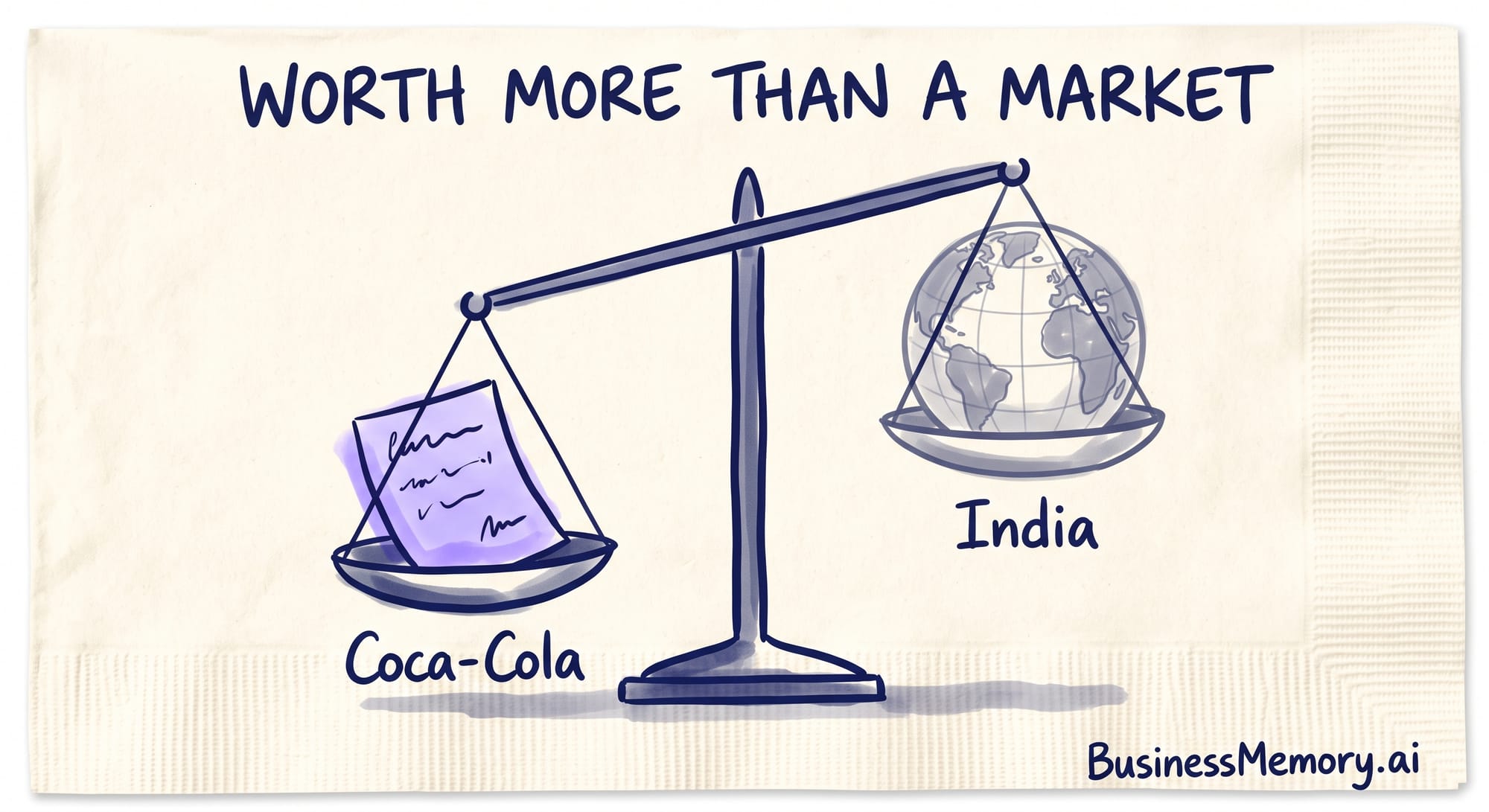
Why did Coca-Cola give up a whole country?
Because by then the record was worth more than a market.
In 1977, India's Foreign Exchange Regulation Act capped foreign equity and the government pressed the company to hand over its formula. Coca-Cola left the country instead.
What it defended was not a taste. It was a WRITTEN record — and the company had only had one since 1919, when a bank asked for the formula on paper as collateral for the loan that bought the business.
Before that it went unwritten for 33 years, and an unwritten thing cannot be pledged, defended or sold. Written and closely held, it became the asset the whole company stood on.
That is exactly what a business memory is for: your costs, your terms and your promises, written down and kept where only you decide who reads them.
| Kept in someone's head | Written into a tool you don't control | Written, kept in your building | |
|---|---|---|---|
| Can you use it | Only when that person is free | Yes, on their terms | Yes, any time you ask |
| Can you prove it | No | Sometimes | Yes — the answer names the file |
| Can you pledge or sell it | No, it is not a thing yet | It is a thing, but not only yours | Yes |
| When the person leaves | It leaves with them | It stays with the vendor | It stays with the business |
| Who decides what is shared | Nobody decided | The terms of service | You, vault by vault |
What turns a record into an asset?
Two things, and you need both.
It has to be WRITTEN, or there is nothing to own.
And it has to be CLOSELY HELD, or everyone owns it.
That is not my framing — it is the test. The World Intellectual Property Organization says information qualifies as a trade secret when it is commercially valuable because it is secret, and known only to a limited group.
Most business advice only gives you half of it.
"Write things down" is half. "Keep your data private" is the other half.
Neither one alone is worth anything.
A business memory is simply both halves in one place: the record gets written as the work happens, and it sits on your own computer where you decide, file by file, what never leaves.
What actually happened to the Coca-Cola formula?
Everybody knows the vault.
Almost nobody knows how the paper inside it got written.
For 33 years there was no written formula at all. It lived with a small group of people, and that was the whole system.
Then in 1919, Ernest Woodruff bought the company and needed collateral for the loan.
A bank will not take a habit as security.
So, by the company's own account, Candler's son was asked to commit the formula to paper — and only then did the most valuable recipe in the world become a thing you could put in a vault.
Now the part I will not sell you, because it is not documented: the famous story that only two executives know the formula and may never fly together.
Coca-Cola does not say that. It circulates anyway, repeated in serious places.
The true version is better, and it is smaller.
A loan officer asked for proof, and somebody had to go and write it down.
What does this cost a small business today?
The same thing, quietly, in two directions at once.
Much of what your business knows never gets written down — the price you agreed by phone, the exception you made for a good customer, the supplier who let you down in March.
That part cannot be used by anybody, including an AI, because it was never a record.
The other half gets written, and then handed over. It goes into a box somebody else owns, on terms somebody else updates.
So the owner ends up with the worst of both: the valuable part is not written, and the written part is not private.
You already know the answer to the second half — we wrote it down in where your data lives.
A policy is a promise; architecture is a fact.
Now the honest part, so you hear it from me. Keeping your files on your own computer is not a magic shield.
If you paste the same paragraph into a public chat box tomorrow, it has left the building, and no folder on your desk can call it back.
Architecture protects what stays inside it. It cannot protect what you carry out.
But that is a choice you get to make, file by file — and until the record exists, you don't even get the choice.
That is the whole reason to give your business one.
A business memory is a private record of everything your business knows — what was agreed, paid, promised and decided — kept on your own computer as plain text files any AI can read, so you can ask anything and get the answer with the exact reference behind it.
Coca-Cola wrote it down because a bank asked.
Write yours down before anybody has to ask.
Records were never meant for storage. Give your business a memory.
Frequently asked questions
Did Coca-Cola really leave a country to protect its formula? Yes. In 1977, under India's Foreign Exchange Regulation Act, the company was pressed to dilute its equity and disclose the formula.
It exited the Indian market instead, and did not return until 1993, when India approved the company's re-entry after a 16-year absence.
Was the Coca-Cola formula always written down? No. By the company's own account, after 1886 the formula "was kept a close secret, only shared with a small group and not written down." It stayed that way for 33 years.
It was first committed to paper in 1919, when Ernest Woodruff needed collateral for the loan that bought the company — a bank would not accept an unwritten recipe as security.
What makes a business record an asset? Two things together: it has to be written, or there is nothing to own, and it has to be closely held, or everybody owns it.
WIPO's own test for a trade secret is information that is commercially valuable because it is secret and known only to a limited group.
Is it true that only two Coca-Cola executives know the formula? That story circulates widely, but the company does not state it, and this page does not use it.
The documented facts are the ones above: unwritten until 1919, written for a bank, and defended.
What is a business memory? A business memory is a private record of everything your business knows — what was agreed, paid, promised and decided — kept on your own computer as plain text files any AI can read, so you can ask anything and get the answer with the exact reference behind it.