Of Course You Don't Remember. That Is Why Your Business Needs a Business Memory.
You forgot the price you quoted in March. Your brain was built to let old things go — so your business needs a business memory.

You forgot the price you quoted in March, and you called it a personal failure. It isn't. Your brain was built to let old things go — so your business needs a business memory that keeps them.
Why does a business need a business memory if the owner has a good memory?
Because even a good memory is built to forget. In 2017, two brain scientists at the University of Toronto, Blake Richards and Paul Frankland, wrote in the journal Neuron that the goal of memory is not to keep everything. It is "to guide and optimize intelligent decision making by only holding on to valuable information."
So your head lets go of what looks like old news. The price you quoted in March. The exception you made for one customer. What you said on Tuesday's call.
Your customer still holds you to all of it.
That is why the record of a business cannot live in a head. It belongs in a business memory. A business memory is a private record of everything your business knows — what was agreed, paid, promised and decided — kept on your own computer as plain text files any AI can read, so you can ask anything and get the answer with the exact reference behind it.
Is forgetting business details a personal failure?
No. But most of us treat it like one.
Forgot the exception.
Forgot why the offer died.
Forgot what you said on Tuesday's call.
Then we call it a personal failure. We say we are too busy, or getting older, or careless.
It isn't.
We keep punishing ourselves for a design feature.
The scientists who study forgetting have been saying it for years. "Maybe the brain is designed to forget information," Ronald Davis, a neuroscientist at The Scripps Research Institute, told Quanta Magazine in 2018.
Honestly, that is good news. Your head is not broken. It was just never the right place to keep your business.
What does your brain let go of first?
The things that stopped helping your next decision.
That is how the Toronto researchers put it: forgetting lets us let go of "outdated and potentially misleading information" so we can handle a world that keeps changing.
Now look at your own week that way.
To your head, March is old news. To your customer, March is the deal.
The quote went out. The job moved on. So your brain treats that price like something it does not need anymore — which is exactly what a healthy brain is supposed to do.
But a promise does not end because your head moved on.
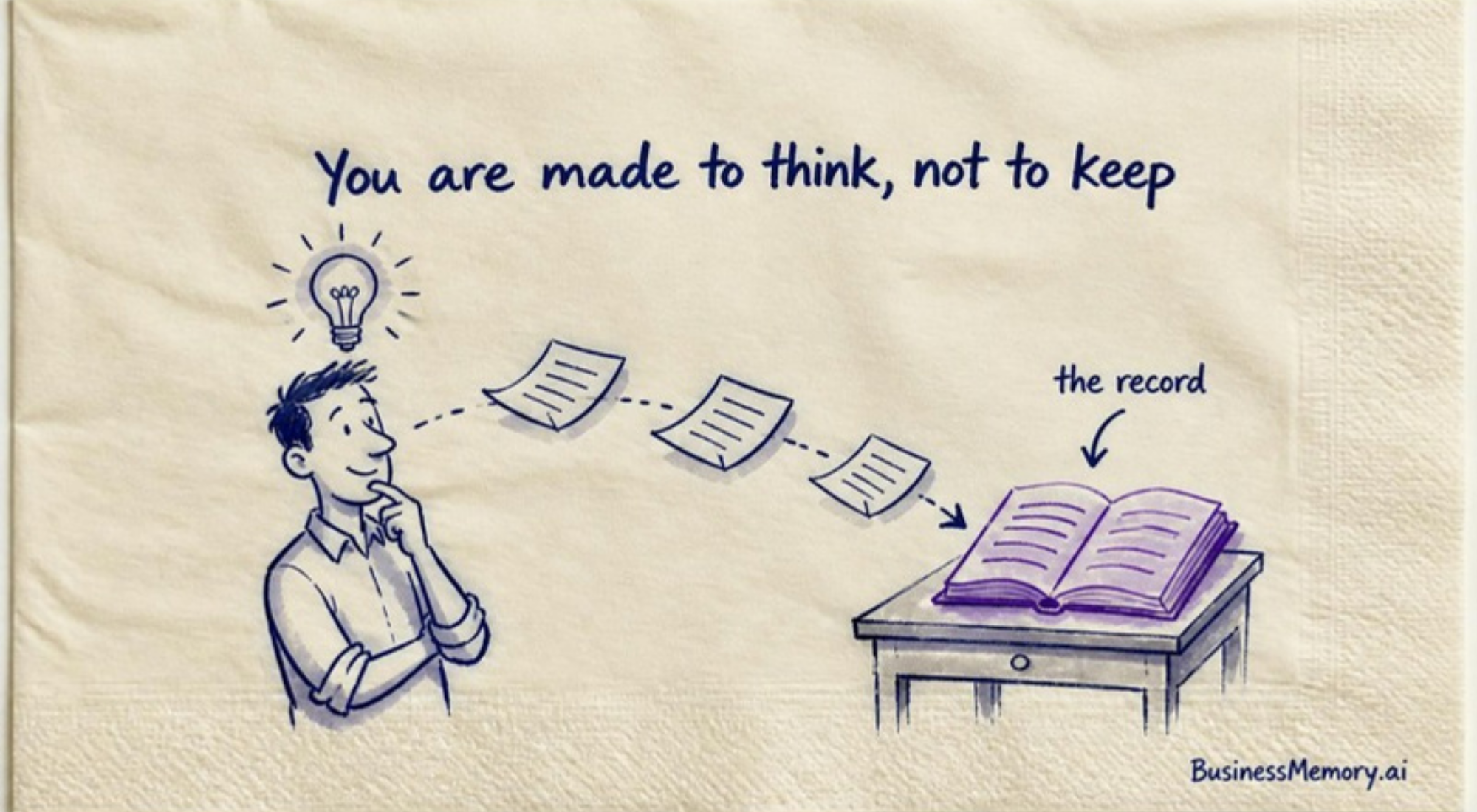
Your head was made to think. It was NEVER made to keep the record.
What does a business memory keep that your head lets go?
Everything the business already knows. Written down, outside every head.
David Allen, the man who wrote Getting Things Done, said it in one line years ago: "Your mind is for having ideas, not holding them." He was talking about your to-do list.
A business needs the same thing, one size bigger. Not a list of tasks. The record of what was agreed, paid, promised and decided.
So here is how a business memory works, in three plain steps:
- Write it down where it can be found. Not in a text thread. Not on the back of an invoice in the truck.
- Date it. A promise with no date is just a story somebody remembers.
- Make the next session quote it before it starts. The next time you, your team or your AI sit down to work, the record comes first.
Because the record is plain text on your own computer, any AI can read it. So when you ask, "What did we agree with this customer in March?", you get the answer with the file behind it — not your best guess.
And forgetting has a real price when somebody asks for proof. We counted some of those bills here.
What can a business memory not do for you?
Now the honest part, from our side.
A business memory does not make you remember. It makes remembering the record's job instead of yours.
And it can only keep what reaches it. A promise made on a phone call and never written down is still a promise it cannot find. Somebody has to write it down, the day it happens.
That is the whole habit. The memory does the rest.
So I'm committed to keeping mine: every deal, every price, every promise, written down the day it happens — so my head is free to do what it was made for.
Let your head do the thinking. Let your business memory do the REMEMBERING.
Records were never meant for storage. Give your business a memory.
BeBusinessSmart
Frequently asked questions
Why does a business need a business memory if the owner has a good memory?
Because even a good memory is built to forget. University of Toronto researchers Blake Richards and Paul Frankland wrote in 2017 that memory exists to guide good decisions by holding on to valuable information only. A price from March looks like old news to your head, but your customer still holds you to it — so the record belongs in a business memory, not in a head.
Is forgetting things at work a sign of a bad memory?
Usually not. Letting go of old details is part of how a healthy brain works, so it can deal with what is new. The problem is not your memory. It is keeping the record of your business in a place that was built to let things go.
Where should a small business keep its promises and decisions?
In one written record outside anyone's head. Write each promise down, date it, and read the record before the next piece of work starts. A business memory keeps that record as plain text files on your own computer, so any AI can answer from it with the source shown.
Can a business memory remember something nobody wrote down?
No. A business memory keeps what reaches it. A promise made on a phone call and never written down is still missing. The habit is simple: write it down the day it happens, and the memory keeps it from there.
Takeaway: A business memory is a private record of everything your business knows — what was agreed, paid, promised and decided — kept on your own computer as plain text files any AI can read, so you can ask anything and get the answer with the exact reference behind it.