What Goes Into a Business Memory? Meetings, Papers and Expenses
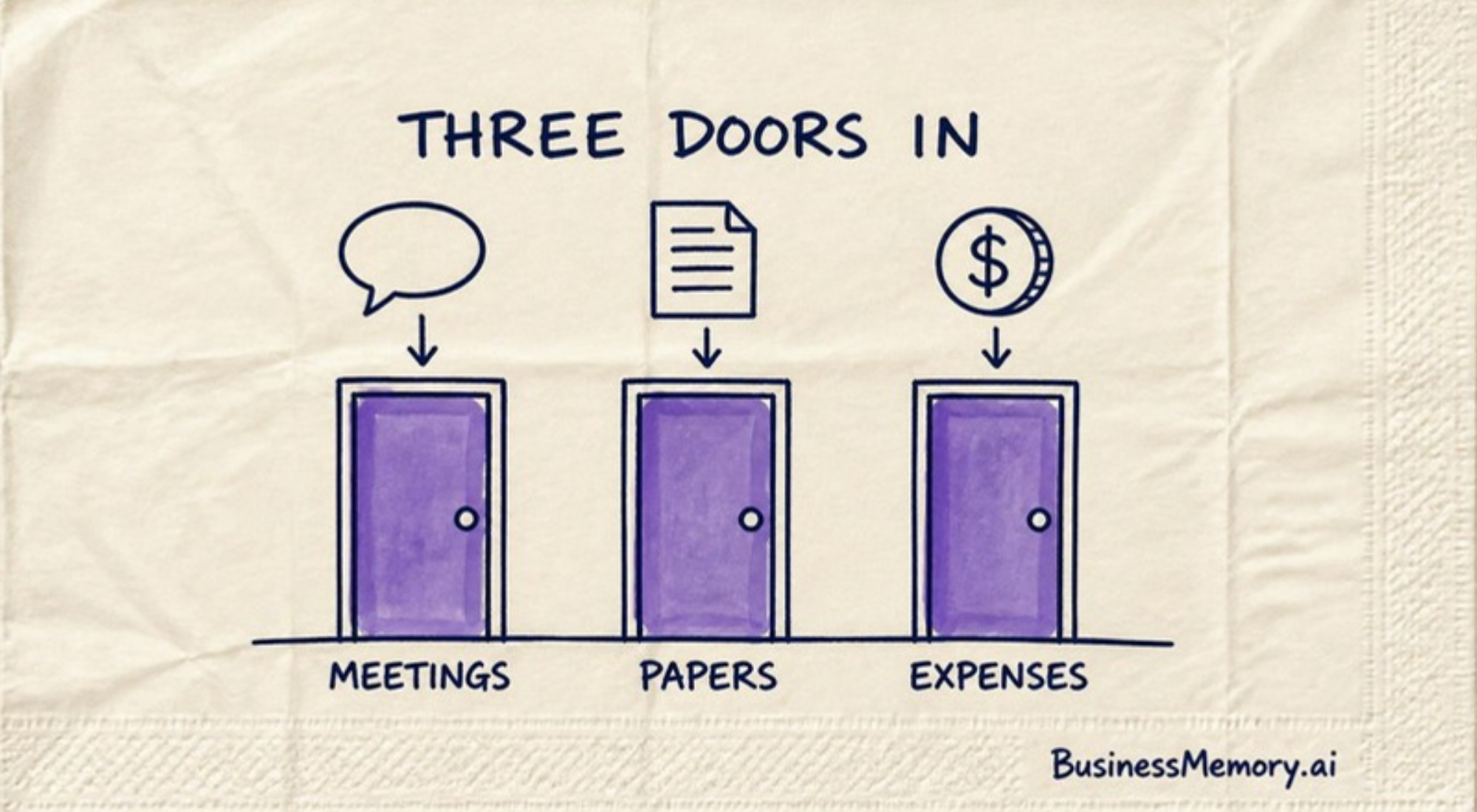
Three things go into a business memory: meetings, papers and expenses, each through its own door. If it never came through a door, it is not in there.

Three kinds of things go in, each through its own door. Here is what goes through each one, what you can ask it later, and the one thing that never gets in.
What goes into a business memory?
Three things: meetings, papers and expenses. Each one comes in through its own door.
Meetings come in recorded or noted. A call with a supplier, a visit to a job, ten minutes with a customer in the parking lot.
Papers are contracts, receipts and photographs. The quote you sent, the contract you signed, the photo of a sign-off on a clipboard.
Expenses are one line per payment, filed by what the money was for.
The night each piece arrives, it is filed by what it is about, not by which folder you remembered to open.
And here is the honest rule. If it never came through a door, it is not in there. A call nobody recorded is a call it never heard.
A business memory is a private record of everything your business knows — what was agreed, paid, promised and decided — kept on your own computer as plain text files any AI can read, so you can ask anything and get the answer with the exact reference behind it.
| What you have in your hand | The door it goes through | What you can ask later |
|---|---|---|
| Notes from a visit to a job | Meetings | What did we agree, and with whom? |
| A recorded call with a supplier | Meetings | What price did they give us, and when? |
| A photo of the signed quote | Papers | What did the customer sign? |
| The contract, as a file | Papers | What did we promise, and by when? |
| The receipt from the counter | Papers | What did we buy for this job? |
| The payment for materials | Expenses | What has this job cost us so far? |
| A call nobody wrote down | No door | Nothing. The memory never heard it. |
Where does the record of a small business live today?
Picture Friday night. You park the truck and look at the passenger seat.
A receipt from the lumber yard. A quote with a coffee ring on it. A price somebody wrote on the back of a business card.
Then your phone. Two hundred photos, and three of them matter. A voice memo you made after a site visit on Tuesday.
Then your head. What you promised the customer on Elm Street, and the day you promised it.
So most owners keep the business in five places at once: the seat, the phone, the drawer, the email, and whatever the accountant has.
Nothing on that seat is lost. Yet none of it can answer a question.
Which door does each thing go through?
Take the same pile, one piece at a time.
The voice memo from Tuesday goes through the first door, meetings. So does the call with the supplier, if it was recorded, or three lines you typed after you hung up.
The quote with the coffee ring, the receipt and the business card go through the second door, papers. A photo is enough. They are filed by subject, so the receipt for the Elm Street job lands with the Elm Street job.
The money that left for the lumber goes through the third door, expenses. One line for the payment, filed by what it was for.
And the promise in your head, the one for the customer on Elm Street?
It goes in the moment it lands on a recorded call, or in three lines you write after the visit. Until then, it lives only in your head.
What does not go into a business memory?
You should hear this from us, not find it out later.
- A call nobody recorded or noted. It never came through a door, so the memory never heard it.
- What lives only in your head. It does not read your mind. Say it on a recorded call, note it or photograph it, and it is in.
- Private records, in a vault you share. Sharing goes by vault, and everyone you invite to a vault sees all of it. So private records go in a vault you never share.
- Decisions. It is not a CRM, a to-do app or a calendar. It keeps the record. You make the calls.
Isn't a business memory just a company knowledge base?
No, and the difference is what goes in.
Most guides to a company knowledge base start with what you should write. One good guide for small businesses says to start with "every question that gets asked twice" and the processes only one person knows.
That is smart advice for a handbook.
A business memory starts somewhere else. Nobody has to sit down and write a handbook for it. It takes what your day already made: the call, the paper, the payment.
A handbook tells your team how things are done. A business memory tells you what actually happened, and shows you the file.
Why does a business memory have only three doors?
So you always know what is in it.
Honestly, the doors are few on purpose. Three doors are easy to remember on a Friday night with a full passenger seat.
If it came through a door, it is in. If it did not, the memory never heard it.
No guessing, and no surprise in March when you need that quote.
So I'm committed to putting every promise, every paper and every payment through a door the day it happens. Not on Friday night.
A business memory is a private record of everything your business knows — what was agreed, paid, promised and decided — kept on your own computer as plain text files any AI can read, so you can ask anything and get the answer with the exact reference behind it.
Your business makes a record every single day. It belongs in the memory, NOT on the passenger seat.
Records were never meant for storage. Give your business a memory.
BeBusinessSmart
Questions people ask
What goes into a business memory?
Three things, through three doors. Meetings, recorded or noted. Papers, like contracts, receipts and photographs. And expenses, one line per payment. Each piece is filed the night it arrives, by what it is about.
What does not go into a business memory?
Anything that never came through a door. A call nobody recorded or noted is a call it never heard, and it does not read your mind. It is also not a CRM, a to-do app or a calendar.
Do I have to sort things before they go into a business memory?
No. It files each piece by what it is about, not by which folder you remembered to open. When it is not sure, like two customers with the same last name, it asks you one question instead of guessing.
Is a business memory the same as a company knowledge base?
No. A knowledge base holds pages people write, like how-to guides and answers to common questions. A business memory holds what actually happened, the meetings, papers and payments, and every answer shows the file it came from.