What Is a Company Brain? The Question Every Guide Skips
Every company-brain guide agrees on four jobs. Not one says whose computer the brain is on. The plain definition, the four jobs, and the fifth job nobody lists.

What is a company brain?
A company brain is a shared memory of what a company knows — its files, emails, chats, decisions and rules — kept current and connected, so people and AI tools can ask it a question and get an answer with the source behind it. The name took off in 2026, when the companies selling one began publishing their own guides. Those guides agree on four jobs: capture what the company learns without anyone typing it in, stay current, keep track of who may see what and where each answer came from, and let AI agents use it. What the guides leave out is where the brain lives. Of the four I read, one says where it runs, and none says who keeps the brain when you stop paying. A business memory does the same job in plain text files on your own computer, so that question is already answered.
What does a company brain have to do?
The sellers' own list has four jobs. Here is each one in plain words, and how a memory you own does it.
1.- Capture without typing. A brain that waits for someone to write things down dies the way the company wiki died. In mine, small helper programs drop my emails, my bank statements and my meeting notes into the folder as plain text files. Nobody types them in.
2.- Stay current. New files land beside the old ones, and each file says at the top what it is and when it was written.
3.- Know who may see what, and where an answer came from. Sharing is by vault: one shared folder for the team, a private one for me. And every answer names the file it came from.
4.- Let AI use it. There is now a standard for plugging AI tools into data, the Model Context Protocol, and it is a good thing. But a plain text file on your disk needs no standard at all. Any AI can open it today.
There is a fifth job, and it is not on anyone's list. Know what is true today. More on that below, because it is the one that bit me.
How does a company brain compare with a business memory?
| Company brain, as sold in 2026 | Business memory | |
|---|---|---|
| What it is | A knowledge layer the seller builds from your apps | Plain text files on your own computer |
| Built for | Teams running AI agents, mostly twenty people and up | The owner, and a small team |
| Where it lives | The seller's service, on their servers or run by them for you | Your own disk |
| Who builds it | The seller's software | Small scripts you run, and you |
| When you stop paying | The guides do not say | Nothing happens. The files were always yours |
| How you check an answer | Source links inside their platform | Open the file. Every answer names it |
| Teamwork | Accounts and permissions the seller manages | The whole team works from one shared vault, and everyone in a vault sees the whole vault |
| Who may see what | Set per person, inside their system | Set per vault, a folder you can see |
Where should a company brain live?
That is the question the guides skip, and for an owner it is the whole question.
A big company can make a seller sign for audits and guarantees. An owner signing up by the seat gets a checkbox.
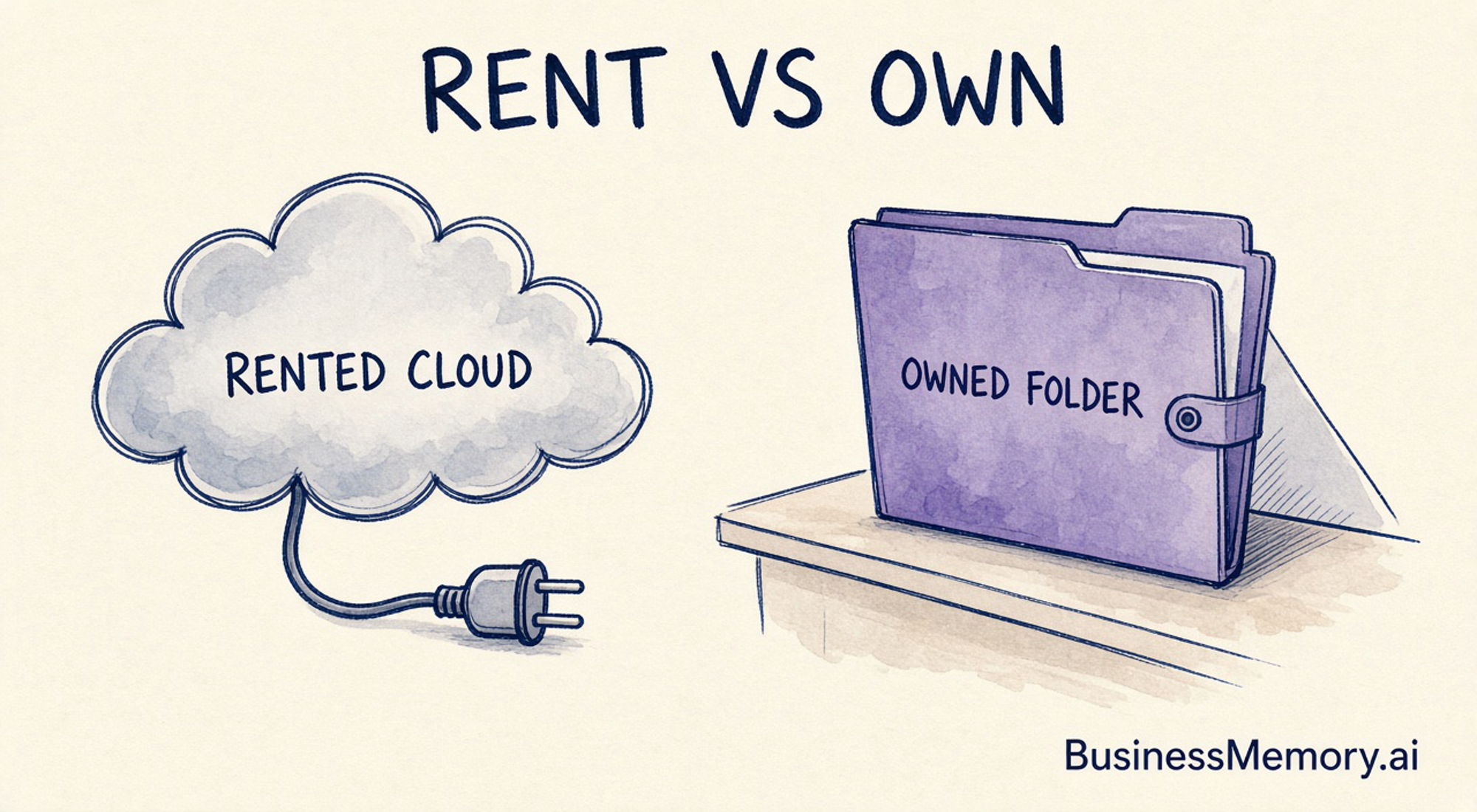
So here is the rule I use. The brain that shows you the file is the brain you can own. If an answer points at a file on your disk, you can open it, check it, fix it, and keep it the day you stop paying anyone. If it points at a page inside someone's platform, you can read it for as long as the bill is paid.
Every company brain fights the same disease, corporate amnesia: the know-how that walks out the door when people leave. Renting the cure works. Owning it is the only version that stays with you. The full rent-or-own case is in Company Brain vs Business Memory.
What does a company brain do when two files disagree?
Last month I opened one folder in my own business memory and found three files side by side.
Pricing 2024. Pricing Ideas. Pricing Current.
Three files. One question: what do we charge?
An AI that grabs whichever file it finds first will answer with total confidence. A brain that cannot tell old from current is not a brain. It is a rumor with a search bar.
So I asked mine anyway. "What do we charge for the standard job today?"
The answer came back with the number, and under it, the name of the file it came from: Pricing Current, dated this year.
I clicked. It was the right one.
Honestly, the magic is not that the AI is smart. The magic is that it had to show me its work. Because the answer named the file, I could see in one click that it was the current one. And the day it pulls the 2024 sheet by mistake, I will see that too. Then I fix the file, not argue with a chatbot.
That is the fifth job, the one no seller's list carries: telling facts from decisions, and old numbers from current truth. In my memory, each file says at the top what it is: history, an idea, or the current call. Programmers call the idea a single source of truth. I call it not getting burned by my own old price list.
Now the honest part. Sharing in a business memory is per vault, not per person: everyone you invite to a vault sees the whole vault. For my team that line is simple, and I can see it. It is not enterprise permissions, and I would rather say so. And a file only tells the truth if somebody wrote at the top what it is. In mine, that somebody is me.
A company brain is a good idea. I want one. I just want it on my own computer.
A business memory is a private record of everything your business knows — what was agreed, paid, promised and decided — kept on your own computer as plain text files any AI can read, so you can ask anything and get the answer with the exact reference behind it.
Records were never meant for storage. Give your business a memory.
#BeBusinessSmart
Frequently asked questions
What is a company brain?
A company brain is a shared, current memory of what a company knows — files, emails, chats, decisions and rules — connected so that people and AI tools can ask it a question and get an answer with the source behind it. In 2026 the name is used mostly by companies that build that memory for you from your apps, as a service.
Is a company brain the same as a business memory?
They do the same job. The difference is where it lives and who owns it. A company brain, as sold today, is built and run by the seller. A business memory is plain text files on your own computer that any AI can read, so every answer can point at the exact file, and nothing changes the day you stop paying anyone.
Is a company brain just a wiki or a knowledge base?
No. A wiki only knows what someone remembered to type into it, and it goes stale the month people get busy. A company brain is supposed to capture what the company learns without anyone typing, stay current, and let AI use it. That is the promise. Whether it lives on your computer or the seller's is a separate question, and the guides do not answer it.
Where does a company brain keep your data?
In the products sold under the name today, the seller builds the brain from your apps and runs it as a service. Of the four vendor guides read for this post, one says where it runs and none says what happens to the brain when you cancel. A business memory keeps everything on your own disk, so there is nothing to retrieve and no export window.
Does a small business need a company brain?
A small business needs the job done: one place that knows what was agreed, paid, promised and decided, that AI can read, and that shows the source of every answer. It does not need a twenty-seat platform to get it. Plain text files on the owner's own computer do the job, and the owner keeps them.