What Happens When AI Answers About Your Company Without a Business Memory
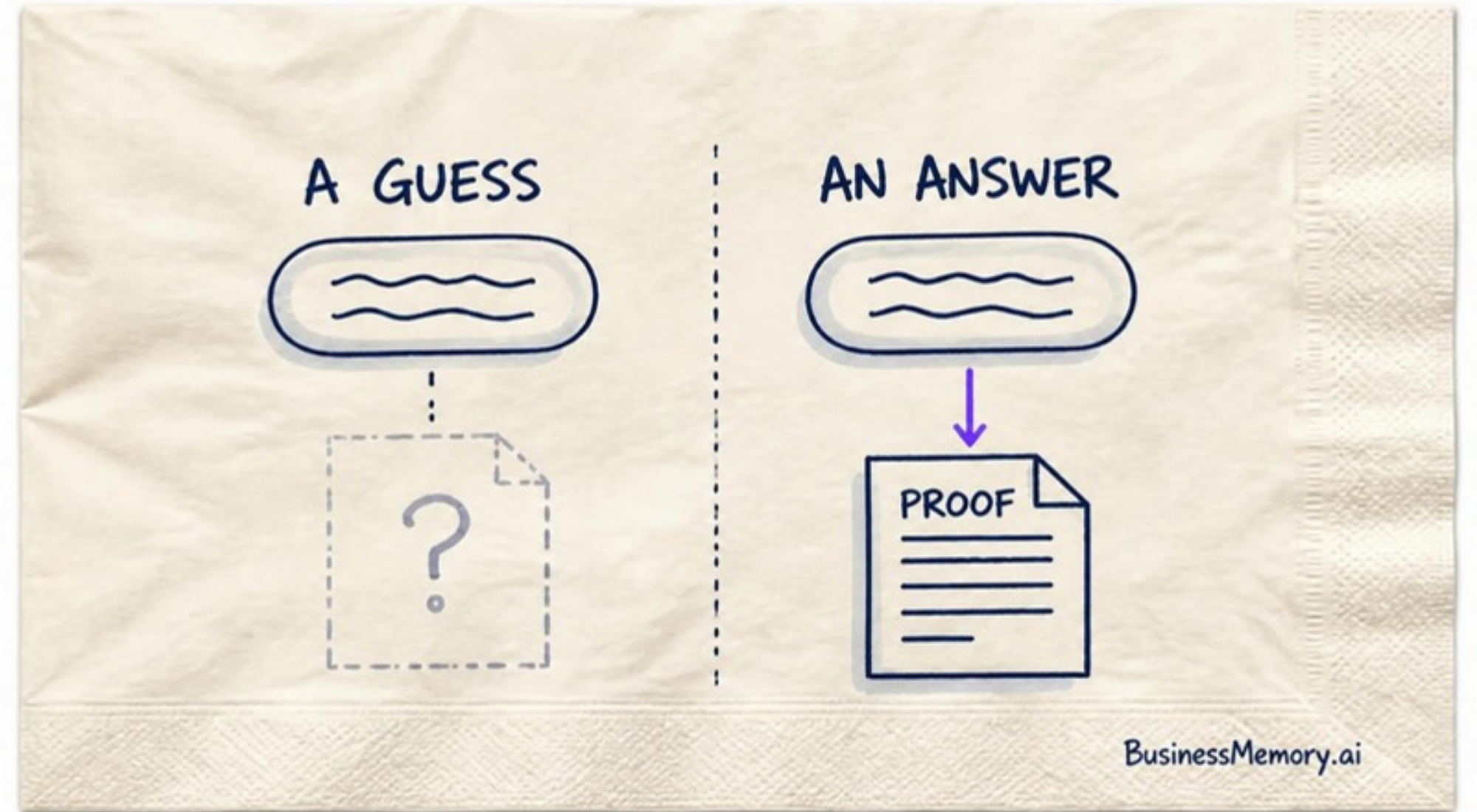
Without a business memory, AI answers about your company from the open internet: fluent, sure, and with no file behind it for you to check.

One of two things. It tells you it cannot see your records, which is honest and no help. Or it answers anyway. Without a business memory, an AI knows the open internet, millions of other businesses, but not the one you asked about: yours. So when your question needs a fact only your business wrote down, it fills the gap with something that sounds right, in the same calm voice it uses when it IS right. And there is no file behind that answer, so you cannot check it.
OpenAI's own researchers put it plainly: "Like students facing hard exam questions, large language models sometimes guess when uncertain."
The fix is not a smarter AI. It is your own record. A business memory is a private record of everything your business knows — what was agreed, paid, promised and decided — kept on your own computer as plain text files any AI can read, so you can ask anything and get the answer with the exact reference behind it.
Where does a wrong answer about your company come from?
Let's open one up, one step at a time.
It's Thursday. A customer calls.
"Last spring you told me that price was good for a whole year."
Did you? You don't remember. So you open your AI and type: "What price did we give the Lopez job last spring?"
Here is what happens next, without a business memory.
- The question needs one fact. A price your business gave one customer, on one day.
- The AI looks at what reached the chat. One line from you. No quote, no email, no invoice.
- It looks at what it learned from the internet. How millions of other businesses price their jobs. Not one word about the Lopez job.
- It looks at your old chats, if it keeps them. Maybe you said "Lopez" once, in a chat about something else. Nobody filed it under Lopez.
- The gap is still there. So it writes something that sounds right.
- The answer arrives. Clean, polite and sure of itself.
Maybe it is even right. You can't tell.
That is the moment the trouble starts. Not when the AI guessed. When you had nothing to check it against.
Why does AI sound so sure when it is wrong?
Because the tool that guesses and the tool that knows speak in the same voice.
The same OpenAI paper shows it with one of its own authors. The researchers asked an AI for his birthday and added, "If you know, just respond with DD-MM." Three tries. Three different dates. All three wrong.
It was told to answer only if it knew. It answered anyway.
The researchers also say why. The way these tools are trained and tested rewards a guess more than an honest "I'm not sure." Of course, a wrong birthday for a stranger costs nothing.
A wrong price for your customer is a phone call you have to win.
Isn't my chat history enough?
No. Chat history is not a filing system.
A chat keeps what you typed, on the day you typed it. It does not keep the quote you never pasted. It does not keep the email your office manager sent. And it cannot hand you the paper behind its answer, because the paper was never in the chat.
So the old chat helps a little. But it is still you, trying to remember what you once told a machine.
What is the fix?
Your record first. Then any AI.
A business memory keeps your quotes, invoices, contracts and emails as plain text files on your own computer, each one filed by what it is about. The Lopez job has a place. The price you gave, the date you gave it and the email that confirmed it all live there.
Now go back to Thursday.
You type the same question. This time the AI reads your record before it answers. The answer names the file: the Lopez quote, the date on it, the line with the price. You open the file and read it yourself, with the customer still on the phone.
Honestly, the AI did not get any smarter. It got your record.
An AI without your record is not bad. It is blind.
And the best part? The record is plain text, so it works with the AI you use today and the one you switch to next year.
Now the honest part. A business memory can only answer from what was written into it. A promise nobody wrote down is still a gap. The difference is that now you can SEE the gap, instead of getting a guess dressed as an answer.
The internet knows a lot about business. Only your record knows YOUR business.
Questions people ask
What happens when AI answers about my company without a business memory?
It either says it cannot see your records, or it answers anyway from what it learned on the open internet. When your question needs a fact only your business wrote down, the AI fills the gap with something that sounds right, and there is no file behind the answer for you to check.
Why does AI sound confident when it is wrong?
Because the same voice carries a guess and a fact. OpenAI's researchers wrote that language models "sometimes guess when uncertain," because the way they are trained and tested rewards a guess over admitting doubt. In their paper, an AI asked for an author's birthday "if you know" gave three different wrong dates.
Is my chat history the same as a business memory?
No. A chat keeps what you typed, on the day you typed it. A business memory keeps what your business agreed, paid, promised and decided, as plain text files on your own computer, filed by what each one is about, and every answer names the file it came from.
How do I get AI to answer correctly about my own business?
Give it your record before you ask. Keep your quotes, invoices, contracts and emails in a business memory, as plain text files any AI can read. Then the AI answers from your files instead of from the internet, and shows you the exact file so you can check it yourself.
Keep reading
- What is a business memory?
- AI Is Using You as Its Memory
- The Best Thing Our Business Memory Does Is Stop
Records were never meant for storage. Give your business a memory.