
How a Business Memory Files Itself Overnight
You do the work in the day. Overnight, your business memory files it by what it is about. Your part is about ten minutes a day.

You do the work in the day. Overnight, your business memory files it by what it is about. Your part is about ten minutes a day — and we would rather tell you that now.
How does a business memory file itself overnight?
While you sleep, your business memory reads what came in that day and files each piece by what it is about.
A meeting is linked to the people and the job it was about. A contract, a receipt or a photo is filed by subject, not by the folder you remembered to open. A payment is filed by what it was for.
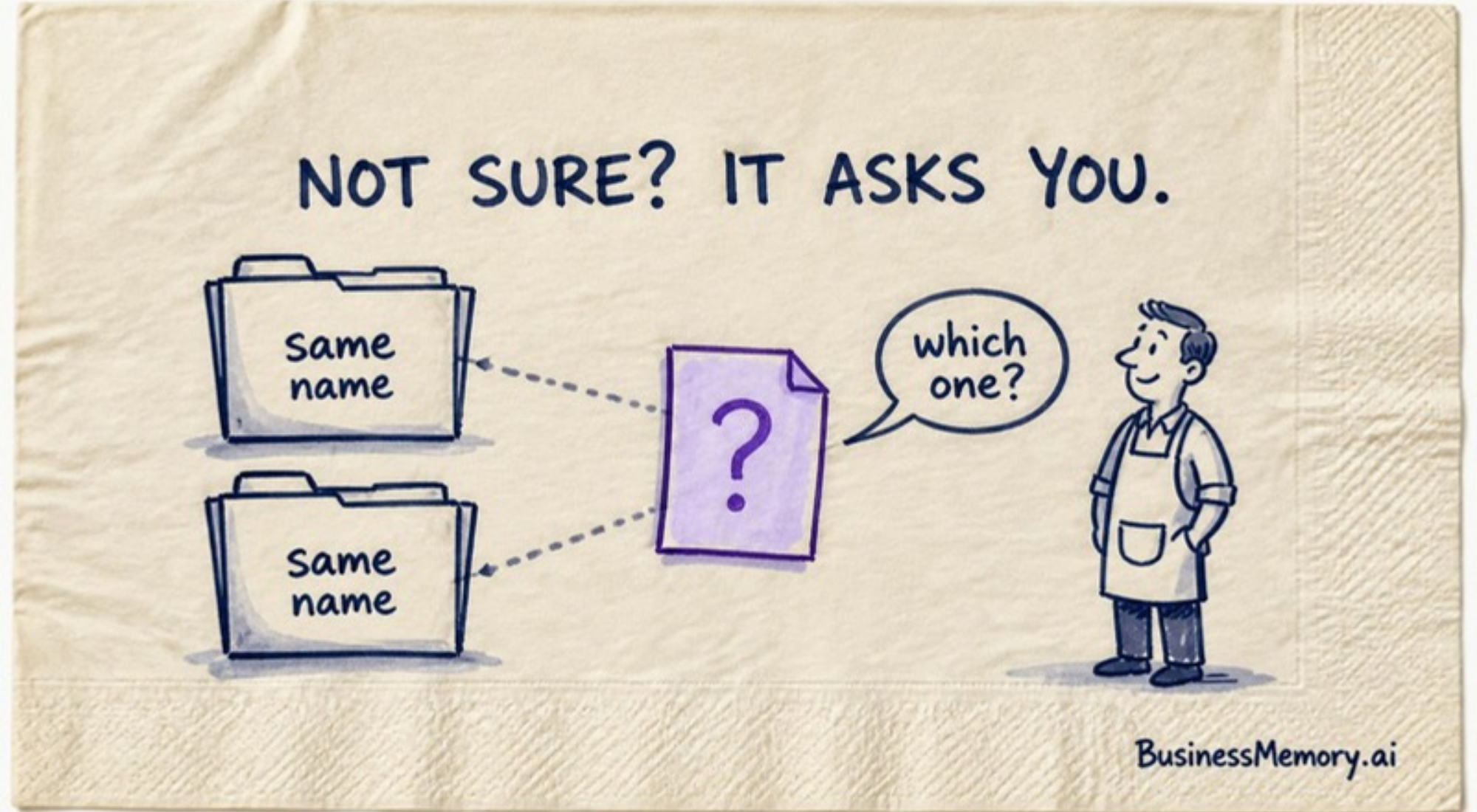
When it is not sure where something goes, it does not guess. It sets that one item aside and asks you one sentence.
Your part is about ten minutes a day. And your computer has to stay awake.
A business memory is a private record of everything your business knows — what was agreed, paid, promised and decided — kept on your own computer as plain text files any AI can read, so you can ask anything and get the answer with the exact reference behind it.
Who files the papers in your business today?
Every business has a librarian. Most of them never applied for the job.
It is the owner, at the kitchen table, at eleven at night. The signed quote is a photo on the phone. The promise is in a text message. The receipt is in the truck.
Honestly, most owners are not careless. They are BUSY. The filing waits for a quiet evening, and the quiet evening never comes.
So the job has no name, no hours and no pay. It still has to be done — because a paper nobody filed is a paper you have to hunt for the day the customer calls.
What does "filed by what it is about" mean?
It means the paper goes where the question will come from.
Many AI filing tools sort a paper by what KIND of paper it is. Filex AI, a document tool for small businesses, says it plainly: "Contracts go to Legal. Receipts go to Expenses." Ajooni AI sorts into folders like "Receipts, Invoices, Tax Documents, Contracts." That is real help, and those tools do it well.
But a customer never calls about "Receipts."
She calls about her bathroom.
So a business memory files the other way around. The quote, the photo from the job and the payment for the tile are all about the same bathroom, so they end up together. When you ask about that bathroom, the answer points at the file it came from, and you open it and read it yourself.
What happens overnight, step by step?
- During the day, your work comes in through three doors: meetings, papers and expenses.
- The night it arrives, each piece is filed by what it is about. Meetings are linked to the people and jobs they belong to.
- Anything it is not sure about waits. Two customers with the same last name, an invoice that could belong to either of your businesses, a note that belongs to your family and not your company.
- It sets that item aside and asks you one sentence, instead of deciding for you.
That is the night shift. Nobody had to stay late for it.
How much of my time does a business memory take?
Not zero.
Setup is about an hour for an interview that teaches it your world — your people, your customers, your jobs. Then an afternoon for the install.
After that, our own home page says it straight: "Ten minutes a day is the job." You answer the one sentence it asked, you look at the morning page, and you go to work.
And the honest part: "Skip a month and you have a filing cabinet again."
So the night does the filing. You still own the ten minutes.
Does my computer have to stay on at night?
Yes. This is the one thing it needs from you at night.
Your business memory lives on your own computer, in your own files. No vendor cloud holds your record. That is the whole point — and it has a price.
It will not work on a sleeping computer. It needs your machine awake and the app open.
If the laptop closes at six and opens at eight, the night had nothing to work with.
How do I know last night's filing is done?
Look at the date on the morning page.
Today's date means last night's filing is done. An old date is an alarm, and you see it the same morning, not three weeks later. We wrote about why silence should never look like success.
Why does a business memory work at night?
Because filing was never the owner's real job. It was just the job nobody else would take.
You stop being the librarian. You stay the owner.
So I'm committed to keeping the owner's part small and honest — ten minutes a day, said out loud, and never sold as zero.
A business memory is a private record of everything your business knows — what was agreed, paid, promised and decided — kept on your own computer as plain text files any AI can read, so you can ask anything and get the answer with the exact reference behind it.
Your day belongs to your customers. The NIGHT belongs to the filing.
Records were never meant for storage. Give your business a memory.
Questions
How does a business memory file itself overnight?
The night each piece of work arrives, it is filed by what it is about. Meetings are linked to the people and jobs they belong to, papers are filed by subject, and payments by what they were for. Anything it is not sure about is set aside, and it asks you one sentence.
How much time does a business memory take each day?
About ten minutes a day, after an hour-long interview and an afternoon for the install. You answer the sentence it asked and look at the morning page. Skip a month and you have a filing cabinet again.
Does my computer have to stay on for a business memory?
Yes. A business memory lives on your own computer, so it will not work on a sleeping one. It needs your machine awake and the app open at night.
What happens when a business memory is not sure where something goes?
It does not guess. Two customers with the same last name, or a note that belongs to your family and not your company: it sets the item aside and asks you one sentence instead of deciding for you.