What does a business memory refuse to guess?
A business memory would rather ask you one plain question than write a guess into your records. Here is what it refuses to guess, and why.

A business memory refuses to guess anything it would have to write down as a fact: which customer a paper belongs to, which of your businesses a bill is for, whether a note is private or shared, and any answer your own files cannot back up. When it is not sure, it sets the item aside and asks you one plain question. You answer in one sentence, and then it files.
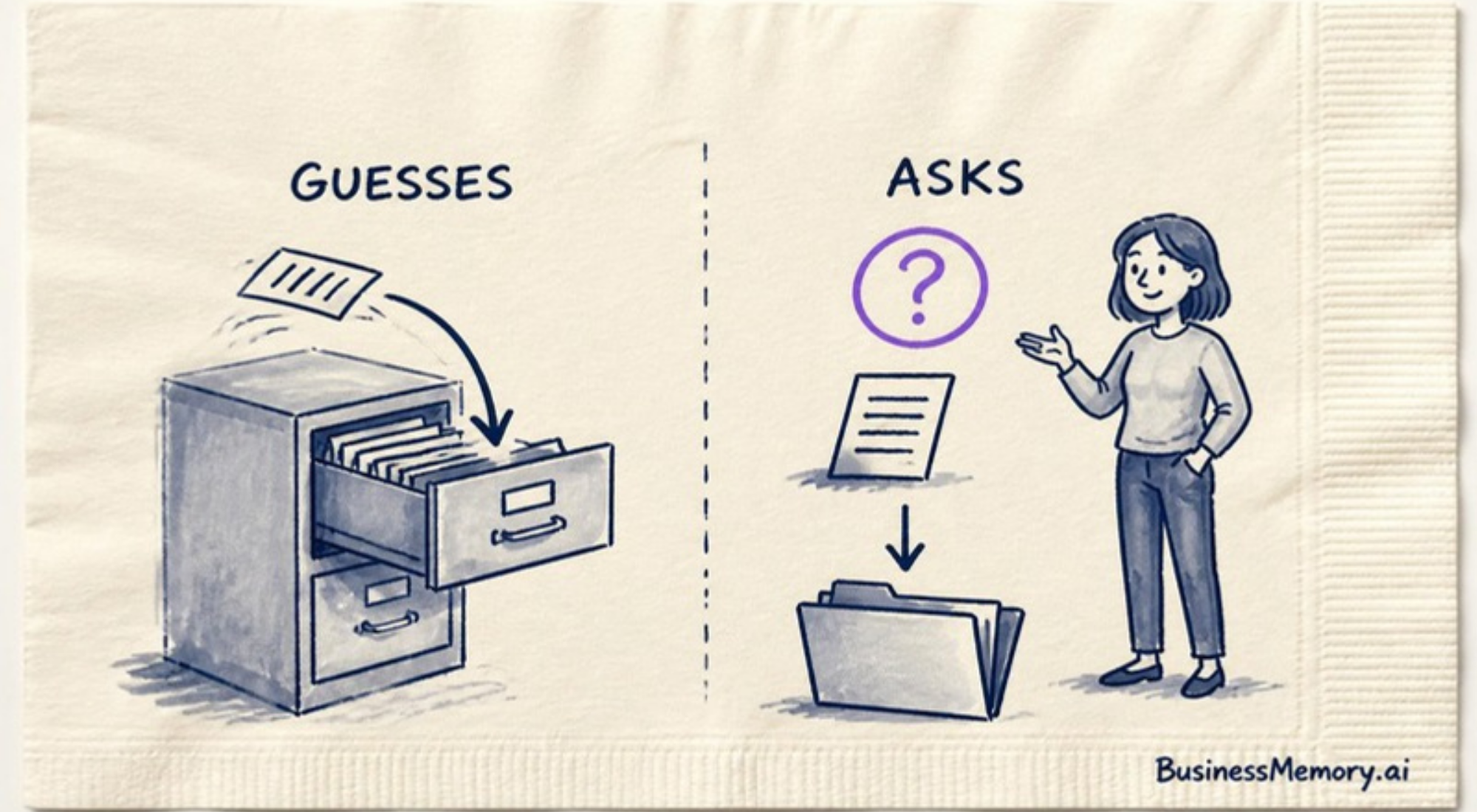
Most AI is built the other way around. In September 2025, OpenAI's own researchers wrote that language models, "like students facing hard exam questions", sometimes guess when they are not sure — because the way they are trained and tested rewards a guess more than "I don't know."
A business memory is built to lose that test on purpose.
What does a question from a business memory look like?
Open your business memory in the morning. At the top of your home page, there may be a short list.
Each line is a question. And each question is a guess it refused to make.
Two bills came in from a Garza this week. Is the second one for Rosa Garza, or for Garza Roofing?
This bill is in your own name. Which of your businesses is it for?
This note says what you pay one of your people. Is it private, or shared with the team?
Three questions. Three sentences from you. Then it files every one of them where it belongs — and it does not ask you the same question again.
Two Garzas in one week is not a mess, by the way. It is a normal week in a business. The memory is not asking because your files are bad. It is asking because two answers are both possible, and only you know which one is true.
Why doesn't a business memory just pick the likely answer?
Because a guess that gets filed does not stay a guess.
In a chat, a wrong guess lives for one answer. Then the chat is over, and the guess is gone with it.
In a business memory, a wrong guess is written into the record. Next month you ask about Rosa's job, and the answer comes back with a file behind it. The wrong file. It looks checked. It is not.
A guess in a chat is one wrong answer. A guess in your records is every wrong answer after it.
That is why "never guesses" and "shows the source" belong together. A source only proves something when the file was filed right in the first place.
What exactly does a business memory refuse to guess?
- Which person. Two customers with the same last name are two people, so they get two files. Before we offered it to anyone, we built a fake business on purpose to trap it — two women, both named Marta — and the memory never mixed them up.
- Which business. If you own more than one company, a bill in your own name could belong to any of them. It does not pick one. It asks.
- Private or shared. A note about pay, health or family stays out of the shared record until you say where it goes. (Here is the day ours stopped and asked me.)
- An answer your files do not hold. Ask about a price nobody ever wrote down, and it will not make one up to keep the conversation going.
That last one matters most. "I don't know" from your own records is an answer you can build on. A made-up price is not.
Isn't all that asking going to slow me down?
No. Most papers file themselves without a single question. It only stops when two answers are both possible.
And once you answer, it learns. The same question does not come back next week.
Honestly, a tool that guesses is the slow one. You have to check its work forever, because you never know which half it got wrong. A tool that asks when it is not sure is the one you can stop standing over.
What is the honest limit?
It asks. It does not read minds.
If you answer wrong, it files wrong. The record is only as true as the sentence you give it. The good news is that every file is plain text on your own computer, so you can open it and see exactly what was written — and fix it yourself.
That is what a business memory is for. A business memory is a private record of everything your business knows — what was agreed, paid, promised and decided — kept on your own computer as plain text files any AI can read, so you can ask anything and get the answer with the exact reference behind it.
Questions people ask
What does a business memory do when it is not sure?
It stops. A business memory sets the unclear item aside, lists it on your home page, and asks you one plain question. You answer in one sentence, it files the item where it belongs, and it does not ask the same question again.
Will a business memory ever say "I don't know"?
Yes. A business memory answers from your own files. If no file holds the answer, it will not make one up. "I don't know" from your own records is something you can act on; a confident made-up answer is not.
How does a business memory tell two customers with the same name apart?
It treats them as two people with two files, and when a paper could belong to either one, it asks you instead of picking. In our own test, built on a fake business on purpose, two women both named Marta stayed on two separate files.
Why is a guess worse in a business memory than in a chat?
A wrong guess in a chat lives for one answer. A wrong guess in a business memory is written into the record, so every later answer can repeat it — with a file behind it that makes it look checked.
Keep reading
- A Business Memory Has to Know Which Mary
- The Best Thing Our Business Memory Does Is Stop
- Is a business memory the same as ChatGPT memory?
Records were never meant for storage. Give your business a memory.