How Does a Business Memory Show You the Source of Every Answer?
Every answer from a business memory names the file it came from. One click opens it on your own computer, and you read the line yourself.

Every answer names the file it came from. One click opens that file on your own computer, and you read the line yourself, instead of believing the machine.
How does a business memory show you the source of an answer?
It puts the name of the file right under the answer.
You ask in plain words: "What date did we promise the Garza order?"
The answer comes back in one line. Under it sits the file it read: the notes from the call, the quote, the email.
You click that name. The file opens. You read the exact line yourself.
That is the third of the four tests a business memory has to pass: it shows the source. The other three are that it files itself, it never guesses, and it proves every morning that it ran.
And the file is yours. It sits in one folder on your own computer, as plain text. You can open it with no AI at all.
A business memory is a private record of everything your business knows — what was agreed, paid, promised and decided — kept on your own computer as plain text files any AI can read, so you can ask anything and get the answer with the exact reference behind it.
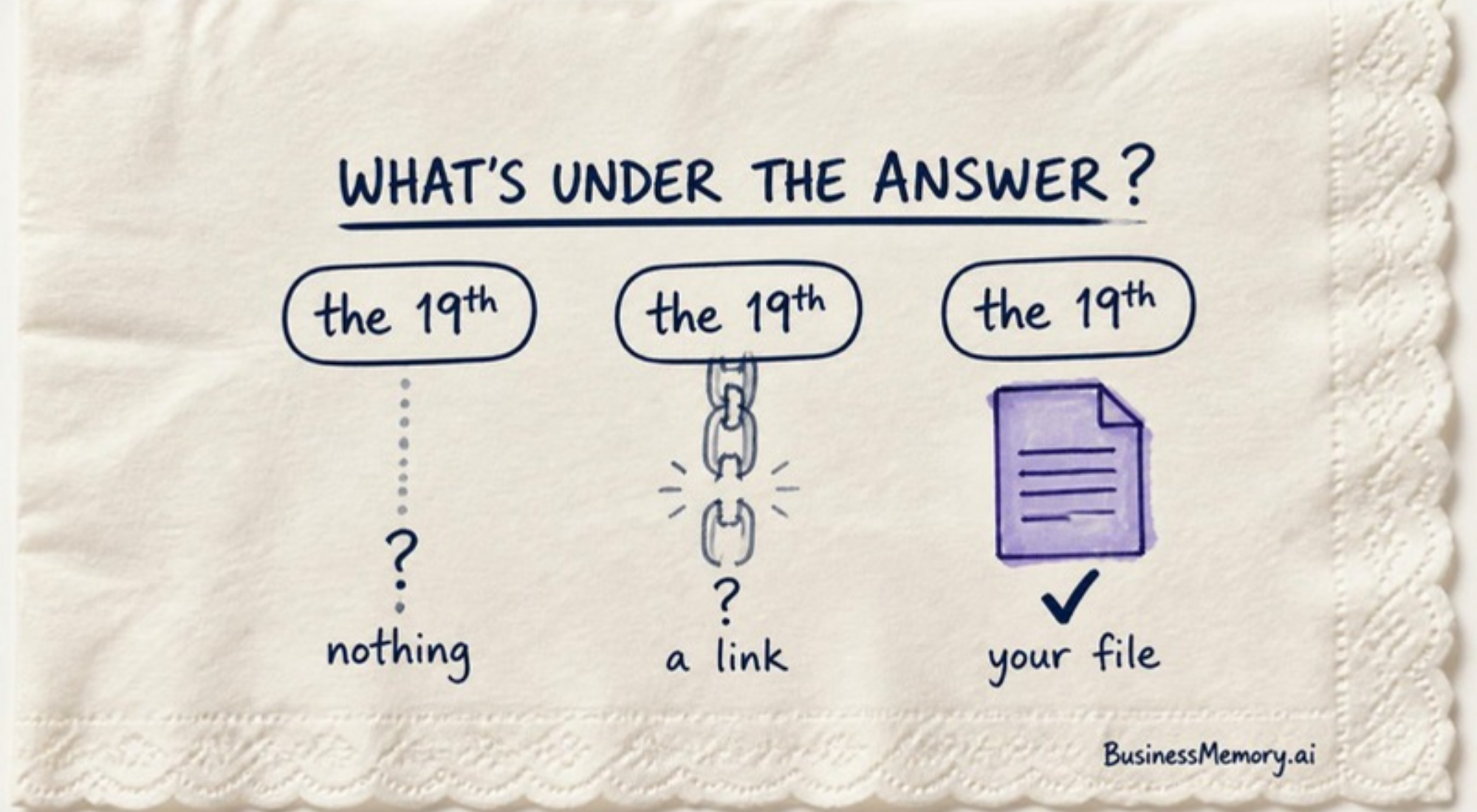
| What comes back when you ask | Can you check it? | What it really is |
|---|---|---|
| An answer with nothing under it | No | A guess, however sure it sounds |
| An answer with a web link under it | Only if the link opens and says the same thing | A promise of a source |
| An answer with your own file under it | Yes, in one click | Your record |
What does checking the source look like in real life?
Picture Thursday afternoon. A customer is standing at your counter, arms crossed.
"You told me Friday. You PROMISED me Friday."
You do not remember saying Friday. Yet you are not sure you didn't.
So you ask your business memory: "What date did we promise the Garza order?"
The answer: "The 19th." And under it, one line: Garza — call notes, 3 Sep.
You click it. Your own note opens, the one you typed after you hung up that day: "Told Mrs. Garza ready the 19th, not before."
You turn the screen around.
Nobody argues with their own words, written down the day they were said. The conversation is over in ten seconds, and nobody had to call anybody a liar.
Now imagine the same answer, "The 19th," with nothing under it.
Would you turn THAT screen around?
Why is a confident answer with no file still a guess?
Because sounding sure and being right are two different things, and most AI is built to sound sure.
Even a link under the answer is not enough on its own. When the Tow Center at Columbia Journalism Review tested eight AI search tools, more than half of the answers from two of them pointed to links that were made up or did not work.
And when researchers at Deakin University in Australia checked the references GPT-4o wrote for them, 35 of 176 were made up. About one in five did not exist at all.
So a source only counts when you can open it and read the line.
Without the file, you are believing. With the file, you are checking.
What does a business memory do when two of your files disagree?
It shows you both.
Say the quote you sent in March has one price, and your notes from the visit to the job have another. A business memory does not quietly pick one. It puts both in front of you on the morning page, each with the file it came from, and waits for your word.
That is the same rule as its second test: it never guesses. When it is not sure, it sets the item aside and asks you one sentence.
Where does the source stop?
You should hear this from us, not find it out later.
A business memory can only show you a file that exists. A promise you made in the parking lot and never wrote down, never recorded, never noted, has no file. So it has no source.
In that case it will not invent one. It tells you it does not know. And "I don't know" is not a weakness. It is the honest answer.
Honestly, that is the whole deal. The memory points. You read. The decision stays yours.
So I'm committed to one small habit: before I tell a customer anything about their job, I open the file first. It takes one click.
A business memory is a private record of everything your business knows — what was agreed, paid, promised and decided — kept on your own computer as plain text files any AI can read, so you can ask anything and get the answer with the exact reference behind it.
Your customer does not need you to sound sure. They need you to be RIGHT, and to show them why.
Records were never meant for storage. Give your business a memory.
BeBusinessSmart
Questions people ask
How does a business memory show the source of every answer?
Every answer names the file it came from, like the call notes, the quote or the email. You click the name, the file opens on your own computer, and you read the exact line yourself.
Why is an AI answer without a source still a guess?
Because an AI can sound sure and still be wrong. Without the file behind it, you have no way to check the answer, only to believe it.
Can I check the source without the AI?
Yes. The files sit in one folder on your own computer, as plain text. You can open any of them with no AI at all.
What happens when there is no file for my question?
A business memory does not invent one. It tells you it does not know. It can only show what was written, recorded or noted, so a promise nobody wrote down has no source.